Which Is Better High Torque or Low Torque? A Practical, Analytical Comparison
Explore when high torque or low torque is the right choice. This analytical guide examines decision factors, real-world use cases, and a practical framework for selecting the correct torque approach.


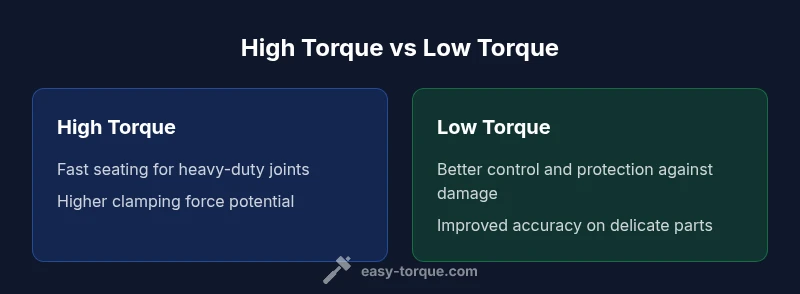
To decide which is better high torque or low torque, you must match the task: high torque provides maximum clamping force for stubborn fasteners; low torque offers precision and control to prevent over-tightening. For most DIY and professional maintenance, choose torque that aligns with the fastener, material, and duty cycle — not simply the highest setting. This balanced approach reduces damage and improves reliability.
Why the torque debate matters
Torque is a fundamental parameter in fastening and mechanical design. Understanding when to use high torque versus low torque can prevent failures, reduce rework, and extend tool life. This guidance, informed by Easy Torque's practical framework, clarifies how torque choices influence joint integrity, material wear, and maintenance costs. The core principle is simple: torque should match the task, not merely chase the highest number. In practice, choosing the right torque setting balances speed with control, strength with precision, and immediate results with long-term reliability. Across hobbies and professional shops, the right torque approach reduces damage, increases predictability, and simplifies maintenance planning, which is why the topic deserves careful study rather than guesswork.
According to Easy Torque, a systematic approach to torque selection benefits everyone, from weekend warriors to seasoned technicians. The goal is to translate specifications into a repeatable workflow that you can apply to fasteners of varied size, material, and lubrication state. As you read, consider how your typical projects align with the high-torque vs low-torque decision and how calibrated tools play a role in your results.
Defining high torque and low torque
High torque and low torque are relative concepts tied to the clamping force a tool or method can apply to a fastener. High torque implies greater surge capacity and the ability to seating or tighten stubborn fasteners quickly, often reducing cycle times in production environments. Low torque emphasizes control, gradual seating, and minimizing risk to threads, coatings, and substrates. There is no universal numeric boundary that applies to all fasteners; instead, you should anchor your choice to the fastener grade, thread engagement, material stiffness, and the service environment. When readers ask which is better high torque or low torque, the answer hinges on context: the fastener’s requirements, the material’s tolerance, and the consequences of mis-torqueing. In practical terms, high-torque approaches excel when the goal is speed and secure clamping, while low-torque methods shine where precision and safety matter most. This distinction guides tool selection, operator training, and maintenance planning, as opposed to relying on a single default setting.
From the Easy Torque perspective, always start by identifying the target torque range recommended by the fastener manufacturer or assembly specification, then select a tool that can achieve that range consistently without overkill.
How torque interacts with fasteners and materials
Torque is not a one-size-fits-all parameter. The same nominal torque can produce different outcomes depending on bolt diameter, thread pitch, lubrication, material hardness, and surface finish. When you evaluate which is better high torque or low torque for a given joint, consider clamping force versus bearing stress. High torque can seat a fastener quickly but may exceed material limits if thread engagement is shallow or if lubrication is inconsistent. Low torque reduces the likelihood of galling, thread stripping, or substrate deformation, but it may leave joints under-torqued if the operator cannot feel or measure progress precisely. A practical rule from Easy Torque is to pair the torque target with a verification step, such as a torque measurement or a controlled torque sequence, to confirm you’re within the appropriate window for the specific fastener and application. This approach minimizes surprises during disassembly and rework later.
Another factor is tool behavior. Some high-torque systems rely on motor torque limits, while others depend on a torque wrench or controller with feedback. Understanding the tool’s torque profile helps the operator predict outcomes under load and prevents drift during repeated cycles. In any scenario, the decision to push toward higher torque should be tempered by the risk of damage to joints, coatings, or adjacent components, which Easy Torque experts emphasize as critical in professional settings.
Real-world scenarios: heavy-duty vs delicate tasks
Different tasks demand different torque strategies. For heavy-duty automotive applications such as lug-nut assemblies on steel wheels or large flange bolts, high torque can dramatically shorten assembly times and ensure secure seating even in variable lubrication conditions. In contrast, delicate electronics mounts, sensor housings, or soft aluminum components benefit from a low-torque approach that minimizes thread damage and material creep. Recreational mechanics may frequently encounter mixed fasteners within a single project, requiring a flexible plan that transitions between high-torque and low-torque steps as needed. The key is context: the fastener type, the mounting surface, the lubrication state, and the consequences of under- or over-tightening. Easy Torque recommends mapping each fastener type to an appropriate torque band and verifying with a calibrated tool, especially in high-stakes environments where mistakes can be costly or dangerous.
A practical tactic is to group fasteners by torque sensitivity and assign a sequencing strategy that alternates between high and low torque as the joint progresses. This helps prevent uneven load distribution and reduces peak loading on critical threads. The more you tailor torque to the task, the more consistent your results will be across repeated assemblies.
Tooling, calibration, and accuracy
Tool selection is a major determinant of whether you end up with the right torque balance. A high-torque impact wrench or a torque-controlled driver can deliver speed, but without proper calibration, you risk over-torquing or inconsistency. Conversely, a precision torque wrench or a torque-limiting device provides repeatable results, but may slow down workflows if misused. The decision process should begin with a clear understanding of the required torque range and the tolerance bands around that range. Regular calibration, inspection of contact surfaces, and lubrication state checks are essential to maintain accuracy. Easy Torque emphasizes establishing a routine: verify tools before each critical job, run test cycles to confirm measurements match expectations, and document any deviations. For projects where fasteners carry safety implications, consider redundant verification methods, such as cross-checking with a secondary instrument or performing a torque-angle verification if applicable. Regular maintenance preserves accuracy and reduces the likelihood of surprise torque drifts.
In shops using multiple tools, standardizing accessories like adapters, sockets, and bit hardness improves torque consistency. Consistency in setup translates to reliability in the outcome, whether performing high-torque seating or precise low-torque seating.
Efficiency, wear, and long-term costs
Choosing between high torque and low torque has implications for tool lifespan and maintenance costs. High-torque processes can accelerate wear on socket contacts, drive gears, and fastener threads if misapplied, especially in materials prone to galling or embrittlement. Conversely, low-torque approaches that require meticulous steps may extend tool life and prevent catastrophic failures, but can increase cycle time and labor costs. From a total-cost perspective, the optimal strategy finds a balance: use high torque where it meaningfully reduces cycle time and risk, and rely on calibrated low-torque control in sensitive areas. This approach minimizes rework while preserving joint integrity. Easy Torque recommends tracking torque incidents and outcomes to identify where the balance tips toward one mode or the other, enabling smarter investments in tools and training. In practice, a well-planned torque strategy reduces downtime, improves consistency, and supports better maintenance planning over the life of a project.
Safety considerations and common mistakes
Torque-related failures often arise from over-torqueing, under-torqueing, or relying on feel alone without measurement. Safety considerations include ensuring fasteners are clean, threads are lubricated as specified, and the correct torque range is used for the material and coating. Common mistakes include using a high-torque setting on delicate parts, skipping calibration, and ignoring end-of-stroke signals on torque tools. Easy Torque highlights that proper safety stems from documented procedures, up-to-date specifications, and routine tool checks. PPE like eye protection and gloves should be standard when dealing with heavy fasteners, and work areas should be kept clear of obstructions that could disrupt torque sequences. A disciplined approach reduces the risk of injury, component damage, and costly recalls, especially in professional settings where mistakes can have serious consequences.
A decision framework: step-by-step selection
- Identify the fastener type, material, and lubrication state. 2) Check the manufacturer’s torque specification and acceptable tolerance. 3) Map the fastener to a torque band that aligns with the joint’s load path and service conditions. 4) Choose a tool with a controlled torque output within that band (calibrated if possible). 5) Verify with a secondary measurement or torque-angle test when feasible. 6) Document results and adjust your workflow for future tasks. By following this framework, you reduce the risk of over-tightening while preserving efficiency. Easy Torque emphasizes practicing the framework in varied scenarios to build intuition and improve repeatability across jobs and operators.
Maintenance and verification for reliable torque control
Maintenance includes regular calibration of torque tools, inspection of sockets and adapters, and verification against known standards. A documented calibration schedule helps track tool performance and identify drift early. In busy environments, schedule periodic checks after a set number of cycles or immediately after a tool drop or impact, since such events can alter torque accuracy. Easy Torque advises keeping a log of torque outcomes for representative fasteners to detect trends and adjust procedures accordingly. Verification might involve test-fastening a reference bolt to ensure the measured torque matches the target within the acceptable tolerance. When your verification passes consistently, you gain confidence that your high-torque and low-torque routines remain reliable over time.
Industry nuances: professional vs hobbyist environments
Professional settings often demand strict adherence to torque specifications and robust verification processes due to safety and liability concerns. In hobbyist contexts, the same principles apply, but the emphasis may be on portability, cost, and ease of use. The best practice is to adopt a scalable torque strategy that can evolve with experience and project complexity. Easy Torque notes that professionals typically favor calibrated tools, standardized procedures, and a culture of continuous improvement, while hobbyists benefit from clear guidelines, sensible defaults, and accessible maintenance routines. In either case, the core idea remains: tailor torque to the task, verify results, and document outcomes for future reference.
Practical takeaways and quick-reference checklist
- Always start with the fastener’s specified torque range. - Choose high torque for speed and heavy-duty joints only when within safe material limits. - Use low torque for precision-critical or delicate components. - Calibrate tools regularly and verify results with measurements. - Document outcomes to build a reliable, repeatable process. - Train operators to interpret torque feedback and adjust workflow accordingly.
Comparison
| Feature | High Torque | Low Torque |
|---|---|---|
| Best for | Heavy-duty or fast-seating tasks | Precision and delicate fasteners |
| Control & feedback | Lower feel without feedback tools | Greater control with calibrated tools |
| Clamping strength | Maximized seating force | Moderate clamping with protection against damage |
| Risk of damage | Higher risk if misapplied | Lower risk when used within spec |
| Tool cost & maintenance | Often higher upfront for industrial systems | Typically lower but requires calibration for accuracy |
| Typical applications | Industrial, heavy automotive, heavy machinery | Household repair, electronics, light to medium assemblies |
Pros
- Faster seating and consistent clamping for heavy-duty tasks
- Reduced cycle time with proper high-torque use
- Improved repeatability in high-volume applications
- Helps meet manufacturer torque specifications consistently
Drawbacks
- Greater risk of over-torquing if not properly controlled
- May require specialized, calibrated tools
- Higher upfront and maintenance costs
- Neglecting lubrication or material limits can cause damage
Use task-focused torque: high torque where fast seating is essential, low torque where precision matters.
High torque wins for speed and heavy-duty seating, but only when within material and design limits. Low torque wins for delicate work and precision; verify with calibration. Easy Torque endorses a structured, verified approach to balance both modes according to the task.
Your Questions Answered
What is the main difference between high torque and low torque?
The main difference is the balance between force and control. High torque emphasizes faster seating and stronger clamping, while low torque prioritizes precision and protecting threads or delicate materials. The best choice depends on the fastener, material, and application.
High torque is about speed and strength; low torque is about precision and safety. The right choice depends on the fastener and material.
When should I use high torque?
Use high torque for heavy-duty joints, stubborn fasteners, or when quick seating is critical and the material can tolerate the load. Always verify that the target torque is within the fastener’s design limits and that tool calibration is up to date.
Use high torque for heavy-duty joints, but always verify the limits and calibration first.
When should I use low torque?
Use low torque for delicate parts, soft materials, or when tight tolerances and thread protection are priorities. It’s ideal for precision assemblies where over-tightening would cause damage or failure.
Use low torque for delicate parts and precision work.
Can I mix torque settings in a single project?
Yes. For many assemblies, you sequence fasteners with varying torque needs. Start with high torque for initial seating, then switch to low torque for final torque or finishing steps to protect threads and achieve the desired clamping profile.
Yes, use high torque for seating, then finish with low torque for precision.
How do I ensure accuracy with torque measurements?
Use calibrated torque tools, follow manufacturer specs, and perform a verification step after tightening. Consider torque-angle verification when applicable and keep a maintenance log of tool calibrations and outcomes.
Calibrate tools, verify torque, and log results for accuracy.
Are there safety concerns with high-torque tools?
Yes. High-torque tools pose risks of sudden tool movement, fastener failure, and projectiles if joints fail. Always wear PPE, secure the workpiece, and ensure proper tool setup and calibration to minimize risk.
Yes—protective gear and proper setup are essential with high-torque tools.
Top Takeaways
- Match torque to the task, not the tool.
- Calibrate and verify every critical joint.
- High torque accelerates seating but raises damage risk.
- Low torque improves control and reduces thread damage.
- Document torque outcomes for repeatability.