Which torque wrench for wheel nuts: A practical guide
Learn how to choose the right torque wrench for wheel nuts, understand drive sizes, torque ranges, calibration, and best practices for safe lug-nut tightening.


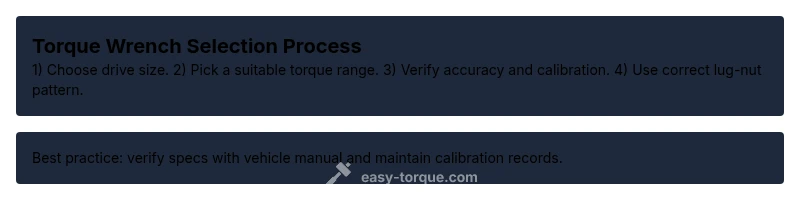
Steps to select your wheel-nut torque tool: 1) choose a 1/2-inch drive wrench with a target range near 80–120 ft-lbs. 2) prefer a reliable click-type mechanism for repeatable torque and an audible confirmation. 3) ensure proper calibration and keep a socket set that fits your lug pattern; always verify exact specs in the vehicle manual.
Why the right torque wrench matters for wheel nuts
For DIY mechanics and regular drivers, the torque wrench you choose for wheel nuts directly affects safety, tire seating, and wheel integrity. A precise tool helps apply the correct force across all lug studs, preventing under-tightening (which risks wheel detachment) and over-tightening (which can stretch studs or warp rotors). According to Easy Torque, investing in a reliable, properly ranged torque wrench reduces uneven lug seating and improves repeatable results across different vehicles. A good wrench also enforces consistent tightening sequences, which is critical given the variety of lug patterns and touchpoints on modern wheels. In practice, the right wrench becomes part of a predictable routine rather than a guessing game, especially when swapping wheels for seasonal tires or performing brake maintenance.
This section covers the essential criteria you’ll use to evaluate options, including drive size, torque range, and accuracy class. You’ll also see how to interpret manufacturer guidance and why calibration matters as part of standard maintenance. The goal is to help you select a tool that stays accurate through typical garage use and holds up to routine calibration checks. The result is safer wheel installations, faster service times, and long-term reliability for your vehicle fleet or personal ride.
Key features to evaluate in a wheel-nut torque wrench
A wheel-nut torque wrench isn’t just a measuring device; it’s a reliability tool. When choosing, consider drive size, torque range, mechanism type, accuracy, and build quality. A 1/2-inch drive is common for lug nuts by many manufacturers, offering enough leverage for tight fasteners without excessive effort. Look for a wrench with a clear, easy-to-read scale, a secure locking mechanism, and a durable ratchet that won’t slip under load. The best models provide a tactile or audible confirmation (a click) when you hit the preset torque, ensuring you don’t over- or under-tighten. Also evaluate calibration history, service availability, and storage features that protect the mechanism from corrosion or drift.
Beyond the core mechanism, assess the wrench’s environment: solvents, humidity, and temperature can affect accuracy. Choose corrosion-resistant finishes for garage or outdoor use and verify the included accessories—such as a storage case and a full socket set that matches your lug nut pattern. Finally, consider whether you want metric, imperial, or dual-unit scales, since some vehicles specify torque in either ft-lbs or N·m. A mindful shopper will balance price with quality and serviceability, ensuring the tool remains accurate over years of wheel maintenance.
Choosing the drive size and torque range for wheels
Wheel-nut torque needs vary by vehicle, but a practical default is a 1/2-inch drive wrench capable of handling common lug torque ranges. A typical passenger-car lug torque falls within a broad window and is often specified in the owner’s manual; if you’re unsure, a wrench with an adjustable range that covers roughly 80–120 ft-lbs will fit many applications. A 3/8-inch drive can suffice for lighter applications or smaller vehicles, but it may struggle with higher torque specs on some cars, requiring more effort and potentially less precision. The torque range you select should align with your most frequent use case; if you work on a mix of small cars and SUVs, aim toward the middle or high end of typical lug torque values. Avoid tools with a range that leaves you near the bottom limit, where fine torque control becomes more difficult.
In addition to range, the accuracy class matters. Look for ±4% to ±2% tolerance over the usable range, depending on the wrench’s design and intended use. Remember that the torque-wrench type—click, beam, or digital—offers different benefits. A click-type is user-friendly and precise for lug nuts, provided the mechanism is well maintained. Always verify the recommended tightening pattern (usually a star sequence) and torque specification for each wheel, as imbalance can cause rotor warp or uneven tire wear. As you gain experience, you’ll develop intuition for when to switch wrenches for high-torque lug nuts or specialty wheels.
Tip: Start with the drive size that matches your lug-nut sockets and vehicle patterns. If you regularly service larger vehicles or wheels with higher torque specs, plan for a wrench with a higher end of the range to minimize rework.
Calibrating and maintaining your torque wrench
Calibration is the cornerstone of accurate torque. Most automotive professionals recommend recalibrating torque wrenches at least annually, or after accidental drops or heavy impacts. If you use your wrench frequently or in a professional setting, consider more frequent checks or professional calibration services. Store the wrench in a case and avoid dropping or exposing it to temperature extremes, which can alter spring tension and measurement accuracy. When calibrating at home, use a certified torque-angle gauge or a known-good reference weight, and verify the instrument at several points within its claimed range to confirm consistency. Maintaining the mechanical integrity of the head and ratchet is essential; keep the mechanism clean, lubricate according to the manufacturer’s guidelines, and replace worn seals promptly.
Easy Torque recommends maintaining a simple log of calibration dates, torque settings, and any anomalies you notice during use. This practice helps catch drift early and ensures you’re always torqueing to spec when you install or remove wheels. If you ever suspect drift, do not rely on memory; recheck the wrench against a standard reference before finalizing lug-nut torque on a vehicle. A well-maintained tool reduces the risk of under- or over-tightened wheels and supports consistent performance across maintenance tasks.
Using torque wrenches with wheel-nuts: best practices
Apply consistent technique to every wheel, including aligning the wrench perpendicular to the lug nut and ensuring the socket is fully seated. Use the recommended star-pattern tightening sequence to distribute clamping force evenly. Once you achieve the preset torque, listen for the audible click or verify the digital readout, then finish with a final verification while the wheel is in contact with the ground and the car is stable. If you notice binding or a false indicator, stop and inspect the socket fit, lug nut shape, or any debris between the nut and the wheel.
Prevent shortcuts: never use a power impact to “get close” to torque; an impact may cause overtightening, thread damage, or nut head rounding. When a multi-step tightening is required, perform the initial pass at a lower torque, gradually increase to the final spec, and recheck. Always use fresh lug-nut hardware if you suspect damage or wear; damaged studs or nuts can yield inaccurate readings and unsafe installations. Finally, always verify torque again after driving a short distance, as wheel assemblies can settle under load.
Pro tip: document the torque value and pattern in your maintenance log for each vehicle you service. This habit saves time on future tire rotations and ensures consistency across your garage.
Authority sources
This section provides external references for torque wrench standards, calibration protocols, and wheel-nut safety guidance. Use these links to deepen your understanding and cross-check recommendations with widely accepted engineering practices. The sources below are intended to supplement your builds and maintenance routines, not replace vehicle-specific specifications from the owner’s manual.
Tools & Materials
- 1/2-inch drive torque wrench(Target range around 80–120 ft-lbs; choose click-type for reliability)
- Socket set compatible with lug nuts(Match lug-nut pattern (across all wheels) and sizes)
- Torque-angle gauge (optional helpful add-on)(Useful for advanced tightening sequences on certain wheels)
- Calibration certificate or service(Keep documentation, especially for professional use)
- Storage case(Protect the wrench from impact and moisture)
- Torque spacer or adaptor (if needed)(Use only if your wheel design requires it)
Steps
Estimated time: 45-60 minutes
- 1
Prepare workspace
Park on a flat surface, engage parking brake, and chock wheels. Gather your torque wrench, sockets, and lug-nut hardware. Inspect the wheel studs for damage and ensure the lug nuts are the correct type for the wheel. Safety first: remove any jewelry and wear gloves if needed.
Tip: Verify the lug pattern and socket fit before lifting the vehicle. - 2
Inspect the tool and components
Check the torque wrench for any drift, ensure the scale is legible, and confirm the wrench is set to the manufacturer’s target value if applicable. Inspect the socket for wear, rounded corners, or cracks. Make sure the lug nuts and studs are clean.
Tip: If the tool feels loose or stiff, don’t use it—calibrate or replace. - 3
Select sockets and adapters
Choose sockets that fit the lug nuts snugly with no wobble. Attach the socket to the wrench and verify it’s fully seated. If your wheels require a different drive size, swap to the appropriate adapter that maintains the correct torque path.
Tip: A loose socket can cause under-torque and damage the lug nut. - 4
Set the torque and initiate tightening
Rotate the wrench to the target torque using the wheel-manual guidance. Apply steady pressure, ensure the socket stays square on the lug nut, and listen for the confirmatory click or readout. Do not slam the wrench; let the mechanism indicate torque gently.
Tip: Keep the wheel in contact with ground while verifying torque to avoid settling errors. - 5
Tighten in a star-pattern sequence
Tighten lug nuts in a star or zig-zag sequence to promote even clamping force. If you’re tightening multiple wheels, repeat the star pattern for each wheel and recheck the final torque. For high-performance or difficult wheels, verify torque after a short road test.
Tip: Always begin at the top even spacing; avoid criss-cross patterns that skip positions. - 6
Final checks and maintenance
Re-check all lug nuts after a short drive to account for wheel seating. Clean the socket and keep the torque wrench in its case. Record the calibration date if you maintain a log. Store in a temperature-controlled area to prevent drift.
Tip: Document any torque anomalies and schedule a quick mid-season check. - 7
Cleanup and documentation
Return tools to their case, wipe away any grease, and note the torque values used for each vehicle. If you serviced multiple vehicles, update the maintenance log with wheel-specific data. Confirm the vehicle’s manual for any vehicle-specific requirements.
Tip: Keep the manual handy for quick reference during roadside or garage work.
Your Questions Answered
What torque should lug nuts be tightened to for typical passenger cars?
Most passenger cars specify a lug-nut torque range in the owner's manual, commonly spanning a moderate high value. Always rely on the vehicle documentation for the exact figure and use a torque wrench to reach that specification. If in doubt, contact the manufacturer for precise guidance and verify with a calibrated tool.
Check your owner's manual for the exact lug-nut torque; use a calibrated torque wrench to reach that specification and recheck after installing.
Can I use an adjustable torque wrench for wheel nuts?
An adjustable torque wrench can work, but fixed-range or torque-specific wrenches reduce drift and improve repeatability. If you use an adjustable model, confirm accuracy across the full range with calibration checks and avoid relying on a single reading.
An adjustable wrench can work, but it’s less repeatable. Calibrate across the range and verify accuracy periodically.
How often should I calibrate a torque wrench?
Calibrate at least once per year for personal use, and more often if you drop the tool or work in a professional setting. Calibration intervals may also be recommended by the manufacturer; follow those guidelines to maintain accuracy.
Calibrate at least every year, or after a drop; follow your manufacturer’s recommendations.
Is it safe to torque wheels after a road test?
Yes. After a road test, re-check lug-nut torque to account for wheel seating and thermal effects. A quick post-drive check ensures that shifting or seating didn’t alter the initial setting and helps prevent loosening.
Recheck lug-nut torque after the test drive to account for seating and heat effects.
Should I use torque-angle guidance for wheel nuts?
Torque-angle guidance is used in some applications to achieve the final clamping force. If your vehicle requires it, pair torque with angle measurement and follow the exact sequence. For most common lug-nuts, a straightforward torque check is sufficient.
If your car requires angle guidance, use it along with a final torque check.
Can lug nuts be reused after removal?
Inspect lug nuts for wear, corrosion, or thread damage. If they’re compromised, replace them. When in doubt, replace the nuts to ensure consistent torque and reliable clamping.
Inspect, and replace damaged lug nuts to ensure safety and proper torque.
Watch Video
Top Takeaways
- Choose a 1/2-inch drive with 80–120 ft-lbs range
- Use a click-type wrench for repeatable accuracy
- Tighten in a star pattern and recheck torque
- Calibrate regularly and store properly