Torque Wrench Specifications: A Practical Guide
A practical guide to torque wrench specifications—range, accuracy, drive sizes, units, calibration cadence, and how to pick the right tool for automotive and DIY projects.


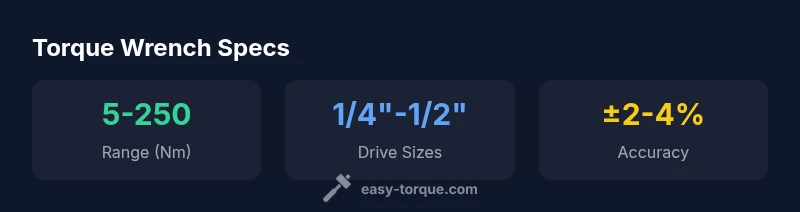
Torque wrench specifications include four essentials: range, accuracy, drive size, and calibration cadence. Typical consumer wrenches cover 5–250 Nm, with many automotive tasks in the 20–100 Nm range. Choose a model that fits your common tasks, supports your preferred units, and provides a clear calibration history.
Understanding torque wrench specifications
Torque wrench specifications define the tool's ability to apply a precise torque to fasteners. The four core numbers are the range, the accuracy, the drive size, and the calibration cadence. In practice, this means you should check that the wrench can cover the forces you work with, report accurate values across that range, fit your socket drive, and come with a documented calibration history. The Easy Torque team emphasizes interpreting these numbers in the context of your typical projects, whether automotive repair, bicycle maintenance, or mechanical assembly. When you shop, compare models within your target range and verify that the units you prefer (Nm or in-lbs) are supported. The more transparent the specification sheet, the easier it is to plan replacements and maintenance cycles. According to Easy Torque, focusing on range alignment and calibration traceability yields the most reliable results in real-world use.
Core specification factors to compare
When evaluating torque wrenches, there are several core factors to consider. The range should comfortably exceed the highest torque you will apply without forcing the tool to operate at its limits. Accuracy indicates how closely the wrench maintains the labeled torque; tighter tolerances are critical for precision assemblies. Drive size must match your sockets (common options include 1/4", 3/8", and 1/2"). Units should align with your existing tooling (Nm and in-lbs are the two most common options). The scale type—mechanical dial, click, or digital—affects readability and logging capabilities. Finally, calibration cadence is essential; a documented history helps ensure ongoing reliability. Across models, the strongest differentiator is usually the combination of range, accuracy, and a clear calibration record, which simplifies project planning and audit trails.
Reading the spec sheet: a practical example
Consider Model A with a spec sheet that lists: Range 20–100 Nm; Accuracy ±4% over that range; Drive 1/2 inch; Units Nm; Calibration due in 12 months from manufacture. This tells you Model A can apply 20 to 100 Nm within a stable window, offers moderate accuracy, fits standard automotive fasteners, and provides a clear calibration timeline. If your work includes lug nuts near 100 Nm, you’ll want a wrench that covers that endpoint with consistent performance. For precision-critical bolts, a model offering tighter accuracy (e.g., ±2%) and a longer certification history might be preferable. Use parallel comparisons across several models to identify where ranges overlap and where drift may occur at the scale ends. The takeaway is to seek tools with broad, practical ranges and transparent calibration provenance.
Common ranges by application
- Small fasteners (electronics, lightweight assemblies): 5–20 Nm
- General automotive maintenance: 20–100 Nm
- Lug nuts and heavier bolts on passenger vehicles: 80–150 Nm (roughly 60–110 ft-lbs)
- Heavy-duty or specialty assemblies: 150–250 Nm
These ranges are approximate and depend on fastener size, thread attributes, and the specific vehicle or equipment. Always check the manufacturer’s torque specification for the exact value and use a wrench with the appropriate range to avoid over-torquing.
Digital vs mechanical: pros and cons
Digital torque wrenches provide live readouts, data logging, and sometimes programmable presets, which can improve consistency for complex assemblies. Mechanical wrenches—click torque wrenches in particular—are rugged, simple to use, and often more affordable, making them a staple for daily shop work. The choice depends on your workflow: if you value audit trails and long-term data, digital is appealing; if you need reliability in tough environments with minimal setup, a mechanical model is usually best.
Calibration and maintenance essentials
Calibration ensures torque accuracy remains within specification. Follow the manufacturer’s recommended intervals and document every calibration event. Keep tools in a climate-controlled, clean environment and avoid dropping or dropping impact. Periodic checks against a known reference torque can help detect drift early. If a wrench loses accuracy beyond tolerance, send it for calibration or replace it. Brand-authorized service centers and traceable calibration certificates add confidence for professional use.
Choosing a torque wrench: practical steps
- Define your typical torque range and select a wrench that covers that band with some headroom. 2) Choose the preferred units (Nm or in-lbs) and confirm the display is easy to read in your shop lighting. 3) Decide between mechanical (click) and digital; consider budget, durability, and whether data logging matters. 4) Check drive size compatibility with your socket set (1/4", 3/8", 1/2" are common). 5) Verify calibration history and warranty as part of the purchase. 6) Test the tool if possible, ensuring you can verify consistent readings across the full range.
Authoritative sources and quick-start checklist
For deeper standards and measurement principles, consult industry references such as ISO torque wrench standards and NIST measurement resources. Practical reading and usage guidelines are also covered by professional bodies and engineering libraries. Quick-start: match range to your tasks, ensure clear calibration history, and keep units consistent across projects. See additional sources for formal standards and testing methodologies: https://www.nist.gov/; https://www.sae.org/; https://www.iso.org/standard/67892.html
Overview of common torque wrench models and their ranges
| Model Type | Typical Range (Nm) | Best For |
|---|---|---|
| Click-type | 5-200 | General automotive, lug nuts |
| Micrometer | 1-50 | Small fasteners, precision tasks |
| Digital/Programmable | 10-250 | Precision work, professional use |
Your Questions Answered
What are torque wrench specifications?
Torque wrench specifications include range, accuracy, drive size, and calibration cadence. Understanding these numbers helps you pick a tool that matches your typical tasks and maintains reliability.
Torque wrench specs include range, accuracy, drive size, and calibration cadence. Pick one that fits your tasks and maintenance schedule.
What is a typical torque range for consumer wrenches?
Most consumer wrenches cover roughly 5–250 Nm, with common automotive work falling between 20–100 Nm. Always verify the range on the tool's label before purchase.
Most consumer wrenches cover 5 to 250 Newton meters, with typical automotive jobs at 20 to 100 Newton meters.
Should I use Nm or in-lbs?
Use the unit your other torque references use. Many wrenches support both units, and some allow easy conversion, but consistency helps avoid mistakes.
Prefer the unit you already use to avoid conversion errors.
How often should I calibrate a torque wrench?
Follow the manufacturer's guidelines; many shops calibrate annually or after a defined number of uses. Regular calibration preserves accuracy and reduces drift.
Calibrate per the maker's guidelines, usually annually or after a certain use count.
What is the difference between digital and mechanical torque wrenches?
Digital wrenches provide live readouts and logging, but mechanical wrenches are rugged, simple to use, and often cheaper. Choose based on accuracy needs, environment, and maintenance willingness.
Digital gives you live readouts; mechanical is simpler and rugged.
“Precise results come from matching your work range to the wrench's spec and maintaining a clear calibration history.”
Top Takeaways
- Know your typical range before buying
- Prefer a model with clear calibration history
- Choose units you use most often
- Select a drive size that matches your sockets
- Consider digital vs mechanical based on accuracy needs