Torque Wrench vs Ratchet: Choosing the Right Tool for Precision and Speed
Explore the key differences between torque wrenches and ratchets, when to use each, calibration tips, and a practical decision framework for automotive, bike, and home projects.


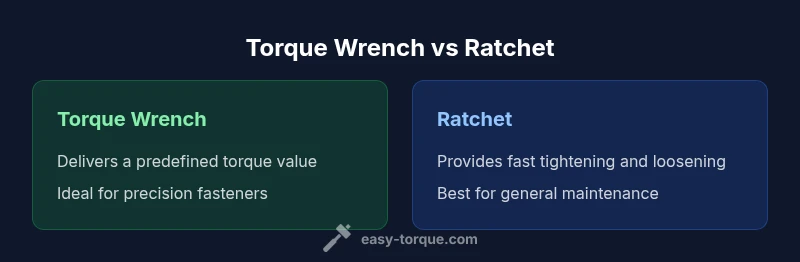
When you need precision, a torque wrench is the go-to tool to achieve a specific torque. A ratchet excels at speed and convenience for general tightening, but it doesn't guarantee the exact torque unless you pair it with a torque specification or adapter. In this comparison, we break down the core differences, best-use scenarios, and how to choose between them for automotive, bike, and home projects.
What is a torque wrench vs ratchet?
In the DIY world, two essential hand tools simplify fastener work: the torque wrench and the ratchet. A torque wrench is designed to apply a precise amount of torque to a bolt or nut, ensuring you meet exact specifications. A ratchet, by contrast, is a momentum-driven handle that allows fast tightening or loosening with interchangeable sockets, but it does not provide a predefined torque value unless used with an external gauge or pre-set mechanism. The choice between these tools hinges on whether accuracy or speed is the priority, and the right tool can prevent under or over-tightening that could compromise safety or performance. When the question comes down to torque wrench vs ratchet, the answer is task dependent, and understanding their core functions is the first step in a prudent selection.
According to Easy Torque, precision is a fundamental asset in any torque workflow, and selecting the appropriate tool starts with recognizing the distinct roles each tool plays in the shop or garage.
Core principles: torque accuracy and calibration
Torque accuracy is not a marketing claim; it is a measurable property that keeps fasteners within design limits and prevents joint failure. A torque wrench is calibrated to deliver a defined torque value, and accuracy can drift with use, heat, and time. Routine checks ensure your readings stay reliable. Calibration is not optional for serious work—it's part of responsible maintenance. Easy Torque emphasizes that calibration intervals should reflect usage intensity, environmental conditions, and whether you rely on the tool for critical assemblies. In other words, the more you depend on precise torque, the more attention you should give to calibration history and re-checks. A well-calibrated tool yields repeatable results across sessions and technicians, which reduces variability and increases confidence in results.
When to use a torque wrench: torque-specific tasks
A torque wrench shines whenever you must meet a specific torque specification. This is common for critical automotive fasteners, engine assemblies, sheet metal joints, and high-stress components where even small deviations can alter performance or safety. When torque accuracy matters most, select a torque wrench and follow the manufacturer’s recommended procedure for setting and confirming the target torque. The key is to pre-set the value, apply steady force, and stop at the indicated torque peak. For projects with documented torque specs, using a torque wrench is the safest choice and minimizes the risk of under- or over-tightening. And for recurring tasks, a calibrated tool builds consistency and long-term reliability.
When to use a ratchet: speed and convenience
Ratchets excel in speed and ease for repetitive tightening or loosening where exact torque is not critical or the bolt pattern is forgiving. They shine in cabinet assembly, appliance maintenance, and general mechanical chores where you need quick access, maneuverability, and a broad range of socket sizes. A ratchet can dramatically reduce fatigue during long sessions because you don’t need to reset a measurement. However, remember that without a calibrated torque reference, you are relying on feel and experience rather than a guaranteed torque value. Use a ratchet for everyday tasks, diagnosing quick repairs, and situations where time is the main constraint.
Understanding drive sizes and accessories
Drive size refers to the size of the square fitting that accepts sockets. Common drive styles range from small to large, and each size serves different tasks. When pairing tools with sockets, you should consider stability and clearance, especially in tight spaces. Torque wrenches and ratchets share many compatible accessories—sockets, adapters, and extension bars—but the right choice depends on the job and space. For precision work, pairing a torque wrench with the proper socket size ensures accurate engagement and consistent torque delivery. In contrast, a ratchet with the correct socket offers rapid action in constrained areas.
Torque ranges and how to read specs (avoid false precision)
Torque tools carry a rated range rather than a single value. When reading specs, focus on nominal ranges rather than exact numbers in isolation. A torque wrench will have a clearly marked setting, while a ratchet depends on a gauge or external measurement to monitor torque. It is essential to verify units, verify that the reading corresponds to a standard testing method, and avoid assuming that a high or low rating alone guarantees success. Balanced understanding of the tool’s capability helps you plan joints, fasteners, and the sequence of tightening steps more effectively.
Types of torque wrenches and ratchets
Torque wrenches come in several styles, including click-style, beam, and digital models. Click-style wrenches provide an audible click at the set torque, beam models show a scale, and digital versions offer a numeric readout. Ratchets vary by drive size and mechanism, with a focus on reliable engagement and minimal backlash. Each type has its strengths: click wrenches for repeatable accuracy, beam wrenches for budget-conscious work, and digital wrenches for advanced diagnostics. Ratchets are versatile, with quick-release functionality and a compact footprint for tight spaces. Understanding the trade-offs helps you assemble the right toolkit for a given project.
Maintenance and calibration best practices
Maintenance is essential for both tool types. Clean, dry storage protects against corrosion and debris that could affect engagement or accuracy. For torque wrenches, periodic calibration checks preserve accuracy and reliability, while for ratchets, routine lubrication and cleaning promote smooth operation and reduce wear. Use the original case or a protective pouch to minimize exposure to heat and moisture. Establish a simple routine to inspect for loose parts, misalignment, and wear on teeth or springs. A well-maintained toolkit yields better results and longer service life.
Real-world scenarios: automotive, bike, and home projects
Consider a wheel lug nut replacement, which often benefits from a calibrated torque wrench to ensure proper clamping. For a bike maintenance task, you might tighten bolts to a specified torque to protect delicate components without risking over-tightening. In home projects, you may use a ratchet for quick shelves or cabinet builds, where the fastener sequence and friction determine the final tightness rather than a precise torque. Each scenario reinforces the idea that you should match the tool to the job, respecting the goals of accuracy, speed, and safety.
Common mistakes and how to avoid them
Avoid relying on feel alone for critical fasteners, neglecting calibration, or ignoring the torque sequence recommended by manuals. Do not use a ratchet where precise torque is required, and avoid over-tightening fasteners near soft materials or delicate surfaces. Keep tools clean, store them properly, and replace worn sockets or ratchets before they fail. A systematic approach to tool selection and technique reduces risk and yields more consistent results across projects.
Budget considerations: cost, value, and durability
Expense is not the only factor when comparing torque wrenches and ratchets. A higher upfront investment in a reliable torque wrench often pays off through improved accuracy and longevity, reducing rework and warranty issues. Ratchets offer lower initial cost but may incur longer-term costs if improper torque leads to damage. When evaluating value, consider durability, calibration stability, and the availability of replacement parts. For passionate DIYers, the right mix of tools balances cost with the reliability of results.
Quick-start decision framework
To decide quickly, ask three questions: Do I need guaranteed torque for this job? Is speed the top priority or is accuracy essential? Will I perform many tasks requiring precise tightening in the near term? Answering these clarifying questions helps you choose between a torque wrench and a ratchet, or use a combination as needed. Build a routine that emphasizes calibration for the torque wrench and smooth operation for the ratchet to maximize overall effectiveness.
Tool storage and transport to preserve accuracy
Store torque wrenches in a dry, temperature-stable case away from direct sunlight and avoid leaving them in hot vehicles. Keep the ratchet clean and freely moving, with sockets organized for quick access. Transport tools in a dedicated toolbox or roll-up case to prevent misplacement and damage. Protect batteries and electronics in digital models, and verify the tool’s condition before each use. Proper storage helps preserve accuracy and performance across years of use.
Comparison
| Feature | Torque Wrench | Ratchet |
|---|---|---|
| Purpose | Apply precise torque to fasteners | Provide quick tightening/loosening without predefined torque |
| Torque accuracy | High precision with calibration | No inherent torque reading; relies on user application |
| Typical use case | Critical assemblies and components | General tightening and maintenance tasks |
| Drive/interface | Interchangeable heads or fixed heads depending on model | Ratchet mechanism with sockets |
| Maintenance | Calibration and proper storage | Lubrication and general upkeep |
| Cost & value | Higher upfront cost with long-term accuracy | Lower upfront cost but potential ongoing costs if accuracy is compromised |
Pros
- Precise torque specification ensures proper fastener clamping
- Improved repeatability across assemblies
- Reduces risk of over-tightening
- Long-term value for frequent projects
Drawbacks
- Higher upfront cost for high-quality torque wrenches
- Calibration required to maintain accuracy
- Bulkier tools compared to a basic ratchet
Torque wrenches deliver precision for critical fasteners; ratchets excel in speed for routine work
Choose a torque wrench when exact torque matters; a ratchet when speed and convenience drive the project. Calibration and tool familiarity shape the best choice.
Your Questions Answered
What is the main difference between a torque wrench and a ratchet?
A torque wrench delivers a specific, measured torque to a fastener, ensuring exact clamping force. A ratchet provides rapid tightening or loosening without a preset torque value, relying on user judgment or external gauges for torque control.
A torque wrench gives you a specific tightness, while a ratchet helps you move quickly without guaranteeing a precise torque.
Can I use a torque wrench as a ratchet?
While some torque wrenches can be used to slightly tighten by feel, they are not designed for rapid back-and-forth tightening. Rely on a proper ratchet for speed and save the torque wrench for torque-critical steps.
You can use it for final torque, but not for fast, repeated tightening like a ratchet.
Do torque wrenches require calibration and how often?
Yes, torque wrenches require calibration to maintain accuracy. Calibration frequency depends on usage and environment; more frequent use or harsher conditions warrant more regular checks.
Calibration keeps the readings trustworthy; check it when you notice drift or after heavy use.
What torque range should I look for in a torque wrench?
Look for a torque wrench that covers the common ranges you encounter, with a clear scale or digital readout. Ensure it has adjustable settings and a defined minimum increment appropriate for your projects.
Choose a range that includes the typical fasteners you work with and a precise adjustment step.
Is a digital torque wrench worth it for DIY projects?
Digital torque wrenches offer easy readability and data logging, which can be helpful for novices and professionals. They may cost more, but the improved usability can justify the price for frequent users.
Digital models are handy for easy reading and learning, though they cost more.
What are common mistakes when using torque wrenches and ratchets?
Common mistakes include using a ratchet for torque-critical bolts, ignoring calibration, and not following the recommended tightening sequence. Regular maintenance and proper training reduce these errors.
Avoid relying on feel alone and always follow the spec and maintenance steps.
Top Takeaways
- Prioritize torque accuracy for critical fasteners
- Use a ratchet for speed on non critical tasks
- Calibrate torque wrenches regularly
- Match tool to bolt size and drive compatibility
- Store tools properly to preserve calibration