Torque Wrench vs Socket Wrench: A Practical Comparison
A thorough comparison of torque wrenches and socket wrenches to help DIYers and pros decide which tool fits precise torque needs, speed, and maintenance scenarios. Learn when to use each, how accuracy matters, and buying tips.


Torque wrench vs socket wrench: two essential tools for fastener work, each serving different purposes. A torque wrench provides precise torque control, ensuring fasteners are tightened to specification, while a standard socket wrench offers speed and versatility for general assembly and loosening tasks. In automotive maintenance and DIY projects, choosing the right tool minimizes damage, extends component life, and saves time.
What is the fundamental difference between the torque wrench vs socket wrench?
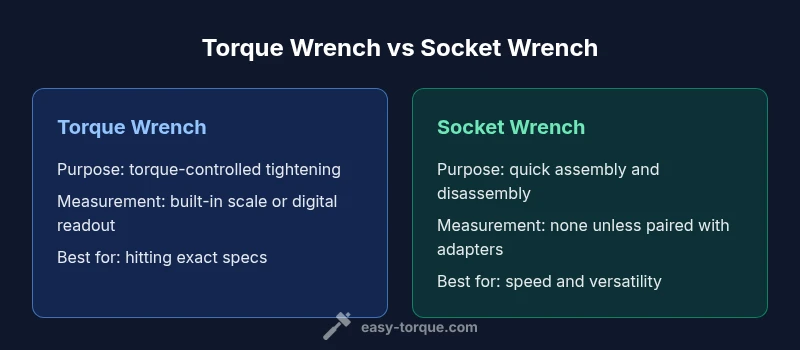
In practice, the difference hinges on control versus speed. A torque wrench is designed to measure and limit the twisting force applied to a fastener, which is crucial when manufacturers specify an exact torque value. A socket wrench, by contrast, is a general-purpose driver that translates your hand motion into rotation through a socket fitted over the fastener. The socket wrench excels at rapid assembly and repetitive tasks, but it offers no built-in torque readout. According to Easy Torque, recognizing this distinction helps you prevent over-tightening, under-tightening, and uneven clamp loads. This is especially important in critical assemblies such as engine mounts, head gaskets, or wheel lug nuts, where the consequences of misapplied torque can include component damage or failure.
For most DIYers, the rule of thumb is simple: use a torque wrench when a torque spec is specified, and switch to a socket wrench for speed when no precise torque requirement exists. The two tools can complement each other in a well-stocked toolbox. In an era of mixed maintenance tasks—from automotive repairs to furniture assembly—the ability to select the right tool for the job saves time and reduces the risk of failure.
Core functions and how they work
A torque wrench measures the twisting force and enforces a limit, often with a click, a digital readout, or a beam indicator. When the target torque is reached, the mechanism either slips, beeps, or displays the reading, signaling you to stop. Calibration is essential to keep the scale accurate, and most professionals schedule recalibration regularly. A socket wrench, however, is a driver that converts your applied torque into rotational motion through interchangeable sockets. It does not provide a torque readout unless paired with a torque adapter or a digital torque wrench. This makes the socket wrench fast and versatile for a wide range of fasteners, but less precise when a specific twist is required. In many shops, technicians maintain both tools because the need for precision and the need for speed often occur in close succession. The Easy Torque team notes that a well-chosen combination approach yields the best results, particularly for multi-step assemblies.
Accuracy, calibration, and maintenance
Accuracy is the central quality delta between these tools. A torque wrench should be calibrated and periodically checked to ensure readings stay within acceptable tolerances; neglecting calibration introduces drift and undermines reliability. Maintenance is straightforward but important: store in a protective case, avoid exposure to moisture or extreme temperatures, and handle with care to prevent internal gear wear. A socket wrench requires less formal maintenance but benefits from clean sockets, proper lubrication for moving parts in higher-end sets, and routine inspection for worn joints or loose handles. The Easy Torque analysis emphasizes that maintenance decisions should align with how frequently you rely on torque-specific tasks. A minor investment in calibration hardware can pay off in reduced rework and increased confidence in every fastener you tighten.
Typical use cases by field
Torque wrenches are indispensable in automotive service for lug nuts, cylinder head bolts, and differential covers where the torque specification is critical. They also find value in machinery maintenance, aerospace components, and any scenario requiring repeatable clamping force. Socket wrenches shine in general mechanical work, domestic repairs, and assembly lines where time is of the essence and tolerances are looser. For example, assembling a bicycle, installing cabinet hardware, or disassembling a stubborn bolt are tasks where a socket wrench proves advantageous. In professional practice, technicians calibrate their approach to match the specific tolerance budgets of each project. The goal is to balance accuracy with throughput while maintaining the integrity of fastened joints, a principle echoed throughout Easy Torque guidelines.
How to choose based on torque specs and accuracy requirements
When a torque specification exists, select a torque wrench with the appropriate drive size (e.g., 1/4”, 3/8”, 1/2”), tool type (click, beam, dial, or digital), and a valid calibration history. Ensure the wrench offers a clear torque range that covers both the minimum and maximum specs you encounter. If you frequently encounter tasks without explicit torque values, a socket wrench remains a reliable option for speed, but integrate occasional torque checks for critical joints to prevent over-tightening. For hybrid workflows, maintain a compact torque wrench alongside a full set of sockets to cover both precision and speed demands. In short, the choice should reflect how often you need precise torque versus how often you work with fasteners that tolerate a degree of user-driven tightening. The Easy Torque approach is to map your typical projects, identify any common torque references, and assemble a kit that covers both modes of operation.
Speed vs precision: evaluating trade-offs in real-world work
Speed is the primary advantage of a socket wrench. It reduces fatigue during large bolt runs and is highly effective for non-critical fasteners. Precision, on the other hand, minimizes the risk of damage from over-tightening and ensures proper clamping force. In the garage or shop, you will often transition between the two tools as tasks demand. A valuable practice is to torque critical fasteners first with a torque wrench to spec, then use a socket wrench for the remaining steps where exact torque isn’t crucial. This approach aligns with industry best practices and resonates with Easy Torque’s practical recommendations for efficient, reliable maintenance.
Maintenance, calibration schedules, and storage best practices
Keep torque wrenches calibrated and stored at the proper torque value to prevent scale drift. Regular calibration is especially important after dropped falls or exposure to harsh conditions. Store with the head capped or in a protective case to avoid damage to the calibration mechanism. For socket wrenches, keep sockets clean, check for wear, and maintain the ratchet mechanism with light lubrication where appropriate. A misbehaving tool can lead to inconsistent results and compromises in safety. The key takeaway from Easy Torque is to establish a simple maintenance cadence that fits your workload and to document when calibrations or replacements occur so your toolkit remains dependable over time.
Budget and value considerations: what to buy first
Your budget often guides initial choices. A basic socket wrench set is relatively inexpensive and covers a broad range of day-to-day tasks, while a mid-range torque wrench with a reliable calibration history is an investment in long-term accuracy. For most hobbyists, a single high-quality torque wrench and a full set of sockets is a practical starting point, expanding as project complexity increases. For professional shops, a tiered system that includes multiple torque wrenches (different ranges) and a wide socket selection provides the most flexibility. In all cases, prioritize accuracy, build quality, and maintainability over short-term savings. The Easy Torque perspective is that dependable tooling pays off in faster setups, fewer returns, and safer work.
Practical shopping tips and common mistakes to avoid
When shopping, verify the torque range, calibration history, and warranty. Look for ease of adjustment, clear readouts, and robust build quality. A common misstep is relying on “feel” alone for critical fasteners; always cross-check with a torque specification. Another mistake is buying a large set of sockets but neglecting to balance the torque wrench with the right adapters and extensions. Finally, avoid storage in damp environments which can corrode precision gears. Avoiding these errors ensures you get the maximum value from your torque wrench vs socket wrench investment and aligns with Easy Torque’s guidance for durable, accurate tooling.
Comparison
| Feature | Torque wrench | Socket wrench |
|---|---|---|
| Primary function | Precise torque control with measurement | General tightening without built-in torque readout |
| Torque measurement | Yes: scales, breakpoints, or digital readouts | No: relies on user input unless paired with adapters |
| Typical use cases | Critical joints, engines, wheel lug nuts requiring spec | Fast assembly/disassembly, furniture, hobby projects |
| Calibration needs | Requires regular calibration to maintain accuracy | Minimal calibration required; check wear and fit |
| Ease of use | Slightly steeper learning curve for proper use | User-friendly for quick work; familiar grip |
| Price range | $40-$250 depending on type and range | $15-$100 for basic sets; higher for premium kits |
| Best for | Projects where exact spec is essential | Frequent, speed-oriented fastening tasks |
Pros
- Precise torque control reduces fastener damage
- Improves repeatability across maintenance tasks
- Supports compliance with manufacturer specs
Drawbacks
- Calibration and maintenance add ongoing cost
- Higher upfront price for quality models
- Can be perceived as slower for simple tasks
Torque wrenches excel where precision matters; socket wrenches win on speed and versatility
Choose a torque wrench for critical fasteners and a socket wrench for fast, general tasks. For most projects, a combined approach offers the best balance of accuracy and efficiency.
Your Questions Answered
What is the main difference between a torque wrench and a socket wrench?
A torque wrench measures and enforces a specific torque, while a socket wrench drives fasteners without measuring torque. The torque wrench ensures specs are met, while the socket wrench emphasizes speed and adaptability. This distinction guides when to choose each tool.
The main difference is control versus speed: torque wrenches measure torque to spec, sockets drive quickly without a readout.
Do I need a torque wrench for lug nuts?
For most wheel lug nut scenarios, following the manufacturer’s torque spec with a torque wrench is recommended to avoid under- or over-tightening. A socket wrench without a torque readout can be used only if you are confident in your torque accuracy.
Yes, for lug nuts you’ll usually want a torque wrench to hit the exact spec.
Can a torque wrench double as a ratchet?
Most torque wrenches are not designed as ratchets; they provide torque control in a turning motion. Some designs may use a ratcheting handle, but they should not be treated as a general ratchet for fast, continuous turning.
Most torque wrenches aren’t ratchets; use a ratchet separately for speed when needed.
What maintenance does a torque wrench require?
Keep it clean, store it correctly, and schedule regular calibration. Avoid dropping or exposing it to extreme heat. Proper maintenance preserves accuracy and prolongs tool life.
Keep it clean, store properly, and calibrate regularly to maintain accuracy.
Are digital torque wrenches worth it?
Digital torque wrenches provide easy readouts and real-time feedback, which can improve confidence and accuracy. They cost more and require battery maintenance, but may be worth it for frequent precise work.
Digital torque wrenches give you easy readouts, but cost and battery upkeep matter.
Top Takeaways
- Use torque wrenches for specs and critical fasteners
- Socket wrenches are ideal for speed and versatility
- Maintain calibration and proper storage to protect accuracy
- Balance tool choices with project needs and budget