Torque Wrench Without Ratchet: A Practical Guide for DIY Mechanics
Learn how a torque wrench without a ratchet works, when to use it, and best practices for accurate torque in automotive maintenance. Easy Torque guides setup, readings, and safety for beginners and pros alike.


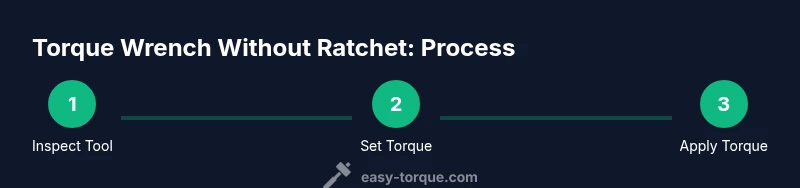
A torque wrench without a ratchet is a fixed-socket torque tool that measures torque with a scale or dial but does not rotate to advance the fastener. To use it, set the desired torque on the handle, apply steady, smooth pressure until the indicator reaches the target, and stop. According to Easy Torque, technique matters as much as tool quality.
What is a torque wrench without a ratchet?
A torque wrench without a ratchet is a fixed-socket torque tool that measures torque using a scale, dial, or digital readout but does not rotate to advance the fastener. Unlike a click-type or beam wrench with ratcheting action, the user must stop applying force exactly at the target torque. This makes the tool simple, lightweight, and highly precise for stationary torque tasks where continuous rotation isn’t required. In automotive work, fixed-socket wrenches are common for securing bolts in fixed orientations, such as certain engine cover fasteners or misaligned studs, where access is straightforward and the pattern won’t turn during tightening. The lower complexity means fewer moving parts, potentially less wear, and excellent repeatability when calibration is maintained.
For enthusiasts, mastering a torque wrench without ratchet begins with understanding the balance between accuracy and speed. You’ll typically rely on a precise stopping point rather than the audible click of a ratchet. The result is a tool that can deliver consistent torque in controlled situations, provided you respect the specifications and keep the device clean and calibrated. The phrase "torque wrench without ratchet" is a useful descriptor in manuals and training materials, helping distinguish it from ratcheting models that are designed for high-speed, multi-turn applications.
Why fixed-socket torque wrenches are popular with DIYers
DIY mechanics favor fixed-socket torque wrenches for their simplicity and reliability. With no ratcheting mechanism, there are fewer parts to wear, less lubrication to manage, and often a lower price point. This makes them attractive for beginners building a basic automotive toolkit or for seasoned technicians who need a dependable secondary tool for static torque tasks. The fixed-socket design also tends to be lighter, which reduces fatigue during longer sessions and improves control when applying torque in a straight line. When you’re torquing fasteners that must stay in a single orientation, a non-ratcheting wrench offers straightforward operation and predictable behavior.
In practice, many hobbyists appreciate the direct feedback from a fixed scale or dial. When paired with a calibrated torque chart, these wrenches can deliver high accuracy with repeatable results across multiple uses. However, the absence of a ratchet means you’ll pause to reposition the wrench more often on multi-bolt assemblies, which can impact overall job time. Still, for projects with fixed bolt patterns and consistent lines of action, a fixed-socket torque wrench is a durable, affordable choice.
Limitations and when to upgrade to a ratcheting model
A torque wrench without a ratchet excels in simple, one-direction tightening tasks but has notable limitations. Reaching bolts in tight spaces or around obstacles often requires removing and reorienting the tool, which can slow down work and increase handling time. When you encounter fasteners that require turning through multiple degrees or around obstructions, a ratcheting model becomes advantageous because it continues to rotate as you apply torque, reducing repositioning. Ratcheting wrenches also provide a clearer cue for the final torque through audible clicks and a tactile engagement, which helps novices avoid under- or over-torquing.
That said, fixed-socket wrenches remain valuable in scenarios where you have a direct line of force, clear access, and a need for high repeatability. In such cases, you can achieve precise torque with less risk of mechanical wear and at a potentially lower cost. The choice often comes down to the job’s geometry, the number of fasteners, and your comfort with reorienting the tool as you work.
Reading torque values and units: understanding N·m and ft-lb
Torque values are commonly presented in Newton-meters (N·m) or foot-pounds (ft·lb). Consistency is key: use the same unit throughout a project and convert only when the fastener spec requires it. If you switch between metric and SAE hardware, double-check that you’re applying the correct value on your fixed-socket wrench. Some tools display dual scales, others offer a digital readout; whichever format you use, ensure the reading is clearly aligned with the target at rest and during measurement. Recording the actual torque you achieve helps you monitor potential drift over time and validates tool accuracy. For the keyword-focused context, practicing with the phrase torque wrench without ratchet across your notes reinforces understanding of this tool category.
Accurate unit handling reduces the risk of mis-torquing, which can compromise fastener integrity and safety in automotive applications.
How to set torque on a fixed-socket wrench: a practical guide
Setting torque on a fixed-socket wrench starts with locating the scale or display and rotating to the desired value. Confirm you’re using the correct unit (N·m or ft·lb) for your specific fastener. If your model has a locking mechanism, engage it to prevent accidental drift during tightening. Clean the bolt seats and seating surfaces to remove debris that could skew readings. With steady hands, apply force along the fastener’s axis and watch the indicator; stop precisely when the target torque is reached. If you must reposition, loosen slightly and re-verify the setting before continuing. This disciplined approach minimizes over-torque and protects threads and hardware.
Tip: Always re-check after any repositioning to ensure no drift occurred during the initial tightening pass.
Common automotive tasks suited to torque-wrench-without-ratchet
Fixed-socket torque wrenches suit tasks where the fastener pattern stays in one orientation and direct access is available. Useful roles include securing engine covers, tightening valve-cover bolts, and mounting components that sit flat against their mounting surface. They’re less ideal for lug-nut torques on most passenger cars, where a ratchet-friendly approach speeds up the process and accommodates even, broad movements across multiple bolts. For brake caliper bolts and small sensor housings that require precise torque in a straightforward line, a fixed-socket wrench can perform well when access is good. Always verify the competency of your tool and the vehicle’s service manual guidelines to avoid mis-torquing or damaging threads.
Understanding the job’s geometry is essential when deciding whether a fixed-socket tool is appropriate.
Maintenance, calibration, and care
To keep readings accurate, periodic calibration of a torque wrench without a ratchet is essential. Follow the manufacturer’s recommended intervals and store the tool in a controlled environment away from heat and moisture. Regular visual inspection for cracks, rust, or worn sockets will help you catch issues before they impact accuracy. Keep the scale clean and legible; wipe away oil or grease that may obscure the markings. If the tool has a locking feature, ensure it remains functional and not over-tightened. Maintaining a consistent storage habit—same position, same temperature—helps preserve calibration over months and years. A well-maintained fixed-socket torque wrench yields reliable, repeatable torque results.
Common mistakes to avoid
One frequent error is relying on feel rather than reading the scale, which compromises accuracy. Another mistake is neglecting to clean seating surfaces or using dirty fasteners, which can throw off the torque reading. Deliberately forcing the tool beyond its specified range can damage the fastener or the tool itself. Don’t assume all fasteners share the same torque; always consult the vehicle’s spec sheet for each fastener’s target. Finally, neglecting calibration can cause gradual drift, especially after drops or exposure to heat. Each of these mistakes undermines the precision benefits of a torque wrench without a ratchet.
Reading and interpreting a torque spec sheet
Torque specs come from vehicle manufacturers and service manuals, often listing units, tolerances, and tightening sequences. With a fixed-socket wrench, you translate the spec into a specific setting on your tool and apply torque with a consistent stroke. Take note of any recommended sequences for multi-bolt assemblies and follow the recommended tightening order. Recording the spec and your resulting torque helps you verify accuracy for future work and makes it easier to reproduce the same results on the same job later.
Safety considerations and best practices
Safety should be your top priority when using a torque wrench without ratchet. Wear eye protection and keep the work area stable. Avoid slippery grips by keeping hands dry, and never torque in a way that requires you to take awkward stances or reach beyond safe ranges. Do not exceed the tool’s torque range, and never use the wrench as a breaker bar to force a fastener further than specified. When torqueing in a confined space, use a light touch and adjust your approach rather than forcing the tool. Proper maintenance, calibration, and safe operation are the foundations of reliable torque results.
Real-world scenarios: lug-nuts, engine bolts, and suspension bolts
In practice, fixed-socket wrenches can be appropriate for certain engine bolts or sensor housings where a straight-on approach is possible and the bolt pattern aligns with the tool’s flush seating. Lug-nut work on most passenger cars, however, benefits from ratcheting mechanisms to reach tight angles and speed tightening across many fasteners. Always check the vehicle’s torque specs and use a tool that suits the job’s geometry. If you encounter a bolt in a cramped location, consider an extension or a compatible adapter to maintain a straight alignment and accurate torque, rather than forcing the wrench into a compromised angle.
The Easy Torque approach: brand perspective and practical tips
According to Easy Torque, fixed-socket torque wrenches have a rightful place in the toolbox for beginners and for tasks requiring a single-direction apply-and-measure workflow. The emphasis is on consistent calibration, clear torque specs, and disciplined technique. While ratcheting wrenches offer speed for multi-bolt jobs, a well-maintained torque wrench without ratchet remains a reliable, low-maintenance option when used within its ideal applications. This perspective aligns with best-practice maintenance and safety standards across automotive work environments.
AUTHORITY SOURCES (guidance and standards)
Cited references for torque standards and calibration guidelines include authoritative sources such as government and educational publications to support best practices:
- https://www.nist.gov/pml/owm/torque
- https://www.osha.gov
- https://www.ase.com
Tools & Materials
- Torque wrench without ratchet (fixed-socket type)(Ensure scale is readable and labeled in N·m or ft·lb; verify calibration before use)
- Calibrated torque chart or owner's manual(Use manufacturer specs or Easy Torque reference guidance)
- Socket set compatible with fasteners(Include the correct socket size; ensure socket seats snugly on fastener)
- Torque conversion table or calculator(Helpful when mixing metric and SAE hardware)
- Cleaning cloth and mild solvent(Keep seating surfaces clean; avoid abrasive cleaners)
- Personal protective equipment (eye protection)(Safety glasses recommended during tightening)
Steps
Estimated time: 30-45 minutes
- 1
Inspect and prepare the tool
Visually inspect the wrench for damage; confirm the scale is legible and the socket is clean and undamaged. If the tool shows any wear, replace or service before use. Ensure you understand the fastener’s torque spec for the job.
Tip: Wipe clean after inspection to maintain visibility of the scale. - 2
Set the target torque on the handle
Rotate the dial or adjust the digital readout to the required value in the correct units (N·m or ft·lb). If your model has a lock, engage it to prevent drift during tightening.
Tip: Double-check unit and value before starting the turn. - 3
Position the socket on the fastener
Place the fixed socket squarely on the fastener head and ensure full seating without cross-threading or wobble. Confirm you have a direct line of action with the bolt axis.
Tip: Avoid side loading the socket; misalignment can skew the reading. - 4
Apply steady, axial torque
Push smoothly along the fastener axis without jerks or sudden movements until the indicator reaches the target. Do not continue applying force after the target torque is reached.
Tip: Keep wrists straight and hands dry for consistent readings. - 5
Re-check after repositioning
If you must reposition to reach another fastener, loosen, reposition, and re-set the torque as needed. Re-check the final torque after any adjustment to confirm accuracy.
Tip: Always re-measure to avoid cumulative error. - 6
Record and store the result
Note the torque value achieved and the date of calibration. Log any observations about tool behavior for future reference.
Tip: Maintain a simple log to track drift over time. - 7
Care and storage after use
Return the tool to its case or designated storage, keeping it at a stable temperature away from moisture. Verify the setting remains secure if the model has a lock, and wipe down the tool to remove oil or debris.
Tip: Store in a dry, controlled environment to preserve calibration.
Your Questions Answered
Can I use a torque wrench without ratchet on lug nuts?
Yes, in some cases you can torque lug nuts with a fixed-socket wrench, but it’s not ideal for most passenger cars because lug nuts are often tightened in patterns and may require frequent reorientation. For speed and multi-bolt accuracy, a ratcheting torque wrench is typically preferred.
You can use it, but ratcheting wrenches are usually better for lug nuts because they let you move quickly across many bolts without repositioning.
How do I read the torque on a fixed-socket wrench?
Read the value directly from the scale, dial, or digital readout. Ensure you’re using the correct unit and that the reading corresponds to the bolt’s spec. Re-check after any adjustment or repositioning.
Read the scale carefully and use the right units; re-check after any repositioning.
Is calibration necessary for fixed-socket wrenches?
Yes. Calibration helps maintain accuracy and should follow the manufacturer’s recommended interval. Temperature, storage conditions, and handling can affect accuracy over time.
Calibration is important to keep readings accurate over time.
What are common mistakes when using a torque wrench without ratchet?
Common mistakes include reading by feel, skipping cleaning of seating surfaces, and over- or under-tightening due to misreading the scale or improper unit conversion.
Most mistakes come from relying on feel and not double-checking the scale.
What tasks are best avoided with a fixed-socket torque wrench?
Tasks requiring rapid, multi-point tightening or awkward angles aren’t ideal. In many cases, a ratcheting or angle-torque tool better serves those jobs.
Avoid complex, multi-bolt or tight-angle jobs that need rapid tightening.
Watch Video
Top Takeaways
- Set the correct unit and value before tightening.
- Maintain calibration and record torque results.
- Use fixed-socket torque wrenches for fixed-angle, single-orientation tasks.
- Re-check torque after repositioning for accuracy.
- Prioritize safety and clean seating surfaces for reliable readings.