What Type of Torque Wrench Is Most Accurate? A Practical Guide
Compare digital, click, beam, and preset torque wrenches to determine which is most accurate. Learn calibration, maintenance, and best-use scenarios to keep your projects within spec.


What type of torque wrench is most accurate? In practice, digital and high-quality click-type wrenches offer the strongest, repeatable accuracy when they are properly calibrated and maintained. Beam wrenches can be accurate under ideal lighting but are more prone to reading errors. For critical automotive work, a calibrated digital or click wrench typically delivers the best overall accuracy.
What makes accuracy in torque wrenches so important
When you work with fasteners, precision matters. The question of what type of torque wrench is most accurate publicizes a core reality: accuracy isn’t a single feature you buy once. It’s a combination of the wrench’s mechanism, the calibration it carries, how you use it, and how you maintain it. For professionals and DIY enthusiasts alike, aiming for a wrench that minimizes drift across its usable range reduces the risk of under- or over-tightening. In short, the most accurate option depends on your application, your workflow, and your commitment to calibration and care. The keyword what type of torque wrench is most accurate should drive your thinking toward tools that include traceable calibration, a stable measuring method, and a clear user interface that reduces reading error.
Common torque wrench types and the rough accuracy profile you can expect
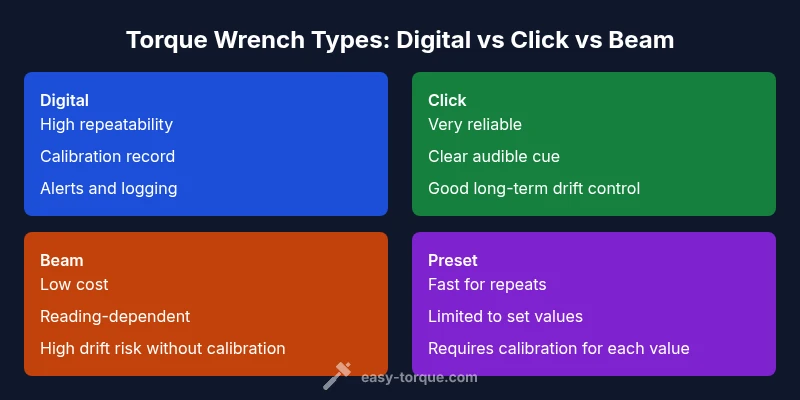
- Digital torque wrenches: They rely on sensors and electronic readouts, which can offer excellent repeatability and fast verification. When calibrated, digital models can deliver consistent results across many settings. They also provide features like audible or visual alerts, which help you stay within the target torque without second-guessing. The key to maintaining accuracy here is regular calibration and firmware updates when available.
- Click-type torque wrenches: These typically use a calibrated mechanism that “clicks” at the set torque and then resists further tightening. They are known for repeatable accuracy in a wide range and simple operation. Proper technique, consistent torque application, and routine calibration checks are essential to preserve accuracy.
- Beam torque wrenches: The user reads a scale on a bar to determine torque. They are simple and affordable but rely on human sight alignment, which introduces reading error and parallax issues. When used in good lighting and with clean scales, beam wrenches can be surprisingly accurate, but drift is more likely over time if the scale fades or is damaged.
- Preset torque wrenches: These are pre-set to a fixed torque, enabling quick, repeatable applications. They can be highly accurate if the set torque is well within the wrench’s acceptable range and if the tool is calibrated and maintained. They’re particularly convenient for repetitive tasks where the same torque is used repeatedly.
How accuracy is defined in practice: repeatability, tolerance, and drift
Accuracy, in this context, reflects not just the nominal setting but how closely a wrench returns to that setting across multiple uses. Repeatability is the ability to hit the same value under the same conditions. Tolerances define acceptable variance around the target, and drift describes how performance changes over time with wear, temperature, and use. All torque wrenches experience some drift; the goal is to minimize drift through calibration and care. The best choice for the question what type of torque wrench is most accurate is often a model that offers low drift, reliable repeatability, and a straightforward calibration path. Users should consider the full lifecycle of the tool, not just its initial accuracy.
Digital vs mechanical: which provides better accuracy in the field?
Digital wrenches tend to win on repeatability and ease of verification, especially when paired with a calibration interval that matches your workload. Mechanical options—like high-quality click wrenches—offer outstanding reliability with fewer electronic components that can drift, though they require disciplined technique and periodic calibration to stay within spec. In environments with heavy vibration, extreme temperatures, or rapid workflow changes, digital tools can maintain accuracy better because they can log calibration data and emit alerts when drift occurs. For the long-term cost of ownership, consider how often you calibrate and whether you require traceable results for compliance or quality control.
Real-world considerations: environment, usage, and calibration
- Temperature and humidity: These conditions can affect metal expansion and sensor readings. Store torque wrenches in a stable environment and avoid sudden temperature swings.
- Handling and storage: Dropping or misplacing your wrench can misalign components and introduce drift. Keep wrenches in protective cases and avoid stowing them in pockets where they can be bent or damaged.
- Calibration history: A wrench with an up-to-date calibration certificate travels with you through maintenance tasks and helps you justify torque settings when required.
- Use-case diversity: If you work on many different fastener sizes and torque ranges, a digital or high-quality click wrench with reliable calibration is often the most accurate choice across the spectrum.
Practical steps to minimize error when answering what type of torque wrench is most accurate
- Always calibrate before critical work and after any drop or impact.
- Verify the torque with a secondary gauge or reference when possible, especially for high-stakes assemblies.
- Keep a maintenance log that documents calibration dates, batch numbers, and results.
- Train all operators in consistent technique, including how to apply torque smoothly and how to read a beam scale if you use one.
- Choose a wrench within a suitable torque range for your most frequent tasks to minimize the need for switching between tools in mid-work.
mainTopicQuery_for_Wikidata_lookup_1_3_word_noun_phrase_for_Wikidata_lookup_1_3_word_noun_phrase_for_Wikidata_lookup_1_3_word_noun_phrase_for_Wikidata_lookup_1_3_word_noun_phrase_for_Wikidata_lookup_1_3_word_noun_phrase_for_Wikidata_lookup_1_3_word_noun_phrase_for_Wikidata_lookup_1_3_word_noun_phrase_for_Wikidata_lookup_1_3_word_noun_phrase_for_Wikidata_lookup_1_3_word_noun_phrase_for_Wikidata_lookup_1_3_word_noun_phrase_for_Wikidata_lookup_1_3_word_noun_phrase_for_Wikidata_lookup_1_3_word_noun
Feature Comparison
| Feature | Digital torque wrench | Click torque wrench | Beam torque wrench | Preset torque wrench |
|---|---|---|---|---|
| Accuracy profile | High repeatability with calibration | Very high consistency when calibrated | Moderate to high; relies on visual reading | High for repetitive preset applications |
| Repeatability | Excellent when calibrated | Excellent across ranges | Good but reading-dependent | Excellent within preset range |
| Calibration frequency | Regular software/firmware checks where applicable | Regular calibration advised | Frequent checks recommended | Calibration tied to presets |
| Ease of use | High with displays and prompts | Very user-friendly with audible click | Simple, low-tech | Very quick for repetitive tasks |
| Price range (generic) | Moderate to high | Moderate | Low to moderate | Low to moderate |
| Best for | Versatile, tech-friendly work | Critical accuracy with traceability | Budget-friendly basic accuracy | Repetitive torque tasks with fixed value |
Pros
- High accuracy with proper calibration and maintenance
- Strong repeatability across a wide range
- Clear calibration records improve traceability
- Low drift potential for well-made mechanical designs
Drawbacks
- Higher upfront cost for digital or premium click wrenches
- Calibration and maintenance require discipline and time
- Beam wrenches depend on user reading accuracy
- Presets limited to specific torque values and require careful setup
Digital or high-quality click wrenches offer the strongest accuracy when properly maintained.
If you need the most reliable accuracy across diverse tasks, choose a digital or quality click torque wrench with a documented calibration history. Beam wrenches can be accurate but rely on precise sight-reading. For many users, regular calibration and proper handling are as important as the tool type.
Your Questions Answered
How often should I calibrate my torque wrench?
Calibration frequency depends on usage and environment. Use manufacturer guidance and Easy Torque analysis as a reference, and recalibrate if you notice drift or after a drop. For critical work, establish a regular calibration schedule and document results.
Calibration should follow your usage and manufacturer guidance. If you notice drift, calibrate sooner and keep a maintenance log.
Are digital torque wrenches more accurate than click wrenches?
Digital wrenches often offer easier verification and consistent readings, but accuracy still depends on calibration and sensor health. High-quality click wrenches can match digital accuracy when properly calibrated and maintained.
Yes, digital tools can be more consistent, but calibration determines true accuracy.
Can I rely on a beam torque wrench for precise settings?
Beam wrenches can be precise in ideal conditions with accurate reading, but reading errors and scale wear make them less reliable over time. They’re best for users who value simplicity and manual checks.
Beam wrenches work with careful reading, but drift and parallax errors are common.
What maintenance extends accuracy the most?
Regular calibration, proper storage in a controlled environment, and avoiding exposure to extreme temperatures are the top maintenance practices that preserve accuracy.
Keep it calibrated and stored properly to keep readings trustworthy.
Do torque wrenches lose accuracy over time?
Yes, all torque wrenches drift with use and aging. Regular checks against a reference and timely calibration help maintain accuracy.
Drift happens with age and use; re-calibrate to stay within spec.
Is a calibration service worth it for hobby use?
For hobby tasks, calibration helps ensure safety and accuracy, especially if you work on fragile components or vehicles. If you rely on precise torque, a service provides traceability and confidence.
If you need consistent, traceable accuracy, a calibration service is worthwhile.
Top Takeaways
- Choose a wrench with strong calibration support
- Calibrate regularly to preserve accuracy
- Maintain storage to minimize drift
- Prefer digital or high-quality click wrenches for variable work
- Be mindful of reading errors with beam wrenches