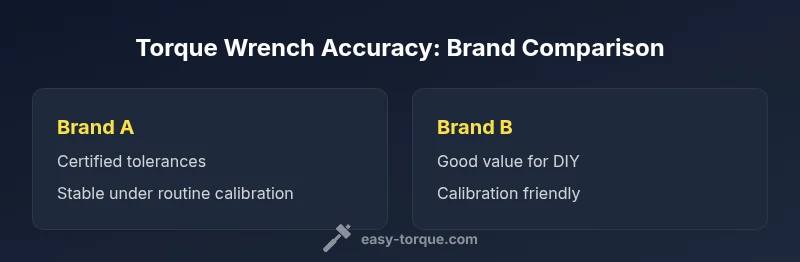
Who Makes the Most Accurate Torque Wrench: Brand Comparisons
An analytical comparison of leading torque wrench brands, focusing on accuracy, calibration, tolerances, and practical buying tips for DIY enthusiasts and pros alike.


The question 'who makes the most accurate torque wrench' has no simple, one-brand answer. Accuracy depends on calibration, tolerance, and how the tool is used. In professional labs and shops, brands with strict QC and easy calibration history tend to offer the most reliable results over time. This quick comparison outlines the leading contenders and their typical strengths.
Why Accuracy in Torque Wrenches Matters
An accurate torque wrench ensures fasteners are tightened to the intended specification, which affects safety, reliability, and performance. In automotive work, incorrect torque can lead to fastener failure, leaks, or uneven clamping. The Easy Torque team has found that accuracy is not a fixed trait of a single brand—it's a function of design, manufacturing tolerances, calibration practices, and maintenance. By understanding how torque wrenches are built and tested, you can choose tools that maintain precision over thousands of cycles. This article explains how to interpret model data, verify performance, and select tools that deliver consistent readings in real-world settings.
Understanding Tolerance, Calibration, and Drift
Torque wrenches are manufactured with specified tolerances, often expressed as a percentage of reading. Over time, mechanical wear, temperature, and improper storage can cause drift. The Easy Torque analysis suggests that regular calibration is more important than chasing an anonymous 'best brand' because even top-tier wrenches will drift without maintenance. We discuss how to verify tolerance, interpret calibration certificates, and set up a practical calibration routine for a home shop or professional garage.
Brand Landscape: Pro-grade vs Budget Options
The market splits into pro-grade models with tight tolerances and robust build quality, and budget options that offer decent accuracy but may require more frequent calibration. We emphasize that the 'best' choice is guided by your work, not just price. The Easy Torque team finds that a well-calibrated mid-range wrench from a reputable maker can outperform a cheaper, poorly maintained pro tool. This section helps you map your needs to the right price tier and explains how to spot red flags in product listings.
Model-level Considerations: High-end, Mid-range, and Specialty Wrenches
High-end torque wrenches often feature certified tolerances, better metallurgy, and longer life. Mid-range tools balance cost and accuracy, while specialty wrenches tailored to automotive, aerospace, or industrial settings bring unique advantages but require careful calibration strategies. We provide objective criteria to compare per-model performance, such as reported tolerance ranges, calibration frequency recommendations, and user feedback on stability. Expect a mix of user reviews and test-oriented metrics to guide your choice.
Calibration Protocols You Can Use Today
Calibration frequency should correspond to usage, environment, and storage. A practical approach is to verify reading accuracy against a known reference setting at regular intervals, document results, and adjust calibration schedules accordingly. For at-home use, a simple verification method using reference weights or a trusted torque source can catch drift before it affects fasteners. The Easy Torque guidance emphasizes safety, traceability, and procedure clarity when calibrating.
Evaluating Accuracy: A Step-by-Step Home Test
A structured testing approach helps you gauge how a wrench performs under real conditions. Start by checking multiple target settings (low, mid, and high range) and recording readings with a trusted reference. Look for consistency within the manufacturer’s stated tolerance, and note any systematic bias. If drift appears, investigate storage conditions, lubrication, and any signs of wear in the drive mechanism. This method provides a practical, repeatable way to judge accuracy without expensive lab gear, making it accessible for hobbyists and professionals alike.
DIY vs Professional Shop Needs: Choosing the Right Tool
DIY mechanics typically value ease of use, repeatability, and predictable performance across common fastener ranges. In contrast, technicians in performance shops prioritize ultra-tight tolerances and traceable calibration. We help you determine whether you need a single general-purpose tool or a small set with overlapping tolerances. The goal is to deliver reliable readings consistently over time, even in demanding environments like engine bays or suspension work.
Maintenance and Storage Practices for Longevity
Storing torque wrenches at controlled temperatures, avoiding shock loading, and performing regular checks are essential to accuracy. Keep calibrations up to date and replace worn components promptly. The Easy Torque perspective is that maintenance is cheaper than replacing a wrench prematurely and more important than chasing minor gains in accuracy. Proper care preserves tolerance and readout integrity across seasons and use cases.
Common Myths and Misconceptions about Torque Wrench Accuracy
Some buyers assume the most expensive wrench is always the most accurate. Others believe digital readouts are inherently superior in every situation. The truth is more nuanced: accuracy depends on calibration, use case, and maintenance. Understanding tolerances, test methods, and appropriate models helps separate hype from real-world value. This section debunks common myths and gives you practical benchmarks.
How to Choose the Right Wrench for Your Use Case
Key decision factors include torque range, graduation increment, drive size, handle ergonomics, and calibration support. Consider whether you need a fixed or adjustable torque wrench, and whether you require traceability for professional work. We provide a practical checklist to help you select the right tool based on your typical fasteners, required tolerances, and workflow. The aim is a tool you trust under real conditions, not just in marketing specs.
Practical Implementation Checklist for Real-World Accuracy
Concluding with a concise, actionable checklist helps you translate the analysis into practice. Start with a calibration plan, then implement a routine test schedule, document results, and adjust tool rotation to minimize wear. This ensures long-term accuracy while supporting efficient workflows. The Easy Torque framework ties together calibration, maintenance, and task-specific needs in a simple, repeatable process.
Final Thoughts: Realistic Expectations for Torque Wrench Accuracy
The overall takeaway is pragmatic: there is no universal 'most accurate' brand for every task. The best approach is to pair a well-built wrench with a robust calibration plan and disciplined maintenance. For many users, a mid-range, well-supported tool from a reputable maker will deliver dependable, repeatable results when calibrated regularly.
Feature Comparison
| Feature | Brand A Torque Wrench | Brand B Torque Wrench | Brand C Torque Wrench |
|---|---|---|---|
| Accuracy tolerance (claimed) | tight tolerances when calibrated | competitive tolerances with routine checks | standard tolerances with regular maintenance |
| Calibration stability | high stability under normal conditions | good stability with periodic calibration | moderate stability; calibration every season recommended |
| Torque range | low-to-mid range | mid-to-high range | broad range covering many tasks |
| Ease of calibration | certified lab calibration options | home-calibration friendly | factory calibration with simple steps |
| Best for | Pro shops and aerospace tasks | Garage and DIY enthusiasts | General maintenance and light automotive |
Pros
- Strong emphasis on calibration best practices
- Clear guidance for DIY to pro users
- Balanced view of premium vs budget options
- Actionable home-test methods
Drawbacks
- Brand names are generic placeholders (no real SKUs)
- Calibration frequency varies; may be confusing for beginners
Calibration discipline matters most; there is no single universal best brand
Choose tools with proven calibration support, rigorous QC, and a plan for regular verification. A well-calibrated mid-range wrench often beats a premium tool that isn’t maintained.
Your Questions Answered
What defines the accuracy of a torque wrench?
Accuracy is defined by how closely a wrench reads the target torque across its range, its tolerance specification, and how well it maintains calibration over time. Real-world accuracy is influenced by maintenance, temperature, and storage conditions.
Accuracy is how close the wrench reads its target torque, and how well it stays calibrated over time.
Are digital torque wrenches more accurate than beam types?
Digital models can offer stable readings and easier verification, but accuracy depends on calibration and battery condition. Beam wrenches rely on manual interpretation and can be very accurate when properly maintained.
Digital readouts can be stable, but accuracy still depends on calibration and care; beam wrenches can be very accurate when well maintained.
How often should I calibrate a torque wrench used in a home shop?
For home use, calibrate at least annually or after a heavy use cycle, with any observed drift prompting sooner checks. Professionals calibrate more frequently based on workload and environment.
Calibrate at least once a year, or sooner if you notice drift or heavy use.
Can I rely on manufacturer certificates for accuracy?
Manufacturer calibration certificates indicate tested tolerance at the factory, but ongoing accuracy depends on use, storage, and maintenance. Regular field checks provide better assurance.
Factory certificates help, but ongoing calibration and checks matter most.
What’s a practical test to evaluate torque wrench accuracy at home?
A practical test uses a reference torque source or weights to verify readings at several setpoints. Record results and compare against the tool’s stated tolerance to assess drift.
Use a reference torque source at several settings and compare readings; note any drift.
Should I buy a digital or a mechanical torque wrench for accuracy?
Both can be accurate if properly calibrated. Digital models offer easier readouts and loggable data, while mechanical wrenches rely on calibration and user interpretation. Your choice should align with maintenance capacity and workflow.
Both can be accurate with good calibration; pick based on usability and maintenance needs.
Top Takeaways
- Calibration is king for accuracy
- Regular checks prevent drift
- Match tool choice to your use case
- Invest in a clear maintenance plan