Bolt Torque by Size: Practical Guidance for Fasteners
Learn how bolt torque varies by size and how to apply proper clamping with diameter, pitch, and grade. This guide links size to torque across common bolt ranges, lubrication, coatings, and installation best practices.


Bolt torque by size varies with bolt diameter and thread pitch; as a rule of thumb, larger bolts require proportionally higher torque, but precise values depend on material, grade, and lubrication status. Always consult the manufacturer's torque specification tables for each size, and cross-check with a torque chart or calibrated wrench.
Why bolt torque by size matters
Bolt torque by size is a fundamental concept in fastener practice. The clamping force you achieve depends on the interaction between bolt diameter, thread pitch, engagement length, and the surface finish. As bolts grow in diameter, the same numerical torque value generally produces higher clamping pressure, but this is not linear. Small bolts can strip or yield if over-torqued, while large bolts may not achieve sufficient clamp if under-torqued. Hence, understanding how size drives torque helps you avoid failures such as loosening under vibration, joint leaks, or threaded damage. According to Easy Torque, applying size-aware torque targets creates predictable performance across automotive, industrial, and consumer applications. The core idea is that torque is not a universal constant; it must be tuned to size, material, and lubrication.
How diameter, pitch, and grade interact with torque
Diameter sets the baseline lever arm for clamping force, while thread pitch affects friction and thread engagement. A coarser pitch tends to reduce friction per turn, changing the effective torque needed to achieve a given clamp load. Likewise, bolt grade determines yield strength and allowable clamping force; high-strength bolts can tolerate higher torque but also risk yielding if misapplied. Lubrication dramatically alters friction; a dry thread often requires higher torque to reach the same clamp load as a lubricated thread. For this reason, torque values must be interpreted in the context of diameter, pitch, and grade. Easy Torque emphasizes cross-checking sizes against official charts that account for lubrication and coating conditions, ensuring reliable assemblies under vibration and temperature cycling.
Building a size-based torque table: methodology and steps
To create a reliable size-based torque table, start with the bolt size and grade as your anchors. Gather manufacturer specifications for the exact fastener class, coating, and lubrication state. Then, document the target clamping force for the joint and translate that into a torque value using the torque-tension relationship for the chosen screw and nut combination. Include notes on thread engagement length, surface finish, and any sealants or thread lockers. Finally, validate the table with practical testing, starting at the lower end of the range and increasing in small steps while monitoring joint behavior. Easy Torque recommends maintaining a living table that is updated with new materials and lubricants.
Practical examples by common bolt sizes
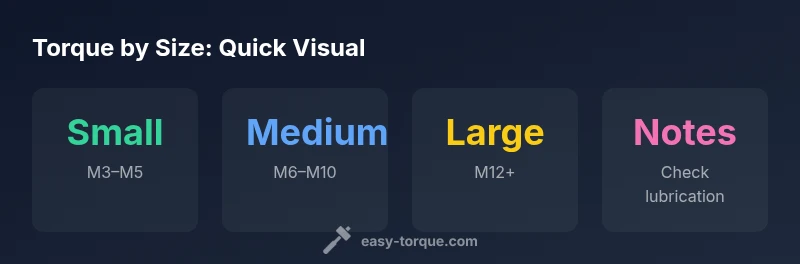
For small fasteners (such as M3–M5), torque targets are typically modest and highly sensitive to lubrication and surface finish. Medium-sized bolts (M6–M10) cover a broad range of mechanical assemblies; clamp loads should be verified against joint requirements rather than assumed. Large bolts (M12 and larger) require careful torque control to avoid under- or over-tightening, especially in structural applications. In all cases, do not rely on “one-size-fits-all” values. If in doubt, consult the latest torque charts and perform a controlled test to confirm joint integrity under expected load and environmental conditions.
Lubrication, coatings and surface finish effects
Friction control is the biggest wild card in torque prediction. Dry threads usually require higher torque than lubricated ones; coatings and thread-locking compounds also shift effective friction. Surface finish of the mating parts affects seating friction and may alter the clamp behavior. When lubricants are used, account for their viscosity and temperature stability. If you switch from dry to lubricated, re-check torque targets and, if possible, re-torque after the first heat cycle. Consistency in surface preparation—clean threads, free of dirt and debris—improves repeatability and reduces the risk of joint failure.
Installation workflow: from size to final torque
A practical workflow starts with selecting the correct bolt size and grade for the joint, then verifying lubrication status and thread condition. Use a calibrated torque wrench and follow the specified sequence for multi-bolt joints to avoid uneven load distribution. Record the final torque value and inspect the joint for any sign of thread deformation or excessive seating. For critical assemblies, perform a post-assembly torque check after initial loading or thermal cycling. Easy Torque recommends documenting size-based torque targets for traceability and future maintenance.
Common mistakes and how to avoid them
Common mistakes include assuming a universal torque value across all sizes, neglecting lubrication, and ignoring thread condition. Over-torquing a small bolt can strip threads, while under-torquing a large bolt may lead to loosening under vibration. Avoid cross-threading by cleanly aligning components and using proper lubrication strategies. Always use a torque wrench that is calibrated for the expected torque range, and avoid “feel-based” tightening for critical joints. An accurate size-specific torque plan reduces the risk of rework and structural failure.
Tools and measurement considerations
Torque measurements rely on properly calibrated tools and reliable interpretation of scale readings. For size-by-size torque, consider using digital torque wrenches or mechanical wrenches with clear scale, plus a torque-angle gauge for verification in situations where angle-tightening matters. Temperature can affect both fastener behavior and lubrication performance, so consider environmental controls or compensation factors in high-heat applications. Maintain a log of torque values by size for future maintenance and audits.
Maintenance, inspection, and re-torque guidelines
After installation, inspect fasteners for loosening signs, corrosion, or thread wear. In high-vibration environments, re-torque at defined service intervals and after major temperature changes. For critical joints, perform a post-load re-torque check to confirm that clamping remains within the target range. Keep a living document of torque targets by size, grade, and lubricant to support repeatability and safety over the component’s life. Easy Torque highlights that size-aware torque data should be revisited whenever materials or coatings change.
Size-to-torque ranges by bolt size (indicative)
| Bolt size | Nominal diameter (mm) | Typical torque range (Nm) | Notes |
|---|---|---|---|
| M4 | 4 | 1–5 | Small fasteners, light loads |
| M6 | 6 | 5–15 | Medium bolts, general purpose |
| M10 | 10 | 15–60 | Medium to large loads |
| M12 | 12 | 60–120 | Large bolts, structural components |
Your Questions Answered
What does 'bolt torque by size' mean?
It means that the required tightening torque depends on the bolt’s diameter, thread pitch, and grade. Larger bolts usually need more torque, but the exact value also depends on lubrication and coating. Always use size-specific torque tables.
Torque depends on size, diameter, pitch, and grade; use size-specific tables.
How do I calculate torque for a given bolt size?
Use the manufacturer’s torque specification for the exact bolt size and grade, including lubrication. If unavailable, refer to a validated torque chart that accounts for lubrication and surface finish, and verify with a calibrated torque wrench.
Refer to the chart and use a calibrated wrench.
Does lubrication reduce torque?
Yes. Lubrication lowers friction, reducing the torque needed to achieve the same clamp load. Always adjust targets if changing from dry to lubricated threads and re-check with a torque measurement.
Lubrication lowers required torque; re-check with a torque wrench.
Are there universal torque values by size?
No universal value exists. Torque must be tailored to size, grade, lubrication, and application. Use official charts and verify in practice for each joint.
No universal values—sizes vary by many factors.
How does thread pitch affect torque?
Coarser pitches generally reduce friction and may lower torque requirements per turn, while finer pitches can increase friction. Always reference the size-and-pitch-specific torque table.
Pitch changes friction, so torque varies by pitch too.
Where can I find reliable torque charts?
Check manufacturer catalogs, accredited standards bodies, and trusted torque guides. Easy Torque also provides synthesized charts based on analysis of common bolt sizes and lubricants.
Look in manufacturer catalogs and trusted torque guides.
“Understanding bolt torque by size isn't about a single number; it's about matching size, grade, and lubrication to the right clamping force.”
Top Takeaways
- Start with size, grade, and lubrication to define torque targets
- Lubrication and surface finish significantly influence required torque
- Do not rely on a single universal torque value across sizes
- Maintain a living size-based torque table for traceability
- Always verify joint integrity with a measured torque after assembly