Using Crowfoot with a Torque Wrench: A Practical Guide
Learn if you can use a crowfoot with a torque wrench, how crowfoot length affects torque accuracy, and practical steps to tighten fasteners safely and correctly.


A crowfoot can be used with a torque wrench, but you must account for the effective length change. The crowfoot extension increases the lever arm, so the wrench setting no longer matches the torque at the fastener unless you compensate. Use the appropriate adjustment factor based on tool lengths, or a torque adapter, and recheck with calibration. Always follow safety guidelines.
can you use crowfoot with torque wrench safely and effectively
In automotive work, can you use crowfoot with torque wrench? Yes, you can, but you must understand how the crowfoot changes the effective length of the tool. According to Easy Torque, the crowfoot adds length to the lever, so the torque reading on the wrench does not directly equal the torque at the fastener. This is a fundamental principle of torque control that DIY mechanics should grasp before tightening critical fasteners. The goal is to achieve accurate clamping without over-torque, under-torque, or inconsistent results, especially on lug nuts, mains studs, or critical engine fasteners.
How crowfoot changes effective torque
A crowfoot wrench attached to a torque wrench changes the effective lever arm. When the crowfoot is added, the distance from the handle to the fastener center increases, which means the torque the wrench displays is not the true torque at the bolt head unless you compensate. The angle of the crowfoot relative to the drive also matters: a perpendicular crowfoot minimizes error; any tilt introduces measurement error. Understanding these concepts helps you avoid under- or over-tightening in critical assemblies.
How to compensate for crowfoot length
Compensation requires knowing two lengths: L, the drive-to-handle length of your torque wrench, and a, the crowfoot's effective length along the drive axis. The corrected torque you set on the wrench depends on these lengths. Use the formula T_wrench = T_desired × L / (L + a) to choose the wrench setting that yields the target torque at the fastener. If you cannot measure accurately, use a published correction chart from the wrench or crowfoot manufacturer and verify with calibration.
Practical usage steps in real-world scenarios
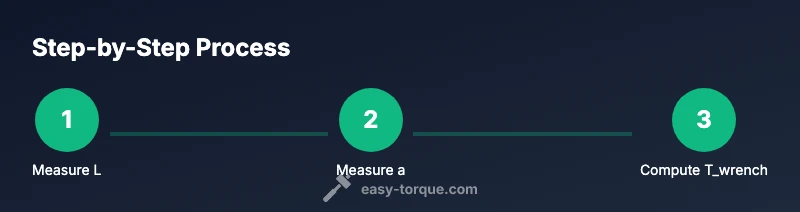
When you work in tight spaces, the crowfoot is often necessary to reach the fastener. Start by measuring L and a, verify the crowfoot orientation is perpendicular, then calculate the adjusted wrench setting. Tighten to the corrected torque, then recheck at the fastener if possible. If space allows, use a torque adapter with an integrated correction feature for even more accuracy and repeatability, reducing human error over repeated cycles.
Safety, care, and maintenance when using crowfoot with torque wrench
Always wear eye protection and gloves when tightening fasteners. Keep the crowfoot clean and free of grease to avoid slippage and to ensure the torque is transferred correctly. Store tools in a dry place to prevent rust that could affect calibration. Periodically check the torque wrench calibration, especially after drops or impacts, and recertify with the manufacturer or a calibration service.
Troubleshooting and common mistakes to avoid
A common mistake is assuming the wrench setting equals torque at the fastener without compensation. Another pitfall is using an angled crowfoot, which distorts the lever arm and introduces error. Ensure the crowfoot is perpendicular to the drive and that the fastener is clean and threads lubricated only if required by specs. If results vary, re-check L and a, or switch to a crowfoot with a built-in correction feature.
Tools & Materials
- Torque wrench(Choose a range suitable for fasteners; ensure calibration is current.)
- Crowfoot wrench adapter(Match the fastener size and ensure perpendicular alignment to drive axis.)
- Ruler or calipers(Measure L (wrench length) and a (crowfoot length) accurately.)
- Length-based correction chart or calculator(Optional tool to compute T_wrench from T_desired.)
- Angle gauge (optional)(Verify crowfoot orientation is perpendicular to the drive.)
- Safety gear(Gloves and eye protection; keep workspace clear.)
Steps
Estimated time: 25-40 minutes
- 1
Measure wrench length (L)
Measure from the center of the torque wrench drive to the handle end where you apply force. Record this length for use in the correction formula.
Tip: Use a caliper for accuracy and double-check zero on the ruler. - 2
Measure crowfoot length (a)
Measure the crowfoot's effective length along the drive axis. If the crowfoot tilts, measure the projection along the axis.
Tip: Ensure the crowfoot is aligned to minimize lateral play. - 3
Compute the corrected wrench setting
Calculate T_wrench using the formula T_wrench = T_desired × L / (L + a). If you don’t have a calculator, use a manufacturer chart designed for your wrench and crowfoot combo.
Tip: Round to the nearest available wrench increment and document the result. - 4
Attach crowfoot perpendicular
Mount the crowfoot so its axis is perpendicular to the drive. Perpendicular alignment minimizes error.
Tip: Lock the crowfoot in place to prevent movement during tightening. - 5
Tighten to the corrected torque
Set the wrench to the corrected torque and tighten until the wrench clicks or indicates target torque at the fastener.
Tip: Pause briefly after the initial torque to ensure the fastener settles. - 6
Recheck and document
If possible, recheck the fastener with a calibrated method and record the L, a, and final torque for future use.
Tip: Keep notes for future maintenance and consistency.
Your Questions Answered
Can I use a crowfoot with any torque wrench?
Most torque wrenches accept standard drives, but you must ensure the crowfoot fits and the orientation is correct. Compatibility also means you can apply the correction formula to achieve the desired torque.
Yes, but ensure drive compatibility and correct orientation, then use the torque correction formula.
Does using a crowfoot affect torque accuracy?
Yes. The crowfoot length changes the effective lever arm, so the wrench setting no longer equals the fastener torque unless compensated.
Yes—the crowfoot changes the lever length, so compensation is needed.
How do I calculate the correct wrench setting?
Use T_wrench = T_desired × L / (L + a). If you don’t have tools to measure, consult a chart from the manufacturer.
Use the simple ratio T_wrench = T_desired times L over (L plus a).
What if the crowfoot is not perpendicular?
Non-perpendicular alignment introduces extra error. Realign to be perpendicular and re-measure the effective length.
Keep the crowfoot perpendicular to minimize error.
Should I recalibrate after using crowfoot?
Yes, periodic calibration preserves accuracy, especially after drops or changes attachments.
Yes—calibrate regularly, especially after changes.
Are there safety concerns I should know?
Follow standard torque safety practices, wear eye protection, and avoid overtightening that can strip threads or break fasteners.
Follow safety practices and avoid overtightening.
Watch Video
Top Takeaways
- Understand crowfoot changes torque due to lever length.
- Use the formula to calculate corrected wrench settings.
- Keep crowfoot perpendicular to avoid angular error.
- Always recheck torque after tightening and calibrate periodically.