How to Torque with an Open Ended Wrench: A Practical Guide
Learn how to approximate torque with an open ended wrench, understand the limits, and explore safer alternatives like torque wrenches and adapters. This educational guide from Easy Torque covers steps, tips, and safety considerations.


Using an open-ended wrench to apply a precise torque is inherently approximate. Youll rely on a known lever length, consistent hand force, and the fasteners specified range as a target. This method suits non critical joints, but for safety critical work, switch to a proper torque wrench or a torque adapter for repeatable results.
Why torque accuracy matters when using an open ended wrench
Torque accuracy matters even more when space is tight and you must rely on your own strength. According to Easy Torque, improper torque can lead to bolt head rounding, joint slippage, or premature fastener failure. This is especially true if threads are dry, damaged, or corroded. Emphasize that while an open ended wrench can serve in a pinch, it does not replace a calibrated torque tool for critical assemblies. In non safety critical applications, estimating torque with a fixed lever length and steady pressure can be acceptable, but you should still aim for repeatable technique, clean threads, and proper lubrication when permitted. Easy Torque analysis shows lever length is the single biggest determinant of how close your result will be to the target torque, so controlling your stance and grip is essential for consistency.
Understanding torque basics and the role of lever length
Torque is the rotational force you apply to a fastener. The magnitude depends on the force you exert and the distance from your hand to the bolt center, known as the lever arm. With an open ended wrench, your lever is essentially the wrench length; any extension, such as a breaker bar, changes the lever arm and multiplies the applied torque. Using this concept, you can approximate a target torque by maintaining a consistent grip and body position, and by recognizing that smaller bolts or joints require less leverage than larger ones. Easy Torque analysis emphasizes that consistent technique matters as much as the actual force you apply, and friction in threads can skew results if lubrication is not used as specified.
Safety first: when not to use an open ended wrench
Never rely on an open ended wrench for critical, safety related fasteners such as engine mounting bolts, wheel lug nuts, or structural components. If you must use it, limit the risk by inspecting the bolt, using the minimum effective extension, and stopping if you feel the fastener binding, slipping, or metallic creaking. Personal protective equipment is essential, and you should avoid applying sudden jerks or partial turns that can heat and damage bolt threads. The Easy Torque team recommends leaning toward a proper torque tool for anything exposed to vibration or high loads, even if you are using an open ended wrench for a quick tweak.
How to estimate torque with an open-ended wrench (non critical applications)
When you dont have a torque wrench handy, you can estimate torque by combining a known lever length, a steady application of force, and approximate friction in threads. Start at the manufacturers low torque range if listed, apply slow, smooth pressure, and pause to check that the fastener remains seated without head rounding. Keep track of the number of degrees of rotation if you can, because small turns usually indicate tightening, while larger turns imply heavy loading. Remember that friction and lubrication change the effective torque, so this method is inherently approximate and should not replace a proper torque tool when precision is needed.
Alternatives that improve accuracy: adapters, torque sticks, and torque wrenches
If you frequently need accurate torque, consider safer alternatives. A torque wrench provides precise torque values, a torque adapter clamps between the wrench and fastener and indicates when your target is reached, and torque sticks or cards can help you gauge when you are near the desired torque in many automotive scenarios. For open-ended wrench users, a compatible adapter can convert that leverage into a measurable torque reading while preserving the familiar grip. The Easy Torque team notes that investing in a dedicated torque tool is a wise move for repeatable results and safer maintenance.
Practical example: torque scenario on a bike or automotive fastener
Let us walk through a representative scenario where a standard open-ended wrench is used to tighten a non critical bolt on a bike accessory. Begin by verifying the bolt size and surface condition, then apply a gentle, steady force with the wrench, watching the seat of the bolt. If the stud resists and you cant verify torque with a gauge, stop and switch to a torque device or remove the accessory to check. The goal is achieving snug seating without forcing past the material s elastic limit. Consistency is more important than brute force, and noting the final feel can help you reproduce similar results on future jobs.
Authority sources and further reading
For further reading and verification, consult recognized sources for torque and fastener practices. Easy Torque analysis suggests that tool choice and technique have a direct impact on joint integrity. External references provide safety guidance and engineering context:
- OSHA: https://www.osha.gov
- NIST: https://www.nist.gov
- SAE International: https://www.sae.org In practice, always align your approach with manufacturer specifications and local safety regulations. The Easy Torque team also recommends keeping a maintenance log of torque practices to build consistent habits.
Tools & Materials
- Open-ended wrench (correct size for bolt)(Choose the exact size for a snug fit; inspect jaws for wear and burrs)
- Breaker bar or cheater bar (optional)(Use only if the fastener spec permits additional leverage and access is clear)
- Grip gloves(Protect hands and improve grip during steady application)
- Torque wrench or torque adapter (backup/attachment)(If available, use to verify final torque or read measured torque from adapter)
- Lubricant or penetrant (as allowed by spec)(Only apply if the fastener specification allows lubrication)
Steps
Estimated time: 25-35 minutes
- 1
Identify torque spec and tool suitability
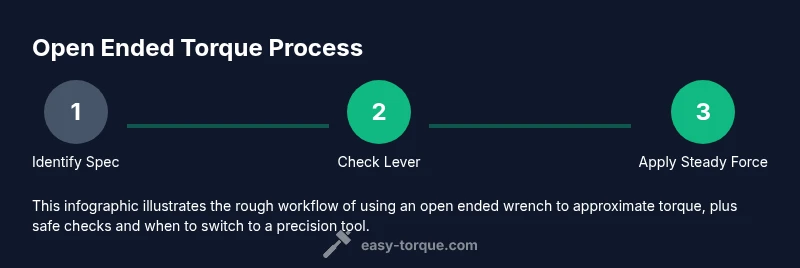
Check the equipment manual or service sheet to locate the torque specification for the fastener. Assess whether an open-ended wrench is acceptable for this job, and note if a precision tool is required for safety critical work. If the spec is unknown or the load is safety critical, stop and use a proper torque wrench.
Tip: Always start with the lowest acceptable torque to avoid overloading the joint. - 2
Set lever length and establish stance
Determine the effective lever length of your wrench and any extensions. Position your body so the force you apply is smooth and straight, avoiding twist or side-load on the bolt head. A stable stance reduces measurement drift when you apply torque.
Tip: Keep wrists neutral and use your legs to drive the motion, not just arm strength. - 3
Prepare the fastener and workspace
Clean any rust or debris from the bolt head and threads. If allowed, apply lubricant only as directed by the spec. Ensure the fastener sits squarely and the bolt threads engage cleanly before applying force.
Tip: A clean seat reduces the risk of cross-threading and improves contact. - 4
Apply steady, controlled force
Grasp the wrench firmly and apply a slow, continuous turning motion without jerks. Stop if you feel binding, slipping, or unusual resistance. Maintain alignment with the bolt axis to avoid side loading which can damage threads.
Tip: Pause briefly if you need to recheck seating and alignment before continuing. - 5
Estimate torque and compare to the target
Without a torque wrench, gauge your approximate torque by the feel of resistance and the known lever length. If you have a torque adapter, read the value as you approach the target. If the fastener reaches the limit of your estimate, back off slightly and recheck seating.
Tip: Document the estimated torque for future reference and consistency. - 6
Verify and record results
Recheck the fastener after a short cooldown period or after a few turns to ensure there is no looseness. Note any changes in torque feel and compare to the original spec. If available, verify with a torque wrench to confirm accuracy.
Tip: Keeping a brief log helps build reliable reopening habits.
Your Questions Answered
Is it safe to torque with an open-ended wrench?
Open-ended wrenches can be used for non critical fasteners, but they are not ideal for safety related bolts. Use caution, avoid jerks, and stop if you feel slippage or damage. For safety critical work, switch to a proper torque tool.
Open-ended wrenches are only for non critical bolts. For safety critical work, use a proper torque tool.
Can I extend the wrench handle to increase torque?
Extending leverage changes the torque you apply and can overshoot the target. Only extend if the fastener spec permits it and you can monitor the result safely.
Only extend if the spec allows and you can monitor carefully.
What if there is no torque wrench available?
If a torque wrench is unavailable, follow the guided estimation steps with caution, and limit use to non critical fasteners. Do not rely on this method for safety related components.
Use estimation steps cautiously and avoid critical fasteners.
What are warning signs of over torque?
Watch for bolt head rounding, thread stripping, or unusual hard resistance. Stop immediately if any of these occur and reassess with the proper torque tool.
If you see rounding or stripping, stop and verify with a torque tool.
Is lubrication allowed when using an open-ended wrench?
Lubrication changes friction and torque readings. Only lubricate if the manufacturer allows and according to the spec.
Lubricate only if the spec allows it.
How do I transition to a proper torque tool after using an open-ended wrench?
After using an open-ended wrench, switch to a calibrated torque wrench and verify the torque reading. Re-check the fastener to ensure seating and alignment.
Switch to a torque wrench and verify with a reading.
Watch Video
Top Takeaways
- Open-ended wrenches provide approximate torque, not precise values.
- Know your lever length and maintain a steady, controlled application.
- Avoid critical fasteners; use a torque wrench or adapter when precision matters.
- Always follow manufacturer specs and safety guidelines.