Difference Between Torque and HP: A Practical Guide
Explore the difference between torque and horsepower, how RPM links them, and what that means for engines and performance. Learn formulas, read specs, and apply practical examples for real-world decisions.


Torque is the turning force produced by a motor, while horsepower measures the rate at which work is done. HP rises with RPM and torque, but the two are not interchangeable. The common conversion is HP = (Torque × RPM) / 5252 for torque in ft-lbs and RPM, or HP = (Torque(Nm) × RPM) / 9550 for torque in newton-meters. Understanding this difference helps interpret engine specs and choose components.
The difference between torque and hp explained
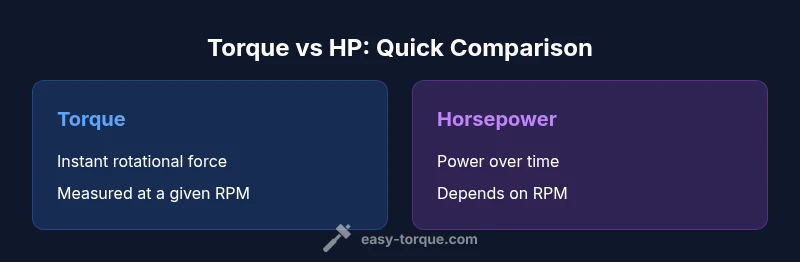
From a practical perspective, the difference between torque and hp is foundational. Torque measures the instantaneous turning force available at the crankshaft, while horsepower measures how quickly that energy can be converted into useful work over time. In simple terms, torque is what you feel as force when you twist a wrench, and horsepower is a measure of speed at which you can do work as you rotate. The two are linked through RPM, gearing, and load, but they quantify different things. According to Easy Torque, many drivers focus on horsepower alone, missing the role of torque during accelerations or towing. Understanding this distinction helps you interpret engine datasheets, choose the right parts, and set expectations for daily driving or off-road use. When you look at a dyno chart or a manufacturer fs spec, you will typically see a torque curve at lower to mid RPM and a horsepower curve that climbs with RPM; both together describe the engine's overall performance envelope. The goal of this article is to clarify the difference between torque and hp so you can design, tune, or select components with confidence.
Comparison
| Feature | Torque | Horsepower |
|---|---|---|
| Definition | Torque: turning force at the crank | Horsepower: rate of doing work per unit time |
| Units | Torque: N·m or ft-lb | Horsepower: HP |
| What it tells you about performance | Torque: strong acceleration at low to mid RPM | Horsepower: sustained speed and top-end performance |
| Core relationships (formulas) | HP = Torque(ft-lb) × RPM / 5252 | HP = Torque(Nm) × RPM / 9550 |
| Best use case | Torque: quick response, towing, off-road readiness | Horsepower: high-speed performance, peak power |
| Measurement basis | Torque: instantaneous at a given RPM | Horsepower: rate across the RPM range |
Pros
- Clarifies how engines achieve different performance profiles
- Guides gearing, tuning, and component choice
- Helps distinguish low-end response from top-end power
- Supports more accurate performance comparisons across engines
Drawbacks
- Can be confusing if RPM context is ignored
- Misinformation may arise if only peak values are considered
- Real-world torque varies with load and temperature, not a constant value
Torque and horsepower are complementary metrics; neither alone defines overall performance.
Use torque to assess low-end response and towing ability, and horsepower to gauge top-end performance. By considering both values together with the engine's torque curve, you can match components, gearing, and tuning to your goals.
Your Questions Answered
What is the difference between torque and horsepower?
Torque is the instantaneous turning force at the crank, while horsepower is the rate at which work is done over time. They are linked by RPM but quantify different aspects of performance.
Torque is the immediate force you feel, horsepower is how fast that force translates into work over time.
How do you convert torque to horsepower?
Use HP = Torque(ft-lb) × RPM / 5252 or HP = Torque(Nm) × RPM / 9550. Rearranged, Torque(ft-lb) = HP × 5252 / RPM. These formulas assume the torque value is measured at the same RPM.
HP equals torque times RPM divided by a constant, depending on the unit you use.
Why do engines have different torque and horsepower curves?
Torque and horsepower curves reflect engine design, gearing, and fuel/tuel delivery. Torque dominates at lower RPMs, giving quick response, while horsepower typically rises with RPM, signaling higher sustained power at higher speeds.
Engines produce torque at all RPMs, but horsepower grows as RPM increases, so curves differ.
Is horsepower more important than torque?
Neither is inherently more important; it depends on the application. For towing or quick acceleration, torque is critical; for top speed, horsepower matters more.
It depends on what you want the vehicle to do best.
What does peak torque mean for everyday driving?
Peak torque indicates the maximum turning force available at a certain RPM. In daily driving, broad torque across a usable RPM range is often more practical than a high peak torque at a very narrow band.
Peak torque tells you where the engine feels strongest, but real-world driveability depends on the entire torque curve.
Can you have high torque and high horsepower at the same RPM?
Yes, if the engine delivers both substantial torque and operates at RPMs where horsepower is produced efficiently. Real-world results depend on the engine design and gearing.
It can happen, but it depends on RPM and how torque holds up across the range.
Top Takeaways
- Torque reflects instantaneous rotational force
- Horsepower measures rate of work over time
- RPM links torque and horsepower via specific formulas
- Read specs with the torque curve in mind
- Choose components based on whether you need torque-rich or high-top performance