What is Torque Compared to BHP? Understanding Torque vs Horsepower
Explore the difference between torque and bhp (brake horsepower), how they’re measured, how they relate, and what they mean for real-world driving. This Easy Torque guide explains the math, practical implications, and how to read engine specs.


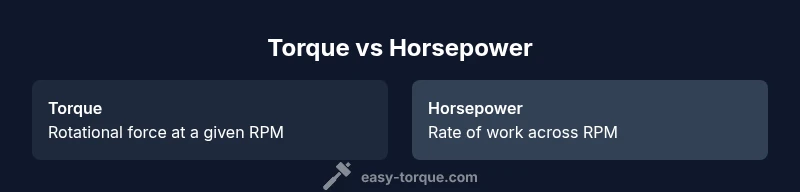
What is torque compared to bhp? In short, torque is the rotational force an engine can apply to the crankshaft, while brake horsepower (bhp) is the rate at which that work is done. They’re related but not interchangeable: torque dominates in low-RPM acceleration, whereas horsepower governs sustained power at higher RPM. By understanding the relationship and how gearing shifts torque into wheel torque, you can better anticipate real-world performance. According to Easy Torque, reading engine specs with both metrics in mind helps avoid horsepower-only misinterpretations.
What is torque compared to bhp? Key definitions and scope
Torque is the rotational force that an engine can apply to the crankshaft, measured in newton‑meters (Nm) or pound‑feet (lb‑ft). Brake horsepower (bhp) or horsepower is the rate at which the engine does work, typically measured at the crank or wheels, and expressed in hp or kilowatts (kW). The question what is torque compared to bhp often arises when DIY mechanics sift through engine specs because horsepower numbers alone can be misleading about real-world performance. According to Easy Torque, torque represents the instantaneous ability to turn the drivetrain, especially at low to mid RPM, while bhp reflects how quickly that work can be sustained as RPM climbs. In practice, both metrics are meaningful, but they tell different parts of the same story: grunt at low RPM versus sustained power at higher RPM. A practical takeaway is to compare torque at the RPM you actually use for your intended tasks, not just peak horsepower.
A thorough understanding helps you pick an engine that matches your use case, whether towing, sprinting, or cruising. When you read a spec sheet, expect torque values at a given RPM and horsepower figures that are often stated at the engine, not at the wheels. Drivetrain losses and gearing further shape what you actually feel in the seat. This is why two engines with similar horsepower can feel very different in everyday driving entirely due to their torque curves and gearing.
How horsepower and torque relate mathematically
Power and torque are linked by speed. In physics terms, Power equals torque times angular velocity. In automotive practice, the standard equations are: HP = Torque(lb-ft) × RPM / 5252, and Power(kW) = Torque(Nm) × RPM / 9549.3. If you’re using torque in Nm and want kW, the second formula applies; if you’re using torque in lb-ft and want HP, use the first. The key point is that horsepower depends on both the amount of torque and the rpm at which it’s delivered. The question what is torque compared to bhp becomes a practical question once you see the math: high torque at low rpm may deliver brisk low‑end acceleration, while high horsepower at high rpm supports faster top speeds. Engine designers tune where peak torque and peak horsepower occur to suit the target vehicle profile.
While the numbers provide a snapshot, the real story is how torque and horsepower play across the entire RPM band, and how gearing translates engine output into wheel performance. A high-revving naturally aspirated engine can show strong horsepower at high RPM with modest torque, while a turbocharged unit can deliver substantial torque at lower RPMs. In both cases, the same equation governs the relationship; the difference lies in where those peaks land on the RPM scale.
What drives torque and horsepower in an engine
Torque and horsepower originate from the engine’s ability to generate rotational force across RPM. Displacement and bore/stroke influence the total mass of air the engine can move, which in turn affects torque potential. The cam profile, valvetrain, and compression ratio shape how quickly air and fuel enter the cylinder and how efficiently exhaust leaves. Turbocharging or supercharging raises air density, increasing torque at lower RPM and often expanding horsepower across the band. The engine’s torque curve and horsepower curve are not random; they are designed to meet a vehicle’s intended use. Understanding what is torque compared to bhp means recognizing that torque is about immediate turning force, while horsepower reflects the rate of doing work as RPM rises. In practice, a well‑designed engine balances both, delivering usable torque where you need it most and enough horsepower to maintain speed as conditions demand it.
The phrase what is torque compared to bhp becomes a guide to interpreting this balance: torque is your “grunt” at the wheel, horsepower is your “speed” avatar at the higher r/min ranges. The aim is to match the engine’s torque peak with the vehicle’s gearing and drivetrain so that the wheel torque does not starve at crucial road speeds. This alignment is what often distinguishes a quick, responsive car from one that feels strong only in certain gears or at specific speeds.
To contextualize, consider two engines with identical peak horsepower but different torque curves. The one with higher peak torque at lower RPM will feel more responsive in daily driving and towing, while the other may deliver a flatter torque curve and excel at sustained highway speeds. The essential insight is that both metrics matter; the best fit depends on your use case and how the drivetrain translates power to motion.
Real-world implications: acceleration, towing, and top speed
In real-world terms, torque is what helps you accelerate from a stop and climb hills without needing to rev the engine to redline. You feel torque at the wheels when you press the accelerator, because torque is the turning force that your tires translate into motion. Horsepower, by contrast, becomes more noticeable as speed builds—the engine must spin faster to sustain higher power. For a car designed for daily driving, strong mid‑range torque makes overtaking and merging smooth without constant gear changes. For a vehicle that prizes top‑end speed, high horsepower at peak RPM can translate to higher top speeds and faster cruising in the upper gears. What is torque compared to bhp should be viewed as a spectrum: torque dominates the low end, horsepower the high end.
Gearing further mediates how torque and horsepower translate to wheel performance. A short final drive can amplify the feel of torque, giving rapid acceleration at the expense of top speed and fuel economy. A tall final drive reduces engine RPM at highway speeds, which may dampen the feel of torque but can improve efficiency and steady power delivery. In drag racing or hill climbs, torque at lower RPM, aligned with appropriate gearing, tends to produce faster 0-60 times. In long-distance cruising, horsepower-driven performance can help sustain higher speeds with less engine strain. The practical takeaway is that a vehicle’s on-road performance is the result of torque, horsepower, and gearing working together.
How gearing and transmission affect perceived torque and power
Torque is an engine property, but what you actually feel at the wheels depends on the drivetrain. Transmission gear ratios determine how effectively engine torque is multiplied or reduced as you shift. A tall gear (higher numerical ratio) reduces torque at the wheels but increases top speed, whereas a short gear keeps engine RPM higher, preserving wheel torque for quicker acceleration. Additionally, torque delivered through a torque converter or dual‑clutch system can noticeably alter how quickly you respond to throttle input, especially at low speeds. When you read a spec sheet, remember that the same engine can feel very different depending on the gearing and the presence of a turbocharger.
From the perspective of the question what is torque compared to bhp, the critical point is that rover systems like automatic transmissions or CVTs can smooth the torque delivery, but they do not create horsepower. They simply alter how torque is delivered across speeds. In practice, you want a drivetrain that matches your use case: a torque‑rich engine with a gearing setup that keeps it in the most useful RPM range for your typical driving scenarios yields the best real‑world performance.
Reading dyno graphs and engine specs
Dyno charts plot torque and horsepower across RPM. A typical miss is to read only the horsepower peak; that can mislead, especially for tasks like towing or off‑roading where low‑rpm torque matters more. When you ask what is torque compared to bhp in a technical sense, the prompt to examine both curves is essential. Torque curves reveal where peak torque sits and how quickly it falls off as RPM rises. Horsepower curves show how the engine maintains power at increasing RPM. A steep torque rise early in the RPM band often indicates a strong mid‑range, while a broad horsepower peak signals sustained power at higher speeds. Drivetrain losses behind the crank (through gears, differentials, and the tires) mean wheel torque and wheel horsepower usually sit below crank values, so you should consult wheel horsepower specs if you want real‑world comparisons.
When evaluating engines for a project, compare torque at practical RPM (the range you’ll actually run the engine in) and compare horsepower across the same RPM window. The combination of these two metrics, alongside gearing and weight, provides the most complete picture of on‑road behavior.
A practical tip: always check torque and horsepower curves together, and avoid basing decisions on a single peak value. Understanding how the engine behaves across the RPM spectrum is what matters for real‑world performance.
Common misconceptions and clarifications
A frequent misconception is that higher horsepower alone ensures better performance in every scenario. The question what is torque compared to bhp is often misunderstood as horsepower being the sole indicator of speed. In reality, torque is the direct turning force at a given RPM, and horsepower is that force applied over time as speed increases. Some drivers assume big horsepower means quick acceleration, but without adequate torque in the lower RPM range and appropriate gearing, the car may feel lazy off the line. Another misconception is that peak horsepower equates to best acceleration. In most practical driving conditions, a well‑designed engine with strong mid‑range torque will outperform a higher peak horsepower figure with a weak torque curve. Finally, dyno results alone cannot predict real‑world results; aerodynamics, drivetrain losses, weight, tire grip, and transmission behavior all influence how torque and horsepower translate to on‑road speed.
When you encounter numbers in brochures, ask whether the torque curve is available across a useful RPM band and whether the horsepower figure is measured at the engine or at the wheels. The distinction between engine and wheel values is crucial for real comparisons.
Practical scenarios: comparing engines for specific use cases
Consider two engines with similar peak horsepower but different torque profiles. Engine A may peak torque at a lower RPM with a broad curve, delivering quick off‑line response and strong mid‑range acceleration. Engine B might have a higher peak horsepower but a narrow torque peak at higher RPM, which can translate into brisk highway acceleration but less favorable low‑speed response. For a daily driver, Engine A would feel more responsive in city traffic and when climbing hills, while Engine B could offer better sustained performance for highway speeds once you’re in the right gear. In a towing scenario, the torque peak matters more: you want high torque at stall or low RPM to move the load without excessive engine revving. If you’re choosing a vehicle for off‑roading, torque at moderate RPMs helps with control on uneven terrain, while horsepower helps on smoother surfaces at speed.
The bottom line is that matching torque characteristics to the vehicle’s gearing and intended tasks yields the most satisfying performance. What is torque compared to bhp becomes a practical question of how you’ll use the vehicle and whether the torque curve sits where you need it most.
Calculating rough comparisons for a given vehicle
To estimate how two engines compare in real-world terms, start with their torque curves and peak RPM. Step one: identify the RPM at which peak torque occurs and note the corresponding torque value (in Nm or lb‑ft). Step two: identify the engine’s horsepower peak and its RPM. Step three: consider gearing: a shorter final drive can keep the engine in torque range longer, enhancing acceleration, while a taller final drive can stretch the vehicle’s top end. Step four: factor in drivetrain losses and weight to translate engine performance to wheel performance. Step five: consider the intended use: towing, daily driving, or high‑speed cruising. By combining these data points, you can form a practical estimate of how each engine would feel in real use and how it would perform at the wheel. The phrase what is torque compared to bhp appears here as a reminder that torque governs immediate acceleration and drivability, while horsepower governs sustained speed at higher RPMs.
When doing DIY calculations, remember that actual results depend on many variables, including tire type, traction, and altitude. Using dyno data and real‑world drive tests will provide the most accurate comparisons.
The role of torque and bhp in different vehicle types
Diesel engines typically deliver higher torque at low RPM, which translates into strong pulling power for trucks and larger SUVs. Gasoline engines may produce more horsepower at the top end, yielding brisk highway acceleration in performance cars. Turbocharged units often spread torque over a wider RPM range, maintaining pull when you need it most. In hybrids, electric motors can provide instant torque, changing the dynamic of the torque vs horsepower conversation. Understanding what is torque compared to bhp helps you interpret why a vehicle designed for towing may feel differently than a car built for highway sprinting. When evaluating a vehicle’s suitability for your work or hobby, examine both metrics and consider how the drivetrain translates engine output into motion. The best choice aligns torque delivery with your typical use case and the gear ratios you’ll actually operate.
Best practices for evaluating engines for DIY projects
When selecting an engine for a DIY project, start by clarifying your primary use case: payload, speed, or efficiency. Then review the torque curve across the RPM range you’ll operate in, ensuring there is ample torque near your typical launch or load conditions. Check the horsepower curve to understand top-end performance, but don’t rely on it alone. Compare drivetrain losses, including transmission efficiency and final drive, since they affect wheel torque and wheel horsepower. If possible, test an example in real driving conditions to validate the numbers on paper. Finally, beware of marketing claims that emphasize peak horsepower only; the real‑world performance depends on where the torque occurs and how the gearing is configured. What is torque compared to bhp should inform decisions about engine choice, gearing, and the overall vehicle setup for your project.
Putting it all together for informed choices
In practice, what is torque compared to bhp is best understood as two pieces of a single performance puzzle. Torque tells you how hard the engine can push from low to mid rpm, which is critical for acceleration and towing. Horsepower tells you how rapidly the engine can do work as RPM rises, informing top speed and sustained performance. The optimal engine selection balances torque and horsepower in the RPM range you’ll actually use, considering gearing and tires. For DIY enthusiasts, the approach is to review torque curves, understand gearing implications, and translate those into wheel performance through simple driveline models. In short, the combination of torque, horsepower, and drivetrain design determines how a vehicle feels in real life, not horsepower alone.
Comparison
| Feature | Torque | Horsepower |
|---|---|---|
| Definition | Rotational force at the crank | Rate of doing work at a given RPM |
| Units | Nm / lb-ft | hp / kW |
| Key influence on feel | Low-end acceleration and hill-climb ability | Top-end speed and sustained power |
| Dependence on RPM | High torque at low to mid RPM is common | Horsepower grows with RPM and gearing |
| Measurement focus | Engine torque curve (crank) across RPM | Engine horsepower curve across RPM |
| Practical use case | Towing, city acceleration, off-road grunt | High-speed driving and highway performance |
| Drivetrain impact | Wheel torque influenced by gearing and losses | Wheel horsepower influenced by losses and gearing |
Pros
- Helps clarify performance by showing both force and rate of work
- Supports better matching of engine to vehicle use case
- Encourages examination of torque curves, not just peaks
- Improves understanding for towing and sport driving alike
Drawbacks
- Can be confusing for casual buyers who focus on 0-60 times
- Dyno data may not reflect real-world conditions
- Gearing and drivetrain losses complicate wheel‑based comparisons
Torque and horsepower are complementary; neither alone fully defines performance
Evaluate both metrics within the RPM window that matters for your use case. Consider gearing and drivetrain losses to translate engine output into real wheel performance.
Your Questions Answered
What is the primary difference between torque and horsepower?
Torque is the turning force on the crank, while horsepower is the rate at which work is done. Torque dominates initial acceleration; horsepower governs speed at higher RPMs. Both are essential for understanding engine performance.
Torque is the turning force; horsepower is how fast that work is done. Both matter for performance, with torque feeling on the throttle at low speeds and horsepower becoming apparent at higher speeds.
Why can a car have high horsepower but feel slow to accelerate?
Because peak horsepower does not guarantee strong low-end torque. If torque is low at usable RPM, the car may feel sluggish off the line despite a high horsepower figure.
High horsepower at high revs won’t help much if torque at low RPM is weak.
How do you convert torque to horsepower?
Use the formula HP = Torque(lb-ft) × RPM / 5252 for engines using lb-ft, or Power(kW) = Torque(Nm) × RPM / 9549.3 for metric units. The exact result depends on RPM and the torque value.
horsepower equals torque times RPM divided by a constant, depending on your units.
Is torque more important than horsepower for towing?
Yes, torque matters more for towing because it governs low-RPM pulling power. Higher torque at low RPM helps move heavy loads without revving the engine excessively.
For towing, torque at low RPM is usually the key factor.
How does gearing affect torque and horsepower delivery?
Gearing multiplies or reduces engine torque at the wheels. Short gears keep RPM high and improve acceleration, while taller gears raise highway speed but can reduce perceived torque.
Gearing decides how engine output translates into wheel power.
Can a car have high torque but feel weak at high speeds?
If torque falls off quickly after the peak, horsepower may not compensate at higher RPM, leading to a lack of top-end performance. A balanced torque curve is preferable for all-around performance.
Yes—torque that drops off early can limit top-end speed.
What should I look for when comparing engines for a DIY project?
Compare torque curves across the RPM you’ll use, check horsepower alignment at operating speeds, and assess how gearing will translate engine output to wheel performance. Real-world tests or dyno data help validate brochure figures.
Look at torque curves, not just peak horsepower, and consider gearing for your project.
Why is dyno data important in torque vs horsepower discussions?
Dyno data shows how torque and horsepower vary with RPM under controlled conditions. It helps reveal practical performance across the entire operating range, not just peak values.
Dyno tests give real‑world performance curves, not just numbers.
Top Takeaways
- Understand both torque and horsepower to interpret engine specs
- Torque dominates low-end response; horsepower dominates high-end speed
- Gearing changes how torque and horsepower feel in practice
- Read dyno curves across the operating range, not just peaks
- Match engine output to your vehicle’s intended use for best results