Torque vs Horsepower: Understanding the Difference
Learn the difference between torque and horsepower, how they relate, and what each metric means for real-world acceleration, drivability, and top speed.


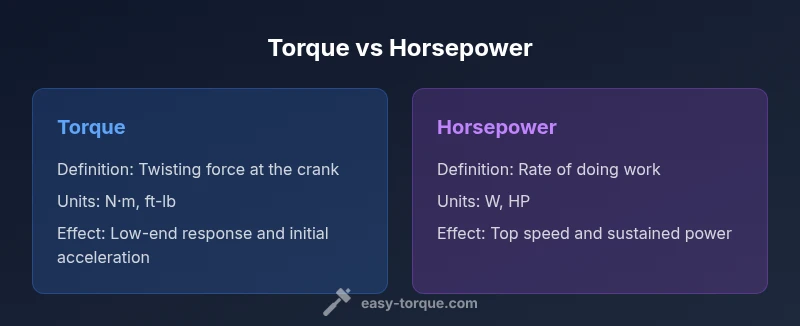
Torque is the twisting force the engine can apply; horsepower is the rate at which that force does work. In practical terms, torque drives low-end acceleration and drivability, while horsepower governs top speed and sustained power. They are linked by the equation horsepower = (torque × RPM)/5252, so both metrics shape overall performance.
What torque and horsepower measure
Torque and horsepower are two fundamental ways to quantify engine performance, but they describe different physical ideas. Torque is the instantaneous rotational force the engine can apply at the crankshaft. Horsepower is the rate at which the engine can perform work over time. Understanding this distinction is essential for interpreting specs, selecting components, and predicting how a vehicle will feel on the road. According to Easy Torque, the best way to grasp the difference is to think about torque as grip and horsepower as speed. In practical terms, you experience torque as quick initial acceleration and throttle response, while horsepower becomes more important as you push into higher RPM where engine speeds translate into sustained power. For DIYers, this distinction matters when evaluating torque curves, gearing, and overall drivability.
Conceptual difference: what each metric tells you
Torque is a property of the engine’s crank – the twisting force you feel when you accelerate and the engine responds. Horsepower is a derived metric that measures how quickly the engine can do work, combining torque with rotational speed. A single engine can produce strong torque at low RPMs and build horsepower as RPM rises, while another design may show a different balance. The key idea is not that one metric is better, but that they describe performance across different operating ranges. Easy Torque emphasizes that a vehicle’s everyday performance depends on where torque occurs on the RPM scale and how gearing translates shaft torque into wheel torque. Mapping both numbers across RPM helps predict throttle feel, acceleration ramp, and the engine’s usable power band.
The relationship: a simple equation and its meaning
The most recognizable relationship is the horsepower equation: HP = (Torque ft-lb × RPM) / 5252. This compact formula links torque, engine speed, and power. When you hold torque constant, increasing RPM raises horsepower, illustrating why engines with broad torque curves can feel both strong off the line and capable of high speeds. In SI units, power is also related to torque via P(W) = T(N·m) × ω(rad/s), where ω = RPM × 2π/60. The exact numbers depend on units, but the qualitative idea remains: higher torque at higher RPM generally yields more horsepower. For DIY enthusiasts, keeping track of torque delivery over the RPM range is more informative than a single peak value.
Torque’s role in acceleration and drivability
Torque dominates initial response and low-end acceleration. When a vehicle can deliver ample torque at modest engine speeds, it can surge from a stop with minimal throttle and cleanly accelerate through gears without long lags. This is especially true for trucks, SUVs, and diesel engines, where usable torque at low RPMs improves pulling power and ease of movement. However, excessive torque without adequate gearing can lead to wheel spin or harsh delivery. The goal is to align torque availability with the vehicle’s gearing so that the wheels can consistently translate engine force into forward motion. Easy Torque notes that the driver’s perceived performance often hinges on torque reach within the usable RPM window.
Horsepower’s role in top speed and sustained power
Horsepower governs how quickly an engine can sustain work as RPM increases. Vehicles with high horsepower can maintain higher speeds and accelerate through higher gears, especially on open roads or tracks. In practice, horsepower matters when the engine reaches higher RPM ranges where power output persists through multiple gears. A car with strong horsepower but a very narrow torque band may feel exciting at high speeds but sluggish from a stop. The balance between torque and horsepower, shaped by gearing, cam profile, and intake flow, determines the real-world top speed and the ability to sustain acceleration. For performance-minded DIYers, understanding horsepower helps in evaluating speeds, gearing choices, and how an engine responds when it’s under load.
Reading torque and horsepower data: what to look for on specs and dynos
Engine catalogs and dyno charts present torque curves and horsepower curves across RPM. Look for where the torque peak occurs and how quickly torque falls as RPM rises. A broad, flat torque curve often translates to strong mid-range performance, while a wide horsepower peak suggests capability at higher speeds. When comparing engines, don’t rely on peak horsepower alone; examine how both curves interact across the intended RPM range and the effect of gearing. The Easy Torque framework encourages cross-referencing both values with practical driving scenarios—ticking boxes for towing, daily commuting, or track use.
Real-world examples: diesel vs gasoline vs high-rev engines
Diesel engines typically deliver high torque at low RPM, which helps towing and heavy-load tasks, while gasoline engines may offer more horsepower at higher RPMs for rapid acceleration and higher top speeds. A high-rev naturally aspirated or turbocharged gasoline engine can feel electric at the apex of its RPM range due to horsepower dominance there. The choice between engines often comes down to the intended use: towing and off-road work favor torque-rich designs; sport and performance driving favor horsepower-rich, high-RPM powerbands. In all cases, it’s the alignment of torque delivery with gearing that determines the driving experience.
Common misconceptions and clarifications
Many buyers assume horsepower alone dictates speed, or that more torque automatically means faster acceleration everywhere. In reality, both metrics matter, but their impact hinges on RPM, gearing, weight, and intended use. A heavy vehicle with modest horsepower may still accelerate briskly if torque is ample at a usable RPM and gearing is tuned to deliver power when needed. Conversely, a lightweight car with large horsepower may feel lively at speed but struggle off the line if torque is lacking at low RPM. Easy Torque stresses that the key is to read the whole powertrain story: torque curve, horsepower curve, and how the transmission and differential translate shaft torque into wheel torque.
Practical tips for DIYers: reading, calculating, and applying
Start by noting the engine’s torque curve and where horsepower peaks occur. If you tow or haul, prioritize torque at lower RPM and a favorable gearing ratio. If you crave speed and agility on twisty roads or track, seek horsepower that remains meaningful across a broad RPM window. When evaluating engines, ask for dyno data showing both torque and horsepower across RPM, not just peak values. To estimate power changes from torque alone, consider how RPM shifts affect the product and how gearing alters wheel torque. Remember that real-world factors such as transmission losses, drivetrain efficiency, and vehicle weight influence final performance. For DIYers, a practical approach is to model driving scenarios and map expected outcomes to the engine’s torque and horsepower profiles.
Quick-start checklist for evaluating torque vs horsepower in a build
- Define your primary use-case (towing, daily driving, or performance).
- Inspect torque curves across the usable RPM range.
- Cross-check horsepower at the rpm range you plan to operate.
- Examine gearing and transmission setup to ensure wheel torque aligns with road demands.
- Review dyno data for both torque and horsepower across RPM.
Comparison
| Feature | Torque | Horsepower |
|---|---|---|
| Definition | Twisting force at the crankshaft | Rate of doing work over time |
| Units | N·m / ft·lb | W / HP |
| Measurement focus | Torque at engine shaft and its immediate effect | Power output across RPM and over time |
| Impact on performance | Drives initial acceleration and mid-range momentum | Informs top speed and sustained acceleration at high RPM |
| Best-use scenario | Towing, low-end responsiveness, off-road torque | High-speed, quick acceleration at higher RPM, sport driving |
Pros
- Clarifies performance metrics for both low- and high-RPM driving
- Helps tailor gear selection and driveline setup
- Improves communication with technicians using standard terms
- Supports better expectations for towing and sport applications
- Encourages using dyno data to validate claims
Drawbacks
- No single metric guarantees real-world performance due to drivetrain losses
- Gear ratios and weight can skew perceived benefits
- Specs can be misinterpreted without considering the full torque curve
- Relying on peak values alone is misleading for most driving scenarios
Torque and horsepower complement each other; the best choice depends on your use-case.
Focus on torque curves for low-end drivability and on horsepower across the RPM range for high-speed performance. In real-world applications, a well-matched powertrain delivers balanced torque delivery and meaningful horsepower. The Easy Torque team emphasizes evaluating both metrics together rather than chasing a single peak.
Your Questions Answered
What is the difference between torque and horsepower?
Torque is the twisting force at the crank that causes rotation. Horsepower is the rate at which the engine can do work across time. Together, they describe how an engine delivers both strength and speed.
Torque is the twisting push the engine applies; horsepower is how fast that push can do work over time.
Why do you need both torque and horsepower when evaluating an engine?
Because they describe performance in different RPM ranges. Torque governs low-end response and usable acceleration, while horsepower matters more as RPM increases and speeds rise. The combination determines overall drivability and top speed.
Both matter, one for start-and-tow, the other for speed—together they give the full picture.
How do I calculate horsepower from torque?
Use the common formula HP = (torque ft-lb × RPM) / 5252 for imperial units, or a SI-based equivalent using torque in Newton-meters and RPM. These equations show how torque and RPM combine to produce power.
Horsepower comes from torque multiplied by how fast the engine is turning.
Is more torque always better?
Not necessarily. Higher torque is beneficial for off-the-line acceleration and towing, but without appropriate gearing and weight considerations, it can lead to wheel spin or inefficiency.
More torque helps in some situations, but balance with gearing and weight matters.
What is a torque curve?
A torque curve shows how torque changes with engine RPM. A broad, flat curve means strong performance across a wide range; a peaky curve may give great low-end power but fall off quickly at higher RPM.
Think of it as how strong the engine is at every RPM.
How does gearing affect perceived torque?
Gearing multiplies or reduces shaft torque to wheel torque. A tall gear can delay torque to the wheels, while a short gear can sharpen initial response even with modest engine torque.
Gearing can change how torque feels when you accelerate.
Top Takeaways
- Understand: torque is twisting force, horsepower is rate of work.
- Evaluate both curves across the intended RPM range.
- Prioritize torque for towing and daily drivability; horsepower for speed and sustained power.
- Always review gearing and drivetrain losses when interpreting specs.
- Use dyno data to validate engine performance in real-world conditions.