HP vs Torque: Understanding the Difference in Engine Power
A thorough, analytical guide explaining horsepower and torque, what each measures, how they influence acceleration and top speed, and how to read engine specs for real-world performance. Learn how to interpret HP and torque with practical examples from Easy Torque.


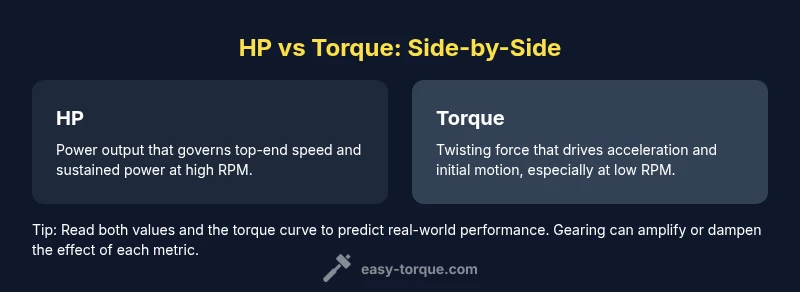
HP (horsepower) measures sustained power over time, while torque is the immediate twisting force that starts motion. What is the difference between hp and torque? In practice, horsepower describes top-end performance, and torque governs off-the-line response and towing capability. Understanding both helps predict real-world behavior better than looking at a single metric.
What the two metrics actually measure
What is the difference between hp and torque? In plain terms, horsepower describes the engine's ability to do work over time, while torque describes the instantaneous twisting force that begins the motion. According to Easy Torque, these two measures are complementary: one describes speed and endurance, the other describes initial pull. In everyday terms, horsepower comes into play at higher RPMs and speeds, while torque is what you feel when you press the accelerator from a stop. Recognizing this distinction helps you compare engines more accurately rather than chasing a single number.
Units and what they imply
Horsepower is the common unit for power; torque is expressed in lb-ft (pound-feet) in the United States or newton-meters (N·m) in metric regions. One horsepower equals 745.7 watts. Torque represents the twisting force that moves the crankshaft; it translates into usable pulling power at the wheels when multiplied by gearing and RPM. The key takeaway: HP tells you how fast the engine can do work; torque tells you how hard it can push at any given moment (this distinction matters when evaluating real-world performance).
The torque curve and the power band
An engine does not produce a single constant level of power. The torque curve shows peak torque at a specific RPM, while horsepower climbs with RPM as torque acts over a changing speed. The interaction between the two shapes your car's feel: a broad torque peak delivers strong mid-range response, while high peak horsepower favors sustained pace at higher speeds. By examining both curves, you can predict acceleration, passing power, and top speed more reliably. Understanding what is the difference between hp and torque helps connect torque curves to horsepower across the RPM range.
Real-world implications: sports cars vs trucks
High-performance sports cars typically maximize horsepower for top speed, but they still rely on torque to deliver quick launches. Trucks and towing-focused vehicles prioritize high torque at low to mid RPM to move heavy loads from a standstill and climb grades. In practice, the best vehicle for a given goal balances both metrics, but the emphasis shifts with use-case: speed-oriented driving leans on HP; heavy-duty work leans on torque.
Reading a spec sheet: formulas and interpretation
A handy way to relate the two metrics is through the formula HP = (Torque x RPM) / 5252, when torque is in lb-ft and horsepower is measured at the engine. For metric units, HP ≈ (Torque (Nm) x RPM) / 9549.3. These formulas show how engine speed (RPM) and torque interact to produce power. When evaluating a car, look for the RPM range where torque peaks and the RPM range where horsepower peaks to understand real-world performance. This is also where the distinction of what is the difference between hp and torque becomes practical.
Gearing, drivetrain, and their effect on HP and torque
Gearing can dramatically change how horsepower and torque influence what you feel in the cockpit. A tall final drive or a high gear offers a smoother ride and higher top speed but can reduce off-the-line torque sensation. Conversely, short gears and a low final drive multiply torque at the wheels, improving launch and hill-climbing ability. The drivetrain (front-wheel, rear-wheel, or all-wheel drive) also affects how much of the engine's torque you actually feel at the tires.
Common misconceptions debunked
A common myth is that horsepower alone decides everything about performance. In reality, torque and horsepower interact across RPM. Another misconception is that a higher HP number guarantees faster acceleration; in many cases, a lower-torque engine with optimized gearing can accelerate more quickly off the line. Finally, numbers on a spec sheet can be misleading if the measurement point (crank vs wheel) and testing conditions aren’t clearly stated.
How to measure HP and torque in practice
Measuring engine horsepower and torque requires specific instrumentation and testing protocols, usually performed at the crankshaft. Wheel horsepower accounts for drivetrain losses and can be substantially lower than crank values. Modern dynos can plot torque curves across RPM, providing a practical view of how an engine will feel in real driving. When comparing vehicles, prefer the same measurement type (crank vs wheel) and RPM range for a fair assessment.
Practical decision guides by use case
If your priority is quick off-the-line acceleration, emphasize higher torque at low RPM and a favorable gearing setup. For highway cruising, top-end speed, and sustained performance, higher horsepower at a usable RPM range matters more. For towing, prioritize torque and gear ratios that keep torque in the optimal RPM window. In any case, plan to drive the vehicle to assess how the HP/torque balance translates to real-world feel.
Visualizing performance with a torque curve
Torque curves plotted against RPM reveal where an engine shines. A broad, flat torque curve means steady pulling power across a wide RPM range, ideal for everyday driving. A sharp torque peak may deliver explosive initial acceleration but can taper quickly if it lacks sustained power, unless the gearing is matched to keep the engine in its peak region. Pair torque curves with horsepower curves for a complete picture.
Marketing claims: spotting hype and limitations
Automakers sometimes emphasize a high horsepower figure to attract buyers, which can distort expectations if torque is weak at usable RPM. Look for the full torque curve, RPM range of peak values, and, if possible, wheel horsepower. Avoid over-reliance on peak horsepower numbers alone; a well-rounded evaluation considers drivability, gearing, weight, and intended use.
Choosing the right engine for your needs
The best engine choice aligns with your typical driving scenarios. If you tow frequently or drive in hilly terrain, prioritize torque and gearing that deliver strong mid-range power. If you value speed and high-speed performance, select a configuration that balances horsepower with a torque curve that maintains pull at higher RPMs. Test-driving multiple options is essential to capture the feel behind the numbers.
Comparison
| Feature | Horsepower (HP) | Torque (lb-ft) |
|---|---|---|
| Definition | Power output per unit time | Twisting force turning the crankshaft |
| Primary role | Predicts top-end speed and sustained performance | Predicts initial acceleration and pulling power |
| Typical units | HP (horsepower) | lb-ft / Nm |
| Measurement context | Engine crank/flywheel (spec sheets) or wheel (dynos) | Engine crank or wheel instrumentation |
| Relation to RPM | Increases with RPM as power builds | Peaks at a specific RPM depending on the torque curve |
| Impact on gearing | Encourages higher gears at speed | Increases low-end response and torque at wheels |
| Best for decision-making | Top-end performance and speed | Low-end response and towing ability |
| Common pitfalls | High HP without substantial torque can feel weak off the line | High torque with low HP may underperform at high speeds |
Pros
- Helps compare engines across RPM ranges
- Shows how a vehicle performs under load
- Supports tuning and drivetrain design
- Encourages balanced performance thinking
- Widely understood by enthusiasts
Drawbacks
- HP alone can mislead about low-end drive
- Torque values vary with RPM and testing method
- Not a direct measure of real-world efficiency
HP and torque are complementary measures; neither alone fully predicts real-world performance
Torque governs initial movement and low-end pulling power, while horsepower governs sustained speed at higher RPM. In most cases, the optimal setup balances both metrics to match driving goals.
Your Questions Answered
What is horsepower and torque, and how do they differ?
Horsepower and torque measure different aspects of engine output. HP describes power over time, while torque is the twisting force at the crankshaft. Understanding both provides a fuller picture of performance.
Horsepower shows speed capability; torque shows how quickly an engine can start moving.
Why is torque important for off-road or towing?
Torque provides the initial pull and hill-climbing ability, which matters when pulling heavy loads or climbing grades. With higher torque at low RPM, you get better starting power.
Torque helps you get moving and pull heavy loads.
Can you have high horsepower but low torque?
Yes, some high-revving engines produce high HP at high RPMs while offering relatively lower low-end torque. You may get strong top speed but dull acceleration off the line.
Yes, high HP with low torque can feel slow off the line.
How should I read horsepower and torque on a spec sheet?
Look at crank horsepower and torque curves across RPM. Note the RPM where torque peaks and where horsepower peaks, and consider drivetrain losses if you want wheel values.
Check both peak values and the torque curve across RPM.
What practical difference does HP vs torque make in daily driving?
Torque governs immediate response and hill-climbing ability, while horsepower affects sustained speed and passing power. For most drivers, a balanced mix yields best daily performance.
Torque helps take off; horsepower helps you maintain speed.
Top Takeaways
- Define horsepower and torque before comparing engines
- Torque drives low-end acceleration
- HP drives top-end speed and sustained power
- Read torque curves across RPM for real-world feel
- Consider gearing and vehicle weight in performance