Horsepower vs Torque: Understanding Power and Torque in Vehicles
Explore horsepower vs torque with clear definitions, RPM interactions, and practical tips for reading specs, dynos, and tuning choices to optimize street and track performance.


Horsepower and torque are two different ways to quantify engine performance. Horsepower measures how quickly work can be done, while torque measures the twisting force available at the crank. In everyday driving, torque often dominates the feel of acceleration at low RPMs, while horsepower becomes more influential at higher RPMs and top speeds. Easy Torque highlights that real-world performance comes from how these two numbers overlap across the engine’s RPM range.
The core question: horsepower vs torque
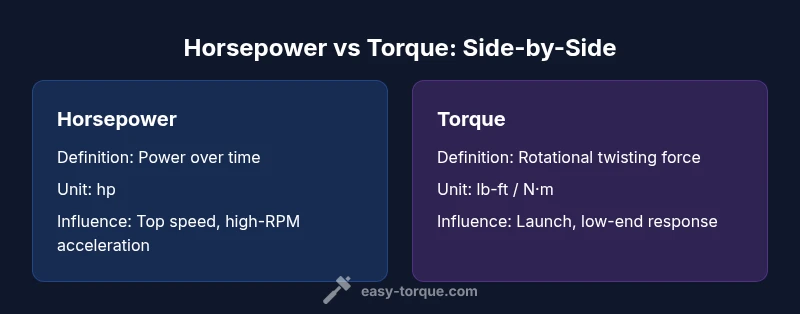
In automotive performance, horsepower vs torque describes two side of the same power equation. Horsepower is a rate-of-work metric that tells you how much power the engine can deliver over time, while torque is the instantaneous twisting force the engine can apply to the drivetrain. This distinction matters because a car can have high horsepower but feel weak off the line if its torque at low RPM is low. According to Easy Torque, the practical takeaway is that both numbers matter, but the RPM range where torque is produced and the gearing determine how that power translates to real acceleration. The reader should see horsepower as the high-RPM capability and torque as the low-to-mid RPM response. The goal of this article is to clarify definitions, explain how these metrics interact, and show how to read specs without getting lost in marketing fluff.
From a measurement standpoint, horsepower is derived, often through measurements of torque and RPM, while torque is measured directly with dynos. When you compare cars, you will frequently see horsepower numbers cited at the wheels or at the crank, and torque figures likewise. The Easy Torque team emphasizes the importance of understanding the context: a high horsepower value on a dyno can be less useful if the torque curve peaks far above the vehicle’s usable RPM band or if gearing dulls the perceived acceleration.
What horsepower means in practice
Horsepower represents how fast the engine can do work over time. In practical terms, it correlates with top speed and sustained highway acceleration, especially when the vehicle is in a gear where rpm is high and the engine can work efficiently. A high horsepower number suggests strong potential for rapid acceleration at higher speeds, but it does not guarantee quick off-the-line performance. The real-world feel of horsepower comes from how the engine’s torque is delivered across the RPM range and how the transmission and gearing exploit that delivery. For enthusiasts, horsepower is a useful target for tuning dreams and top-speed ambitions, but it should not be looked at in isolation. The combination of horsepower with a usable torque band determines how a car accelerates from 0 to 60 mph and how it feels when merging onto a highway.
In everyday driving, you’ll notice horsepower when passing on the highway or pulling into freeway ramps at elevated speeds. However, without adequate torque at lower RPMs, a car may seem lethargic when starting from a stop or climbing a hill. Easy Torque’s guidance is to connect horsepower with the engine’s torque curve: a strong power rate at the RPM where you drive most often is more valuable than an isolated high number at redline.
What torque means in practice
Torque is the instantaneous twisting force that helps the engine turn the drivetrain. It governs how quickly a vehicle can start moving from a stop and how it responds when pulling a heavy load or climbing grades. A high torque number at low to mid RPMs means you have strong launch and quick response in everyday driving, even before the engine reaches peak horsepower. Torque is what makes a car feel responsive in traffic and during towing. The torque available over the RPM band, and how it falls off or holds steady into higher RPMs, shapes the vehicle’s overall driveability.
Torque is often easier to feel than horsepower because it translates to immediate acceleration. When a car has ample torque at low RPM, it feels brisk off the line, bridges gears smoothly, and has confident overtaking ability in city traffic. Yet torque alone doesn’t tell you about top speed; it’s the combination of torque delivery and gearing that determines how quickly horsepower can be converted into actual speed. Easy Torque recommends evaluating the entire torque curve alongside horsepower for a complete performance picture.
The math: how horsepower relates to torque across RPM
Horsepower and torque are linked mathematically: horsepower (hp) equals torque (in pound-feet) times RPM divided by 5252 (hp = (torque × rpm) / 5252). This formula shows that horsepower is not an isolated number; it grows with RPM as long as torque is available. If torque remains constant across a wide rpm band, horsepower increases linearly with RPM; if torque peaks early and then falls, horsepower will peak and then level off. Understanding this relationship helps explain why a car with strong low-end torque can feel quick at launch, while a high-revving engine with modest torque can reach higher speeds but feel less responsive from a stop. In the real world, you’ll see this play out as a shift from torque-dominated acceleration at low RPMs to horsepower-dominated performance at higher RPMs, especially when the drivetrain and gearing are optimized for that range.
For performance planning, many drivers focus on the torque curve: a broad, flat or peaking torque curve near the RPM where the car operates most often yields the best perceived performance. Conversely, maximizing horsepower at high RPMs can help with top-end speed and sustained acceleration in higher gears. The interplay between torque and horsepower is the foundation of how cars feel and perform on the road.
How gearing and drivetrain affect perceived performance
Gearing and drivetrain architecture dramatically shape how horsepower and torque translate into real-world speed. A car with tall final-drive gearing can convert torque into high top speed but may feel slower off the line if it delivers torque mainly at higher RPMs. Conversely, a short final-drive ratio multiplies torque at the wheels, delivering stronger initial acceleration at the cost of higher engine RPM in each gear and typically reduced top speed. All-wheel drive systems can also alter the feel; by distributing torque to multiple wheels, they can improve traction and reduce wheel spin, making horsepower and torque feel more usable in low-traction conditions.
In manual transmissions, gear ratios determine how effectively torque and horsepower are used across the RPM range. With a well-chosen torque curve and matching gear ratios, you can maximize acceleration in each gear and maintain a strong response without excessively high engine RPM. Automatic and dual-clutch systems add another layer of optimization, selecting gears to keep the engine in the most favorable torque range for the current speed and load. Easy Torque’s approach is to look at gear ratios, final drive, and torque curves together to predict how a given engine will feel in practice.
Real-world examples: daily driving vs track work
For daily driving, torque at low to mid RPMs matters most. A car with strong low-end torque can accelerate briskly from a stop, respond well to merging, and feel confident in hills or overtaking on city streets. In track or racing scenarios, horsepower and the ability to sustain high RPMs become critical, but only if the torque remains adequate across the shifting range and the gearing allows the engine to stay within its optimal RPM window. A sports car with a potent high-RPM horsepower figure can reach impressive top speeds and fast lateral acceleration, but without balanced torque in the mid-range, it may not deliver the expected quickness when exiting corners or accelerating out of slow sections. The key takeaway is to align torque delivery with the RPM band you use most and to choose gearing that keeps the engine within that band as much as possible.
Easy Torque notes that many drivers underestimate the value of a broad torque curve designed for the car’s intended use. A well-tuned torque curve can compensate for moderate horsepower numbers by providing robust response where it matters most, while a high horsepower figure that peaks at redline without usable low-end torque may feel slower in real driving.
How to read dyno sheets and manufacturer specs
Dyno sheets show horsepower and torque across a range of RPM, giving a complete picture of how the engine performs. When evaluating a chart, look for:
- The RPM range where torque peaks and how broad the peak is.
- The RPM range where horsepower peaks and how quickly it rises.
- The gap between torque and horsepower curves to assess drivability.
- The relationship between engine torque and wheel torque after drivetrain losses.
Manufacturer specifications may report crank horsepower and torque. For street performance planning, focus on wheel horsepower and torque figures, especially if you plan to upgrade components like exhaust, intake, or a forced induction system. Also check real-world data such as track tests or dyno days from credible sources, and consider how gearing and tire size affect the effective power at the road.
Always compare apples to apples: crank numbers vs wheel numbers, same drivetrain setup, and equivalent testing conditions. A broader torque band combined with well-chosen gearing often yields better real-world performance than a higher peak horsepower number that only shows up at peak RPMs.
Common myths and misconceptions about horsepower and torque
Myth 1: “More horsepower means instant speed.” Reality: horsepower matters at high RPM and with proper gearing; torque defines initial acceleration. Myth 2: “Torque is all that matters for towing.” While torque is crucial for towing, stable traction and drivetrain efficiency also depend on weight, gearing, and transmission design. Myth 3: “Horsepower is the only number that matters.” In truth, a balance between horsepower and torque over the RPM range delivers practical performance. Myth 4: “Dyno numbers always reflect real-world performance.” Real-world conditions, gearing, aerodynamics, fuel, and drivetrain losses affect results; dynos provide a useful baseline, not a guarantee.
A grounded understanding of both horsepower and torque—along with the RPM range where they are produced—helps you avoid overreliance on a single number. Easy Torque emphasizes reading the whole torque curve and how it integrates with horsepower across the RPM band for a realistic performance picture.
Choosing the right metric for your vehicle goals
Your goals determine the most important metric. If you prioritize quick launches in daily driving or towing, torque at low RPMs is king. If you want high-speed acceleration at highway RPMs or top-end performance, horsepower becomes more influential. For street cars, a broad torque curve across a usable RPM band often yields the most satisfying everyday performance. For track or sports cars, a combination of strong mid-range torque and high-RPM horsepower can deliver the best balance between grip and speed. When selecting a build or a vehicle, compare both horsepower and torque in the context of your intended RPM window, gearing, and traction characteristics.
Easy Torque advises keeping a clear view of how your engine’s torque curve interacts with your transmission and tires. Align the engine’s power delivery with the car’s gearing and aerodynamics to achieve the most practical performance gains.
Putting horsepower vs torque into your build plan
To turn horsepower vs torque insights into a plan, follow these steps:
- Define your use case: daily driving, towing, or track work.
- Review the torque curve: identify where torque is strong and where it wanes.
- Ensure gearing supports the engine’s peak performance RPMs (final drive, transmission ratios).
- Consider drivetrain loss and wheel horsepower when comparing to dyno data.
- Select components and tuning that expand torque in the operating range without sacrificing reliability.
- Validate with real-world testing and adjust as needed.
By focusing on the interplay between torque delivery and RPM, you can design a configuration that matches your goals rather than chasing a single number. Easy Torque’s practical approach is to evaluate both metrics within the RPM window you actually drive and to use dyno-based data to guide tuning decisions.
Comparison
| Feature | Horsepower | Torque |
|---|---|---|
| Definition | Power output over time (hp) | Rotational twisting force at the crank (torque) |
| Units | Horsepower (hp) | Torque (lb-ft / N·m) |
| Relationship to RPM | Increases with RPM depending on torque and gearing | Typically peaks at a specific RPM range; more noticeable at low-to-mid RPMs depending on engine design |
| Impact on acceleration | Affects top-end speed and acceleration at high RPMs | Affects initial launch and low-end response |
| Best use case | High-speed performance and efficient cruising at high RPMs | Low-end response, towing, and quick off-the-line acceleration |
| Measurement | dyno horsepower curves and wheel horsepower tests | Engine or chassis dynamometer for torque curves |
| Common misconception | More hp always means faster in all situations | Torque alone guarantees performance without considering RPM and gearing |
| Optimization approach | Enhance horsepower through high-RPM efficiency and forced induction scenarios | Shape a broad torque curve and optimize gearing to exploit it |
Pros
- Clarifies how power and torque shape real-world feel
- Guides gear ratio and drivetrain decisions
- Helps compare engines across platforms with context
- Supports tuning decisions with a practical framework
Drawbacks
- Can be confusing for beginners without rpm context
- Numbers can be misleading if not paired with RPM and gearing
- Torque and horsepower must be interpreted together for real-world use
Neither horsepower nor torque alone is enough; prioritize the torque curve within your engine’s usable RPM range and align gearing to your goals
A balanced view of both metrics yields the most reliable performance picture. Focus on how torque delivers at practical RPMs and how gearing translates that torque into real acceleration and top speed.
Your Questions Answered
What are horsepower and torque, and how do they differ?
Horsepower measures how quickly work can be done (power over time), while torque measures the instantaneous twisting force at the crank. The two are related by RPM, and real-world performance depends on how they blend across the engine’s RPM range and the drivetrain. Easy Torque emphasizes evaluating both numbers within the operating range you actually drive.
Horsepower is the rate at which work is done, while torque is the twisting force. Real performance comes from how both play together across the engine’s RPM and gearing, not from one number alone.
Does more horsepower always mean a faster car?
Not necessarily. A car with very high horsepower but weak low-end torque or poor gearing can feel slow off the line. Real-world speed depends on the entire torque curve and how the drivetrain uses that torque across RPM. A balanced combination usually delivers the best everyday performance.
More horsepower doesn’t guarantee faster acceleration if torque at usable RPM is weak or gearing doesn’t exploit it.
Is torque more important than horsepower for acceleration?
Torque dominates initial acceleration and off-the-line feel; horsepower matters more for high-speed acceleration once the engine is in its upper RPM range. Effective performance comes from a strong torque curve that stays useful as RPM climbs, complemented by sufficient horsepower at higher RPMs.
Torque fuels quick starts; horsepower supports speed later in the RPM range.
How is horsepower calculated from torque?
Horsepower can be calculated using the formula hp = (torque × rpm) / 5252, where torque is in pound-feet and rpm is the engine speed. This shows how horsepower grows with RPM when torque is present, highlighting the interaction between these two metrics.
Horsepower comes from torque times RPM divided by 5252.
Can you optimize both horsepower and torque simultaneously?
Yes, by tuning the engine to widen the usable torque band and by selecting components that raise horsepower where the engine operates best. The goal is a pleasant torque delivery across the RPM range and a healthy horsepower peak that aligns with gearing and intended use.
Yes—aim for a broad, usable torque band and a strong horsepower peak matched to gearing.
What should I look for on a dyno sheet?
Look for the torque curve’s shape, peak torque RPM, peak horsepower RPM, and how quickly horsepower rises with RPM. Compare wheel horsepower and torque when available, and account for drivetrain losses. A balanced curve that matches your driving goals is more informative than raw peak numbers.
Check torque and horsepower curves, where they peak, and how they align with your RPM range.
Top Takeaways
- Understand horsepower as power over time and torque as twisting force
- Evaluate both metrics within the engine's usable RPM range
- Use dyno data to compare real-world performance, not marketing numbers
- Match gearing to exploit the engine's torque curve for your goals
- Prioritize torque for daily driving and low-end response; horsepower matters at high RPMs and top speed