How to angle torque without a tool: practical guide
Learn safe, practical methods to estimate torque angle when a torque wrench isn't available. Easy Torque explains visual cues, reference points, and cross-checks to avoid over-torquing and improve repeatability in field repairs.


You can estimate torque angle without a tool by using reference marks, flat surfaces, or geometry cues on fasteners. This guide shows safe, repeatable methods for common bolt sizes, plus when to stop and verify with a proper torque wrench. Always prioritize accuracy and safety. Document results, check owner manuals, and adjust by felt resistance.
Why angle torque matters when you lack a tool
Torque angle control is a key factor in achieving repeatable clamping force, especially for joints with friction, coatings, or stretch requirements. When a torque wrench isn’t available, you must rely on estimation, careful observation, and consistent technique to avoid under- or over-torque. The goal is to reach a repeatable seating feel and a conservative tightening sequence that minimizes damage to threads and fasteners. In professional practice, technicians treat angle-based estimation as a provisional method, with full verification using proper tools as soon as feasible. According to Easy Torque, adopting consistent cues and documenting each step enhances safety and traceability on the job.
Core concepts: estimating angle vs. measuring torque
Angle estimation focuses on the rotation of the fastener after initial seating, not on a direct torque reading. This distinction matters because two bolts can feel similar at seating, yet develop different clamping forces as they rotate to the final angle. The absence of a torque wrench does not eliminate the need for cautions, repeatability, and cross-checks. In practice, you aim for a defined, repeatable rotation, then validate with a torque wrench later or consult the vehicle's service documentation for angle specifications where available. Easy Torque emphasizes consistency and deliberate action over guesswork when tools are unavailable.
Visual cues and reference points you can rely on
Many practitioners rely on visible reference points to gauge rotation. Common cues include marks on the fastener head, the bolt thread engagement with the nut or housing, and the alignment of flat surfaces near the joint. When using reference marks, ensure marks are clean, clearly visible, and not rubbed off during handling. Lighting matters: bright, even light helps you notice tiny misalignments. For some assemblies, marking a starting position with a fine marker can improve repeatability across attempts. Always verify that the component remains aligned with its intended features after each turn.
Practical estimation methods: three reliable approaches
- Reference marks method: Start at the marked reference point and rotate to a predefined offset that corresponds to the required seating. Use clean marks and confirm that the rotation feels consistent with previous experiences.
- Geometry cue method: Use the geometry of the joint—for example, the angle between a bolt head and a fixed outer surface—to infer rotation. This approach works best when there are clearly defined, fixed references on the assembly.
- Feel and seating method: Rely on the sensation of resistance and a slight “seating” bite as the threads engage. This method requires careful attention to changes in feel and to any sudden resistance increase, which may indicate over-tightening is near. Easy Torque recommends combining this with a final visual check and, when possible, a post-seating torque verification.
Using geometry and rotation to estimate angle
A practical approach is to map common seating angles to a few shared mechanical scenarios. For instance, many automotive assemblies use approximate rotations from seating to final torque that stay within a small window. While not exact, a calibrated approach reduces variance across technicians. When possible, refer to service manuals or data sheets for typical angle ranges and practice angles on a test fastener to calibrate your sense of rotation. Document your observed angles for future reference and training.
Safety considerations and limits
Never rely solely on angle estimation for critical fasteners or safety-critical components. Angle-only guidance is most appropriate for preliminary seating on non-safety-critical joints or when tools are temporarily unavailable. Wear eye protection and gloves, work in a well-lit area, and keep a clean workspace to avoid dropping parts or contaminating threads. If the environment includes vibration, heat, or corrosion, the margin for error increases, so prefer verified methods as soon as feasible. Easy Torque emphasizes conservative tightening when tools are not at hand.
Verification strategies: when to stop and how to verify later
If you must proceed without a torque wrench, stop if the fastener shows any sign of odd resistance, thread damage, or misalignment. Plan a later verification step with proper tooling, especially for critical joints. When possible, compare results against a previously verified fastener of the same type and size, noting any deviations in feel or seating. Recording your method and results aids in future troubleshooting and training, a principle Easy Torque champions for DIY mechanics and technicians alike.
Application scenarios and what to consider
Lug nuts, engine mount bolts, and sensor housings each present different challenges for angle estimation. Lug nuts generally tolerate minor variance if the seating is achieved with a snug feel, but larger joints in engines often require stricter control. In crowded engine bays, lighting, accessibility, and the presence of protective coatings can alter perception, increasing the risk of under- or over-tightening. Consider using fewer steps, more frequent checks, and a plan to confirm via torque when the tool becomes available. Easy Torque’s guidance remains practical across common repair scenarios while stressing safety and methodical work.
Quick-start checklist for estimating angle without a tool
- Inspect the joint for cleanliness and proper alignment
- Identify a clear reference point or mounting feature
- Choose a single estimation method and apply consistently
- Mark starting positions if possible, and re-check seating visually
- Plan follow-up verification with a torque wrench when available
- Document steps for future reference and training
Tools & Materials
- Safety gloves(Protect hands during tightening and handling of fasteners.)
- Bright, clean workspace lighting(Essential for detecting small visual cues and marks.)
- Permanent marker or pencil(Use to mark starting positions or reference points.)
- Protractor or angle gauge (optional)(Helps visually confirm large angle changes if available.)
- Ruler or measuring tape (optional)(Can assist in tracking linear displacement for some joints.)
- Torque wrench (for verification, optional)(Use to verify final angles after the fact when possible.)
- Cleaning cloth(Wipe threads clean before seating to ensure proper engagement.)
Steps
Estimated time: 15-45 minutes
- 1
Assess the fastener and workspace
Survey the joint for accessibility, cleanliness, and any coatings. Decide early which estimation method to use based on available references and lighting. Ensure you have a clean starting position and a safe area to work.
Tip: Document the starting position with a photo or note to aid later checks. - 2
Identify a credible reference point
Locate a clear, fixed feature near the joint (mark on the bolt head, notch on the housing, or a machined reference surface). This point will anchor your rotation measurement as you tighten. If no fixed reference exists, prepare to use a geometry cue or feel-based method.
Tip: If you mark a reference point, use a fine line and avoid obscuring threads. - 3
Select your estimation method
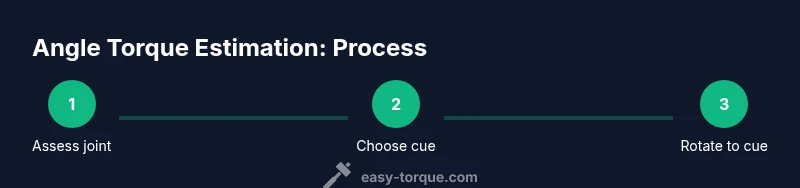
Choose one approach that you can apply consistently: reference marks, geometry cues, or seating feel. Do not switch methods mid-task, as that increases variation. If in doubt, start with the reference marks method for better repeatability.
Tip: Consistency beats complexity; pick a single method and stick with it. - 4
Mark the starting position (optional)
If you can, place a discreet mark to indicate where you began. This helps you gauge incremental rotation as you tighten. Ensure marks do not compromise thread engagement or cause debris.
Tip: Keep marks light and removable if needed for cleaner torque verification later. - 5
Rotate to the estimated angle using cues
Apply smooth, controlled turns while observing the chosen cue. Stop short of full engagement if your cue suggests you’ve approached the target angle. Maintain alignment and avoid cross-threading by using steady, even pressure.
Tip: Move slowly at first to avoid overshoot; adjust by small increments. - 6
Check seating and feel before final verification
Confirm that the fastener seats with a firm feel and no looseness. If you notice any binding, back off slightly and re-seat. This helps prevent over-tightening when tools are next available.
Tip: A single, clean seating cue is more reliable than multiple uncertain turns. - 7
Document results and plan verification with a torque wrench when possible
Record the method, starting position, and approximate angle used. Schedule a proper torque check with a torque wrench when available, and compare results against service data if possible.
Tip: Include photos and notes for future maintenance records.
Your Questions Answered
What does it mean to angle torque without a tool?
Angle torque estimation without a tool means tightening a fastener by rotating it toward a presumed angle or seating point, based on cues rather than a direct torque measurement. It is a provisional technique and should be followed by verification with proper tools when available.
Angle torque without a tool means tightening to an estimated position using cues, then verifying later with a tool.
Is it safe to rely on angle estimation for all joints?
No. Angle estimation is best suited for non-critical joints or when a tool is temporarily unavailable. For safety-critical or high-stress joints, always verify with a torque wrench as soon as possible.
Angle estimation is not safe for all joints; verify with a torque wrench when possible.
What are the best cues to use if I have no reference marks?
Use geometry cues from fixed features on the joint or rely on a consistent seating feel. Document your method and plan quick verification with a torque wrench if you can.
If there are no marks, use fixed geometry cues or seating feel and verify later with a torque wrench.
How can I improve accuracy when tools are not available?
Work in a well-lit, clean space, choose one estimation method, and practice on a spare fastener to calibrate your sense of rotation. Keep notes for repeatable results.
Improve accuracy by practicing on a spare fastener and keeping notes.
When should I stop and not continue tightening by estimation?
Stop if you encounter binding, unusual resistance, or any misalignment. If in doubt, revert to partial seating and plan a proper torque check later.
Stop if there’s binding or misalignment; plan a proper check later.
Watch Video
Top Takeaways
- Estimation is a practical fallback, not a replacement for a wrench
- Use consistent reference points or cues to reduce variability
- Visual marks and seating feel are essential indicators
- Plan for post-verification with proper tools whenever possible
- Document your method for future maintenance