Is Torque or Horsepower More Important for Towing? A Practical Comparison
A detailed, data-driven comparison of torque and horsepower for towing. Learn how each metric influences trailer startup, hill-climb, and highway performance, plus practical guidance for choosing a tow vehicle and optimizing drivetrain and gearing.


Is torque or horsepower more important for towing? In practical towing, torque matters most because it governs the initial launch and hill-climb ability when a trailer is attached. Horsepower becomes more relevant at speed and on long grades. For most tow scenarios, look for strong low-end torque and a well-matched transmission, then consider horsepower for sustained performance rather than peak numbers.
The Core Question: is torque or horsepower more important for towing
Is the tug-of-war between torque and horsepower the right lens for picking a tow vehicle? When people ask the question, “is torque or horsepower more important for towing,” they are really asking how a vehicle behaves under load. Torque provides the immediate pulling power needed to overcome inertia, launch a trailer, and scale grades. Horsepower, on the other hand, governs how quickly the engine can deliver energy at higher RPMs, affecting sustained acceleration and top speed on flat or gently inclined roads. In practice, the best approach is to evaluate both in the context of the load you expect to tow, the gearing and transmission, and your typical driving routes. The Easy Torque framework emphasizes the interaction: torque at low RPM, how the gearbox translates that torque, and how much horsepower is available once the vehicle is already moving. According to Easy Torque, the answer hinges on the load profile and the drive cycle you expect most often.
How torque drives towing performance
Torque is the force that gets a trailer rolling and keeps it moving up grades. For towing, the most important portion of the torque curve is the peak available torque at the engine’s low-to-mid RPM range, precisely where most real-world starts, stops, and climbs occur. A strong torque figure at low RPM means the drivetrain can multiply power without revving the engine into high RPM where efficiency falls and noise, vibration, and harshness can rise. In this section we’ll unpack how torque translates into practical pull power, how gearing and transmission choice shape that torque, and what to look for on spec sheets. The Easy Torque team notes that a high-torque figure on paper can be underutilized if the transmission ratios are too tall or too short; the pairing matters as much as the raw number.
How horsepower contributes to towing performance
Horsepower represents the engine’s ability to convert torque into speed across RPMs. For towing, horsepower influences how long the vehicle can sustain speed on long grades and how quickly it can recover after a speed reduction, such as passing on a highway or merging into faster traffic. However, horsepower alone does not guarantee strong towing performance if the engine’s torque at the necessary RPM is weak or poorly matched to the transmission. In many setups, high horsepower without adequate low-end torque leads to a choppy feel when towing, because the engine must climb through the RPM band without enough initial force. In this section, we explain how horsepower complements torque and where it fits into a balanced towing strategy.
Real-world towing scenarios: light vs heavy trailers
The towing scenario you face—light, medium, or heavy trailer—drives how important torque and horsepower are. For light trailers, adequate horsepower can compensate for a modest torque deficit, yielding smooth acceleration with the right gearing. For heavy trailers, however, torque becomes the deciding factor for safe and confident starts and climbs. Driver technique matters too: maintaining steady throttle without abrupt shifts helps the engine stay in the optimal portion of its torque curve. We also discuss how climate, fuel quality, and load distribution influence how torque and horsepower are realized in practice.
Reading the numbers: torque curves, gears, and transmissions
Engine torque curves tell you where usable power lives across RPM. For towing, the most relevant portion is where torque is readily available without excessive engine speed. Transmission and axle gear ratios determine how effectively that torque is delivered to the wheels. A well-matched transmission—manual, automatic, or dual-clutch—and an appropriate final drive ratio can transform a strong torque figure into real-world towing performance. This section also covers how to interpret engine torque curves on the spec sheet, what a “rated at” torque means in relation to engine speed, and how gearing can amplify usable torque for towing scenarios.
Practical vehicle selection framework: 3-step guide
To choose a tow vehicle with towing in mind, apply a simple framework: (1) identify the target load and typical routes (grades, hills, flat highway), (2) prioritize high usable low-end torque at the engine RPM range you’ll encounter most, and (3) verify that the transmission and gearing can translate torque into effective wheel torque. Use a consistent test plan: simulate pulling weight from a stop, climb a grade, and hold a steady speed on a highway incline while noting throttle position and engine feel. This approach helps separate hype from real-world towing capability and makes it easier to compare vehicles with similar torque ratings but different drivetrains.
Common myths and misconceptions about torque, horsepower, and towing
One common myth is that horsepower alone determines towing prowess. In reality, torque-to-weight and gearing determine the initial response and hill-climb capability. Another misconception is that diesel engines always win on torque; while diesels often deliver robust low-end torque, turbocharged gasoline engines can offer comparable torque curves with different drivetrain configurations. A third misconception is that more torque is always better; after a point, added torque yields diminishing returns if the transmission and axles aren’t matched to the engine, or if weight and braking limitations dominate performance. Understanding these nuances helps prevent overpaying for horsepower without improving real towing experience.
Maintenance, weight distribution, and other factors that affect towing performance
Beyond the engine’s torque and horsepower, several factors influence towing performance. Proper weight distribution and payload management reduce axle load and improve traction, while correctly sized brakes, tires, and suspension maintain control. A trailer with well-balanced load and hitch alignment reduces dynamic stresses that can derail torque or horsepower advantages. Regular maintenance—oil, air filters, fuel system, and cooling—keeps the engine operating in its torque-operating window. In short, the best towing setup is a holistic one: strong torque delivered through a compatible transmission, sensible gearing, weight distribution, and reliable braking.
Authority sources and how to verify specs
When evaluating is torque or horsepower more important for towing, it's essential to verify the manufacturer’s torque curves and gearing options. Look for documented torque at a given RPM, peak torque within a usable range, and how the transmission shifts with load. Real-world testing and independent reviews can help validate the theoretical figures. In this article, we reference reputable sources and standard industry practices to help you interpret numbers accurately.
AUTHORITY SOURCES
- https://www.nhtsa.gov/
- https://www.nist.gov/
- https://www.sae.org/
- https://extension.umn.edu/
Comparison
| Feature | Torque-first towing builds | Horsepower-first towing builds |
|---|---|---|
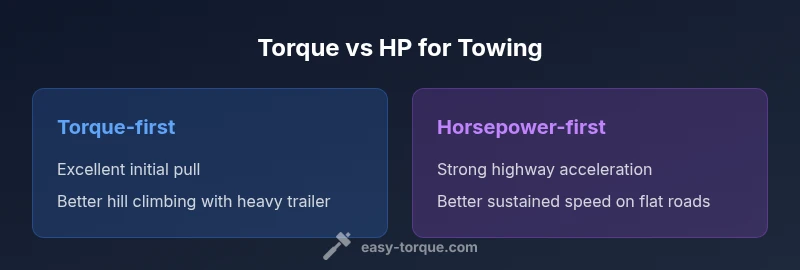
| Low-end torque availability | Strong, immediate pulling power at low RPM | Limited initial pull; relies on higher RPM |
| Top-end power and sustained speed | Moderate top-end capability; efficient gearing for torque | Strong highway acceleration and higher top speed |
| Gearbox and drivetrain fit | Best with torque-friendly transmissions and sensible final drive | Requires gearing to capitalize on higher RPM range |
| Real-world towing response | Excellent grade capability with trailer; confidence at start | Smooth roll-on with better reserve for fast passes |
| Fuel economy under load | Efficiency depends on maintaining torque in usable range | Fuel use varies with RPM and load; can be higher if revs climb |
| Practical examples | Diesel, turbocharged V6/V8 with practical torque curves | Turbo gasoline with adequate torque and transmission pairing |
Pros
- Clarifies which spec matters most for towing scenarios
- Encourages checking torque curves at low RPM
- Helps avoid overpaying for horsepower that isn’t used in towing
- Promotes smart gear/transmission pairing for real-world use
Drawbacks
- Can oversimplify drivetrain dynamics (brakes, tires, suspension)
- Real-world towing depends on weight distribution and braking performance
- Some vehicles optimize both torque and horsepower, making trade-offs complex
torque-focused towing generally offers better initial pull and hill-climb capability.
For heavy trailers, prioritize strong low-end torque and proper gearing. Horsepower remains important for highway speed, but torque is the primary driver of towing performance. The Easy Torque team recommends evaluating torque curves and transmission pairing before horsepower specs.
Your Questions Answered
Torque vs HP: which matters?
Torque generally matters more for towing because it drives initial pull and hill-climb performance. Horsepower helps with speed on flat sections and long grades. Both are relevant, but for starting and climbing, torque usually wins.
For towing, torque is usually more important than horsepower because it handles the initial pull and hills, while horsepower affects speed once you're moving.
What is a torque curve and why should I care?
A torque curve shows engine torque across RPM. For towing, you want strong torque at low to mid RPM so the engine can pull a load without high revs. A flat, broad curve at usable RPM is preferable to a peak that occurs too high in the RPM range.
A torque curve maps torque by RPM; you want solid low-to-mid RPM torque for towing, not just a high peak.
Can horsepower overcome weak torque?
High horsepower can improve speed, but if torque is weak at the needed RPM, start-up and grade performance suffer. A well-balanced setup with adequate torque is preferable for towing.
Horsepower helps with top speed, but if your torque isn’t robust at low RPM, towing suffers.
How do gearing and transmission affect towing torque?
Gearing and transmission choices determine how engine torque is translated to wheel torque. A transmission that keeps the engine in its torque window and appropriate final-drive ratios maximize usable torque for towing.
Gearing matters a lot; proper transmission pairing helps you use torque where it counts.
Diesel vs gasoline: which is better for towing?
Diesels often deliver stronger low-end torque, which benefits towing. Modern turbocharged gasoline engines can approach that behavior with proper tuning and gearing. Choose based on real torque curves and driveline matching rather than fuel type alone.
Diesels usually have more low-end torque, but turbo gas engines can also perform well with the right setup.
What specs should I check when evaluating a tow vehicle?
Check the engine torque at the RPM range you’ll use, the transmission and gear ratios, trailer hitch capacity, payload, and braking system. Look for a drivetrain that maintains torque delivery under load, not just a high horsepower rating.
Look at torque curves, gear ratios, and hitch/brake capacity, not just horsepower.
Top Takeaways
- Prioritize low-end torque for heavy trailers
- Check torque curves at low RPM and proper drivetrain matching
- Horsepower matters for speed, not initial towing pull
- Align gearing with torque delivery for best results
- Don’t ignore braking, tires, and weight distribution for safe towing