Torque or Horsepower for Towing: A Practical Comparison
A thorough, objective comparison of torque and horsepower for towing. Learn how low-end torque and high-end horsepower influence starting, hill climbs, highway cruising, and overall tow performance, plus practical guidance to pick engines, transmissions, and gear ratios that match your trailer weight.


For towing, torque matters most in the critical pull and control phase, especially at low to mid RPMs. While horsepower helps on highways, a strong torque curve ensures steady acceleration, confident hill climbs, and reduced lugging with heavy loads. The best towing results come from high usable torque paired with sensible gearing, maintaining engine in its torque band while preserving highway performance.
The Core Question: Torque vs Horsepower for Tow Loads
According to Easy Torque, the central question when towing is not simply which number is higher, but how those numbers translate into real-world performance. Torque is the turning force available at the crankshaft, while horsepower merges torque with engine speed. In practical terms, torque governs how quickly a loaded vehicle can start moving, accelerate from a stop, and climb grades without lugging the engine. Horsepower, by contrast, becomes more noticeable as speed rises, contributing to highway acceleration and maintaining speed on long climbs. The trade-off is that too much focus on peak horsepower can leave you with a narrow window of optimal performance, whereas a broad, strong torque curve delivers steadier pulling power across a range of speeds. The Easy Torque approach emphasizes matching torque delivery to the trailer’s weight, terrain, and gearing to avoid lugging while preserving highway capability.
– block1 引用
Tip: In real-world towing, you’ll often notice that a big, heavy trailer responds more to how the engine delivers torque than to peak horsepower at the top end.
Comparison
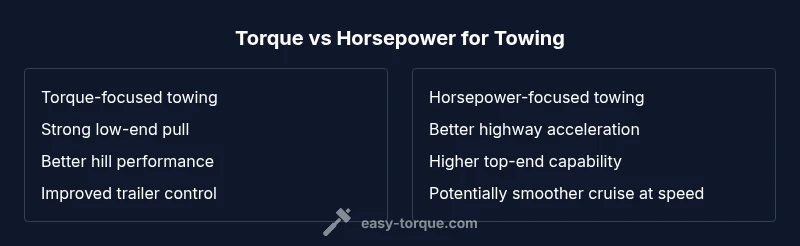
| Feature | Torque-focused towing | Horsepower-focused towing |
|---|---|---|
| Power delivery profile | High torque at low RPM for easy start and pull | Strong top-end power for highway acceleration |
| Hill and start performance | Stable starts with heavy payloads; less lugging | Good highway pace but may struggle on steep climbs without gearing adjustments |
| Drivetrain needs | Gearing must keep engine within torque band | Requires adequate gearing to avoid lugging at low RPMs |
| Best-use scenario | Heavy payloads, slow climbs, trailered loads | High-speed towing, light to moderate payloads on highways |
| Maintenance impact | Torque-forward setups emphasize drivetrain matching | Top-end power emphasis can stress cooling and fuel system under load |
Pros
- Torque delivers reliable low-end performance for starts and climbs
- Broad usable torque bands improve trailer control and stability
- Good torque management reduces lugging and gear hunting
Drawbacks
- Overemphasis on torque can limit top-speed capability without adequate gearing
- High torque without appropriate transmission tuning may reduce fuel economy
- Strong torque at low RPMs requires proper cooling and drivetrain protection
Torque-focused towing generally provides better real-world control for heavy loads; horsepower remains important for highway performance.
For most towing scenarios, prioritize engines and drivetrains that deliver strong, usable torque in the RPM range you actually use while ensuring the transmission and gears keep that torque within the optimal band. Horsepower matters when you maintain higher speeds over long distances, but torque is the lever you pull to get moving and stay confident under load.
Your Questions Answered
Is torque more important than horsepower for towing?
In most towing scenarios, torque dominates at the moment you start moving and climb. Horsepower becomes more influential at higher speeds on highways. The best setups balance both, with a drivetrain tuned to keep the engine operating in its torque band during towing.
Generally, torque leads the way for starting and climbing, while horsepower helps once you’re cruising. The key is pairing strong torque with appropriate gearing.
Can a vehicle with high horsepower still tow well?
Yes, high horsepower helps with highway speeds and maintaining momentum on long grades, but without adequate torque and proper gearing, you may struggle to start or maintain pace on climbs. A balanced system often performs best.
High horsepower helps on the highway, but torque and gearing determine how well you handle starts and hills.
How does the torque curve affect towing performance?
The torque curve shows how the engine delivers torque across RPM. A broad, flat curve means strong pulling power across many speeds, which is ideal for towing. A steep, peaky curve may provide better peak torque but can require precise shifting to stay in the band.
A broad torque curve gives steady pulling, while a peak-only curve can make you chase the right revs.
What role does transmission play in towing torque?
The transmission and gearing determine how effectively torque is translated to the wheels. A gearbox that keeps the engine in its optimal torque range prevents lugging and maintains steady RPM during climbs and starts.
The transmission keeps you in the torque sweet spot so you feel the pull consistently.
Should I prefer a diesel or gasoline engine for towing torque?
Diesel engines typically deliver stronger low-end torque and better fuel economy on heavy loads, which is advantageous for towing. Gas engines may offer lighter weight and lower upfront cost but can require higher RPMs to sustain torque.
Diesel engines usually provide better bottom-end torque for towing, though every setup varies.
How can I evaluate a vehicle for towing capacity beyond horsepower numbers?
Look at the engine’s torque figure across RPM, the torque curve shape, transmission gearing, axle ratio, and cooling capacity. Real-world tests or independent reviews often reveal how a vehicle performs under load.
Check torque curve, gearing, and cooling to judge real towing ability.
Top Takeaways
- Prioritize usable torque in the engine’s operating band for towing
- Match gearing and transmission to keep torque within the torque curve
- Horsepower aids highway performance but is less critical at low speeds and heavy loads
- Consider total drivetrain design (engine, transmission, gears) to optimize torque delivery
- Diesel engines often offer strong low-end torque advantageous for towing