Is Torque or Horsepower More Important? A Practical Guide
Explore when torque or horsepower matters most, and how to balance these metrics for engines, tools, and performance tuning. A practical, data-informed comparison from Easy Torque.


Compared to a single score, the practical answer is nuanced: is torque or horsepower more important depends on the task. In most real-world situations, torque matters most at low speeds and under load, while horsepower drives top speed and sustained power. This quick guide from Easy Torque helps you map your needs to the right emphasis for engines, tools, and drivetrain components.
The Core Difference: Torque vs Horsepower
Torque is the twisting force an engine (or motor) can apply, whereas horsepower is a measure of how quickly that work can be delivered over time. For many DIY projects and everyday vehicles, the practical question is is torque or horsepower more important? The short answer is that both metrics matter, but they influence different phases of motion. According to Easy Torque, torque governs initial response and ability to overcome resistance, while horsepower governs speed at which power is delivered after the engine reaches optimal RPM. When you compare engines, you should look at torque curves, gearing, and drivetrain losses rather than relying on peak numbers alone. In short: torque gets you moving; horsepower keeps you moving fast.
Why torque is crucial at low speeds
Torque dominates at low RPM because it's the raw twisting force that starts motion and helps overcome inertia. In practical terms, this means brisk launch off the line when pulling a trailer, climbing a steep grade, or negotiating heavy equipment at slow speeds. A torque-rich setup with good low-end torque reduces the need for aggressive throttle input and minimizes lugging the engine, which improves drivability and control. The Easy Torque team emphasizes that for tasks like towing, rock crawling, or negotiating steep grades, torque delivery matters more than peak horsepower. This is why many off-road and work-oriented vehicles emphasize torque curves over peak horsepower.
How horsepower affects high-speed performance
Horsepower relates to the rate at which work is performed and becomes more noticeable as RPMs rise. When a vehicle or tool revs into its upper ranges, horsepower drives faster acceleration and higher potential top speeds. For road cars and performance machines, horsepower boosts accelerative capacity once gears are shifted and the engine stays within its power band. It's important to note that horsepower without sufficient torque can lead to a "slow start" even if the peak number looks high. In performance tuning, balancing horsepower with a strong torque foundation yields the best results.
Real-world scenarios: towing, off-road, and daily driving
Different scenarios reveal the practical importance of torque vs horsepower. Towing heavy loads benefits from stout torque at low to mid RPM, ensuring the vehicle can move from a standstill under load without stalling. Off-road driving relies on controlled torque delivery for rock-crawling and wheel speed management. Daily driving benefits from a broad and usable torque curve that makes stop-and-go traffic feel responsive without constantly chasing high RPM. Easy Torque notes that evaluating your typical duty cycle—start-stop commutes, long hill climbs, and occasional highway passes—helps decide which metric requires more emphasis in your build.
Gearing, transmission, and drivetrain efficiency
Power delivery is not just about the engine's numbers; the drivetrain shapes the real-world feeling of torque and horsepower. Shorter gears amplify torque at the wheels for quicker acceleration, while taller gears extend top speed but reduce immediate torque. Transmission efficiency, torque converter behavior, and drivetrain losses all determine how much of the engine's potential becomes usable at the wheels. The takeaway is that a high horsepower figure on paper can underperform in practice if the gearing doesn't match the power curve. Conversely, a well-matched torque profile with smart gearing can deliver impressive daily performance and towing capability.
Reading performance specs without getting lost
Manufacturers publish peak numbers for torque and horsepower, but these specs only tell part of the story. Look for the torque curve across RPM rather than a single peak, and examine where horsepower peaks relative to available torque. A broad, flat torque curve typically provides better real-world performance than a high peak at a narrow RPM range. Also consider weight, aerodynamics, and gearing. Easy Torque recommends checking how the engine's power is sustained under load, since real-world tasks depend on continuous power, not just a short spike in thrust.
Engine design tradeoffs: turbocharging, displacement, and NA
Design choices influence where torque and horsepower come from. Naturally aspirated engines rely more on displacement and peak torque near mid RPM, while turbocharged engines push horsepower up dramatically at higher RPM but may require faster spool and gearing to stay in the torque zone. Smaller, force-fed engines can produce strong torque across a useful band, while larger, naturally aspirated units may deliver broader torque at modest RPM. Understanding these tradeoffs helps you pick an engine that matches your usage profile, whether you want everyday responsiveness or high-speed performance.
Vehicle type breakdown: trucks, cars, motorcycles
Trucks and SUVs typically prioritize torque for hauling, towing, and off-road capability, while sports cars emphasize horsepower for rapid acceleration and high-speed stability. Motorcycles often blend both metrics, with strong torque at low RPM and high horsepower for sustained speed. The best choice depends on weight distribution, transmission, and intended use. In all cases, the relationship between torque and horsepower should be considered alongside gearing, weight, and aerodynamics to achieve the desired performance.
Common myths about power metrics
This section confronts myths like 'more horsepower is always better' or 'torque is never important at high speeds.' Real-world performance relies on a combination of both metrics, adapted to the task, drivetrain efficiency, and vehicle weight. Another myth is that peak numbers alone guarantee better performance; in practice, the power delivery curve matters more for daily driving. Always look at the full powertrain picture rather than a single figure.
How to balance torque and horsepower in your build
To balance torque and horsepower, start by defining the use-case and load profile. For towing and off-road work, prioritize torque in the lower RPM range, and design gearing to keep the engine in its power band. For highway performance and track days, ensure the engine can sustain high RPM with enough torque to keep acceleration brisk. Calibration, exhaust flow, and intake tuning can shift the torque curve and horsepower peak in beneficial directions. Easy Torque suggests testing combinations on a dynamometer or in real-world trials to validate results.
Practical steps for choosing engines, tools, and gear
Here is a practical decision checklist: 1) List primary tasks (towing, daily driving, racing). 2) Identify the expected weight and aerodynamic profile. 3) Compare engines and tools to the torque curve at your typical RPM range; 4) Evaluate gearing options (final drive, CVT, manual), 5) Ensure cooling and components can handle the intended power. 6) Plan maintenance and tuning to preserve the chosen balance. The key is to have a clear target for the desired power delivery rather than chasing peak horsepower alone.
Maintenance, tuning, and future-proofing your power strategy
Maintenance and tuning influence how long power delivery remains effective. Regularly check belt systems, bearings, and cooling to sustain torque and horsepower delivery under load. Future-proofing means considering potential weight increases (payload, equipment) and electric or hybrid powertrains, which may alter the torque-to-horsepower balance. Keep your expectations realistic: improvements in one metric can shift the other, and the best outcome is a balanced, durable system aligned with your use case. Easy Torque's approach combines theory with field-tested practice to guide upgrades and maintenance.
Comparison
| Feature | Torque-focused setup | Horsepower-focused setup |
|---|---|---|
| Launch/initial acceleration | Torque-heavy setup delivers brisk launches in low RPM | Horsepower-heavy setup shines when RPMs rise and gears shift to high speeds |
| Top speed and sustained acceleration | Better sustained performance with ample torque across the RPM range | Maximized horsepower improves high-speed acceleration once in the power band |
| Towing and hauling capability | Torque translates to practical pulling power | Horsepower aids maintaining speed under heavy load |
| Drivetrain stress and durability | Lower drivetrain stress with well-managed torque delivery | Higher horsepower can push components to limits during sustained high power |
| Cost and complexity | Often simpler and more efficient for common tasks | Higher-performance builds may require stronger parts and tuning |
| Best use case | Heavy towing, off-road, slow-speed work | Track days, highway cruising, rapid acceleration |
Pros
- Provides clear guidance on when to prioritize torque vs horsepower
- Reduces risk of underspecifying torque for heavy loads
- Helps match components to intended tasks
- Improves planning for towing and off-road setups
Drawbacks
- No single metric works for all applications
- Overemphasis on one metric can mislead purchases
- Results depend on gearing and drivetrain efficiency
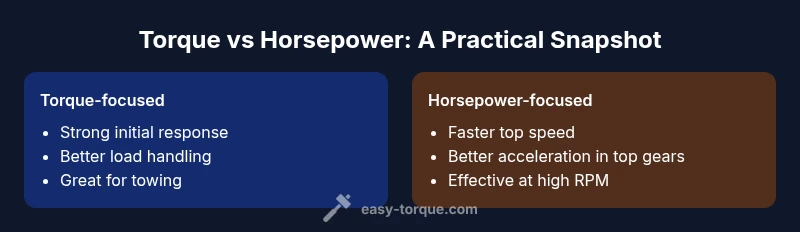
Torque and horsepower are both essential; neither is universally dominant
Choose torque-focused setups for load and launch; prioritize horsepower for top-end speed. Balance both with appropriate gearing and sustained power in mind.
Your Questions Answered
What is the main difference between torque and horsepower?
Torque is the twisting force that starts motion, while horsepower measures the rate of doing work. They complement each other, and real-world performance depends on how they are distributed across RPM and how the drivetrain transmits power.
Torque starts motion; horsepower keeps it going. Both matter, depending on the task.
Is torque more important for towing?
For towing, torque at lower RPM is typically more valuable because it helps the vehicle move from a standstill under load. High-torque engines reduce stall risk and improve hill-climbing ability.
Yes—torque is crucial for towing and hill climbs.
Can you have high torque and high horsepower at the same time?
Yes, many modern engines aim to deliver a broad torque curve with substantial horsepower. The goal is to provide strong, usable torque across a wide RPM range while maintaining peak horsepower for top-end performance.
Often you can balance both, but it requires careful tuning and design.
How do gearing and RPM affect power delivery?
Gearing determines how engine torque is translated to wheel torque. RPM and gearing together shape when torque is available at the tires and how horsepower translates into acceleration at various speeds.
Gearing changes how torque and horsepower feel at the wheels.
What should I prioritize for daily driving?
For daily driving, a broad, usable torque curve is often most comfortable, providing responsive throttle without high RPM fatigue. Balanced power delivery with efficient gearing improves everyday usability.
Prioritize smooth torque delivery for daily driving.
Do torque wrenches relate to engine torque?
Torque wrenches measure the torque applied during fasteners tightening, not engine output. They are essential for maintaining correct assembly torque but do not indicate engine horsepower or torque.
Torque wrenches measure fastener torque, not engine power.
Top Takeaways
- Define the primary task, then prioritize power delivery.
- Torque governs launch, towing, and off-road capability.
- Horsepower drives top-end speed and sustained acceleration.
- Match gearing to the power curve for real-world results.