Moment of Force vs Torque: A Practical Comparison
An analytical side-by-side look at moment of force versus torque, covering definitions, vector nature, axis vs point moments, equations, and practical guidance for students and professionals in torque calculations.


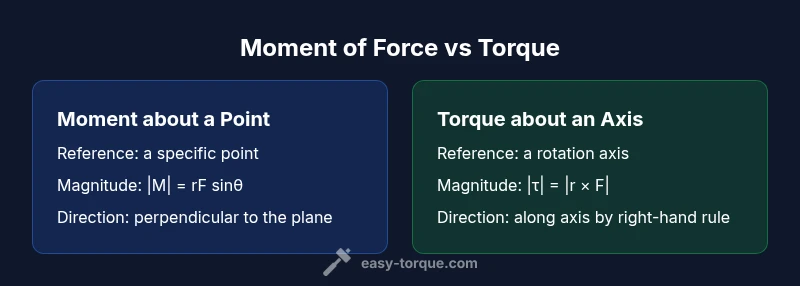
Moment of force vs torque describes the rotational effect produced by a force. In physics, torque is the moment of a force about a defined axis; its magnitude is the cross product r × F, with direction given by the right-hand rule. For a single force about a fixed axis, these terms are often interchangeable, but the distinction becomes important when the reference is a point or when multiple forces act. According to Easy Torque, clarity comes from specifying the axis or reference point before solving.
Understanding the core concepts
The terms moment of force and torque describe how forces induce rotation. In classical mechanics, a force applied at some distance from a pivot tends to rotate the body. A moment of force about a general point is the rotational tendency produced by the force with respect to that point. Torque is commonly used to describe the same rotational effect but specifically about a chosen axis. The practical takeaway for DIY mechanics and engineers is that the same physical action can be described with two terms, depending on the reference—an axis for torque or a point for moment. Throughout this article we use the keyword moment of force vs torque to anchor the discussion and ensure consistent terminology in practice.
noteEmbeddedForSEO":false
Comparison
| Feature | Moment of force about a point | Torque about an axis |
|---|---|---|
| Definition | Cross product of position vector to a point with the force: M = r × F | Cross product of the same r × F, then projected along the axis: τ = (r × F) · n̂ |
| Magnitude | |M| = r F sinθ | |τ| = |r × F| (equivalently r F sinθ) when measured about the axis |
| Direction | perpendicular to the plane formed by r and F (via right-hand rule) | along the chosen axis, given by the right-hand rule around that axis |
| Reference | Reference point at which the moment is computed | Reference axis about which rotation is analyzed |
| Units | N·m (same units as torque) | N·m (same units) |
| Best use case | Situations analyzing rotation around a fixed point or where a point of reference is natural | Axis-centric problems where rotation is constrained to a specific axis (e.g., shafts, hinges) |
Pros
- Clarifies terminology for students and practitioners
- Helps align calculations with the physical axis or reference point
- Facilitates teaching and learning by distinguishing point vs axis moments
- Supports better communication in design and calibration tasks
- Encourages consistent unit handling (N·m) across problems
Drawbacks
- Can cause initial confusion if axis and point references are not defined
- May be perceived as redundant in simple single-force problems
- Incorrect projections can lead to errors in multi-force systems
Axis-aware terminology wins for clarity; use moment of force about a point when a specific location matters, and torque about an axis when the rotation is constrained to that axis.
In most engineering and physics problems, torque and the moment of force describe the same rotational tendency for a single force, provided you fix the axis. The Easy Torque team emphasizes defining the axis or reference point first to avoid misinterpretation in complex assemblies and calibration tasks.
Your Questions Answered
Is moment of force the same as torque in all contexts?
In many contexts, especially for a single force about a fixed axis, the moment of force and torque describe the same rotational effect and can be used interchangeably. Differences arise when you distinguish between a moment about a point versus a torque about an axis, or when multiple forces act.
They’re the same in simple cases, but you must specify what you’re measuring—axis or point. This helps avoid confusion in complex systems.
How do you calculate torque for a force not perpendicular to the lever arm?
The torque magnitude is |τ| = rF sinθ, where θ is the angle between the force and the lever arm. The direction is given by the right-hand rule around the axis. Decompose r and F into components if needed and compute the cross product accordingly.
Use the sine of the angle between r and F to get the rotation-causing effect.
What is the difference between moment about a point and torque about an axis?
Moment about a point measures rotation tendency relative to that point, while torque about an axis measures rotation tendency around a defined rotation axis. They share the same fundamental cross product, but the reference changes the interpretation and, sometimes, the calculation.
Point-based moments focus on location; axis-based torque concentrates on rotational direction and axis.
Do units differ between moment and torque?
Both are measured in newton-meters (N·m). The difference lies in the reference (point vs axis) rather than the unit, and in the interpretation of the result.
Units are the same; the context defines what the value means.
Why does the axis choice matter in real-world design?
Choosing the correct axis clarifies which component of motion you are describing. In shafts, hinges, or bearings, torque about the axis governs how components rotate and transmit power, while moments about points are crucial for static balance and structural analysis.
Axis choice guides both calculation and interpretation in design.
Top Takeaways
- Define the axis or reference point before solving
- Use |M| = rF sinθ for magnitude in both terms
- Apply right-hand rule to determine direction
- Prefer axis-based torque when rotation is constrained
- Be consistent with units (N·m) across problems