Torque Set: How to Choose, Use, and Maintain
Learn how to select, use, and care for a torque set so you tighten fasteners to exact specifications. This guide covers ranges, drive sizes, calibration, safety, and best practices for DIY mechanics, technicians, and enthusiasts.


A torque set provides multiple wrenches and accessories to tighten fasteners to precise specifications. It’s essential for automotive work to prevent over- or under-torquing. Choose a set with a suitable range, drive size, and included adapters; ensure calibration, proper storage, and periodic verification with the manufacturer’s torque chart. Invest in a quality case to keep bits organized and prevent corrosion.
What is a torque set and why it matters
A torque set is a collection of torque wrenches, accessories, and reference materials designed to help you tighten fasteners to exact specifications. For automotive work, electronics assemblies, or machinery maintenance, using the correct torque value ensures parts tighten securely without damage. According to Easy Torque, the right torque set combines accuracy, range, and organization to reduce rework and extend component life. A well-chosen set also supports consistency across projects, making it easier to train new technicians or hobbies to achieve repeatable results.
In practice, a torque set is more than a group of wrenches. It’s a system that includes the tools, the measurement units (Nm or ft-lbs), the calibration data, and the workflow for verifying torque. When you invest time in understanding your set, you gain confidence in critical assemblies—from suspension fasteners to engine components.
Density and diversity in a set matter. A broad range lets you cover small fasteners and large bolts without swapping tools. However, larger ranges can increase cost and complexity. Balance is key: pick a core range that matches your typical projects, plus a few adapters for nonstandard fasteners.
Storage and care are part of reliability. A sturdy case or rack reduces tool loss and prevents corrosion. Keep instruction sheets accessible; they guide correct torque values, lubrication recommendations, and cross-thread prevention methods. A tidy setup speeds up your work and helps maintain accuracy over time.
noteHTMLToMarkdownAllowed":true
imagesReferences":null},
toolsMaterials
Tools & Materials
- Torque set case / organizer(Hard-shell case with foam inserts or partitioned tray to keep wrenches and adapters in place)
- Torque wrenches (multiple wrenches or a universal adjustable wrench)(Include a ratcheting or fixed-head wrench covering your common range (e.g., 5–60 Nm, 20–150 ft-lbs) depending on your needs)
- Adapters and extensions(A selection of drive adapters and extension bars to reach difficult fasteners)
- Torque angle gauge or equivalent (if using angle-torque method)(Useful for applications requiring both torque and angle tightening)
- Calibration certificate or documentation(Keep supporting documentation for traceability and compliance)
- Lubricants/anti-seize (as specified by fastener manufacturer)(Only apply where specified; improper use can alter torque readings)
- Torque reference chart or manual(Includes torque values, units (Nm/ft-lb), and sequence guidance)
Steps
Estimated time: 30-40 minutes
- 1
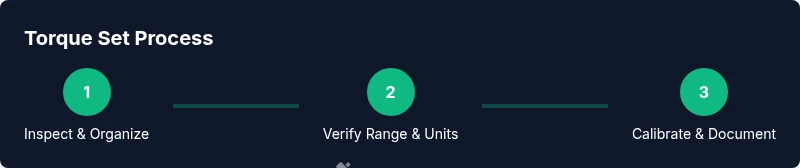
Inspect and organize the set
Unpack the torque set and verify all wrenches, adapters, and documentation are present and undamaged. Check for loose pieces and ensure each tool sits securely in its compartment. This step prevents misreads caused by missing parts.
Tip: Take a photo of the contents for your records and quick reordering if anything is missing. - 2
Review the torque range and units
Identify the minimum and maximum torque values covered by your set, and confirm the units (Nm vs ft-lbs). Mark the most used range for quick access. If you need higher or lower torque, consider additional tools or adapters.
Tip: Always align the unit with the fastener’s specification to avoid misapplication. - 3
Zero, calibrate, and verify the wrenches
If your wrench supports calibration, follow the manufacturer’s procedure to set a known zero and verify readings with a calibrated reference. Record calibration dates and any deviations. Calibration ensures accuracy across projects.
Tip: Calibrate in a controlled environment and document results for future audits. - 4
Match fasteners to the correct torque values
Consult the service manual or torque chart to identify the right value for each fastener. Note the sequence if multiple bolts are involved and plan incremental tightening.
Tip: Use a cross or star pattern for flange bolts to avoid uneven load. - 5
Tighten gradually and verify
Apply torque gradually until the target value is reached. Recheck after a short interval to account for settling. Use torque wrench settings precisely and avoid rounding.
Tip: Double-check the value in complex assemblies where multiple fasteners share a load. - 6
Store, maintain, and re-check periodically
Return tools to their case after use, clean any residue, and ensure dry storage. Schedule periodic rechecks of calibration to sustain accuracy over time.
Tip: Revisit calibration intervals based on how often you use the set and the environment (industrial vs. home workshop).
Your Questions Answered
What is a torque set and what does it include?
A torque set is a collection of torque wrenches, adapters, and reference materials designed to tighten fasteners to precise specifications. It typically includes a range of wrenches, guides, and a storage case. Proper use improves accuracy and protects components.
A torque set is a kit with wrenches and adapters to tighten bolts to exact specs, often including guides and a case for organization.
Do I need to calibrate my torque wrenches?
Yes. Regular calibration ensures readings are accurate and repeatable. Use manufacturer guidelines or a certified torque verification service. Keep a calibration log for audits and warranty requirements.
Yes—calibrate per the manufacturer’s guidance to keep readings accurate and consistent.
What torque range should I look for in a set for automotive work?
For common automotive work, a versatile set should cover a mid-range that includes about 10–80 Nm (7–60 ft-lbs) and a high-range extension for larger bolts. Always confirm with your vehicle’s service manual.
Look for a mid-range that covers typical car bolts and an extended range for larger fasteners.
How do I read torque specifications correctly?
Torque specs specify the target value in a unit (Nm or ft-lbs). Apply steadily until reaching the value, then verify. Some applications require additional angle tightening after torque for a secure fit.
Read the unit, apply gradually until the target value, and verify.
Can I use a torque set for high-torque automotive tasks?
Yes, if your set includes high-range wrenches within the required torque. Ensure the fastener and surface are compatible and follow the recommended tightening sequence.
Yes, as long as your set covers the needed torque and you use the correct sequence.
What maintenance steps extend the life of a torque set?
Keep tools clean and dry, store in the case, recheck calibration periodically, and replace worn adapters. Regular maintenance reduces inaccurate readings and tool wear.
Keep it clean, dry, and calibrated to extend tool life and accuracy.
Watch Video
Top Takeaways
- Choose a torque set with the right range for your work
- Keep the set organized and well stored
- Calibrate and verify regularly for accuracy
- Follow manufacturer torque specs and tightening sequences
- Maintain documentation for traceability