Torque Specifications for Cars: A Practical Guide
Learn how to locate, interpret, and apply torque specifications for cars with practical ranges, step-by-step torque-wrench practices, and maintenance tips to keep fasteners secure and components intact.


Torque specifications for cars vary by bolt size, material, and application. The standard approach is to follow OEM torque specs published in the owner's manual or service manual, and to torque fasteners in the recommended sequence. Deviations risk overstressing threads, gasket failures, or component misalignment. Always consult the vehicle's service documentation and use calibrated torque wrenches.
Understanding Torque Specifications for Cars
Torque specifications define how tight a fastener should be tightened to achieve the intended clamping force without over stressing components. For car maintenance and repair, torque specs are not optional: they ensure sealing, proper seating of gaskets, correct joint stiffness, and predictable performance under load. In practical terms, a bolt tightened to the OEM torque spec will exhibit the designed clamping load, while over tightening can strip threads, warp components, or crack housings. Conversely, under tightening can lead to loosening, leaks, or misalignment during operation. According to Easy Torque, the most reliable way to work with torque specs is to start from the vehicle’s official service documentation and verify that the bolt grade, thread size, and lubrication assumptions match the chart. Always use a calibrated torque wrench and set it to the specified value before sign-off. Temperature, thread condition, and lubricant status can all shift the effective clamping force, so consider environmental factors and condition of mating surfaces when planning a torque procedure. This discipline is reinforced by OEM guidelines that account for material science and surface coatings designed to yield consistent torque behavior across model generations.
Note: The first paragraph places the keyword naturally while highlighting practical relevance.
How OEM Torque Specs Are Determined
OEM torque specs are the result of engineering analyses that balance clamping force, joint stiffness, and thermal expansion. Engineers consider bolt grade, thread engagement length, lubrication status, coating, gasket material, and service conditions. They also account for manufacturing tolerances and long-term durability under heat, vibration, and environmental exposure. The Easy Torque team emphasizes that factory specs assume clean threads, correct bolt size, and the lubricant state described in the chart. When these variables change, a torque value re-interpretation may be needed, and the practitioner should consult the service manual for any stated adjustments. In short, OEM specs are not arbitrary; they reflect a designed compromise between reliability and serviceability across a vehicle’s lifespan.
This section clarifies the rationale behind torque values and underscores the responsibility to adhere to OEM guidance.
Common Bolt Classes and Their Typical Ranges
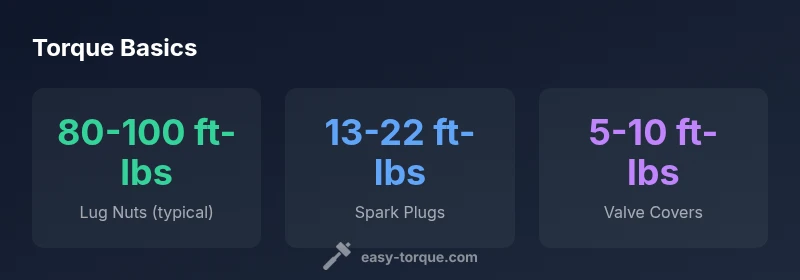
Many car fasteners fall into familiar categories with typical ranges, though exact figures vary by model. Lug nuts on most passenger cars commonly fall in the 80-100 ft-lbs range (110-135 Nm). Spark plugs are generally torqued in the 13-22 ft-lbs range (18-30 Nm), depending on thread size and seating. Valve cover bolts tend to be low-torque at about 5-10 ft-lbs (7-14 Nm) to avoid gasket damage. Higher-stress fasteners such as transmission or crank bolts often require 20-60 ft-lbs (27-81 Nm). Always reference the OEM chart for your specific vehicle, because misalignment or improper seating can lead to leaks, failure, or noise. Easy Torque notes that bolt grade, thread pitch, and the presence of threadlocker or sealant can shift these ranges; use OEM documentation and verify the lubricant status before finalizing torque.
The block uses ranges to illustrate typical categories without claiming universal numbers.
How to Read and Apply Torque Specs Safely
To apply torque specs safely, start by confirming the exact bolt type, size, grade, and lubrication condition described in the service manual. Clean threads and seating surfaces to prevent zinc-coating or debris from altering friction. Torque in the recommended sequence to avoid binding or misalignment, and recheck after assembly once components have cooled to ambient temperatures. Use a calibrated torque wrench and set the dial to the OEM value; if you must work with alternative lubricants, double-check the adjusted value as indicated in the manual. When in doubt, do not improvise—record the vehicle’s VIN and refer to the official helpline or service database for the precise specification. This practice minimizes leaks, misfits, and warranty concerns while promoting safety.
This section offers practical steps to implement torque specs correctly.
Tools and Best Practices for Accurate Torque Application
Choosing the right tool is essential. A good torque wrench—preferably a click-type or digital model with a verified calibration certificate—delivers consistent results. Regularly calibrate devices (at least annually or after a hard impact), and store them properly to prevent drift. When using lubricants, follow the manual’s guidance because friction changes influence the effective tightening. Distinguish torque from angle tightening; some components also specify an angle turn after reaching a base torque. Keep a log of torque values by bolt type and vehicle model to support troubleshooting or warranty claims. Easy Torque recommends maintaining a clean, organized work area, labeling fasteners by location, and using a torque-sequence guide to avoid skewed clamping forces. This attention to detail enhances reliability and safety across maintenance tasks.
This block covers tools, calibration, and best practices.
Common Mistakes and How to Avoid Them
A few frequent errors undermine torque accuracy: failing to clean threads, over-tightening, skipping the correct sequence, and using improper lubrication status. Another pitfall is assuming that all OEM specs apply universally across model years; updated service bulletins may adjust values based on revised parts or coatings. Always cross-check the VIN and model year against the latest OEM documentation, and resist the urge to improvise when under time pressure. If you suspect a torque-related issue, perform a re-torque check after installation and re-evaluate gasket seating or thread engagement. Following a systematic approach reduces the risk of leaks, cracks, or loosened components.
This block explains frequent mistakes and mitigation strategies.
Adapting Torque Procedures for Old and New Cars
Older vehicles may show wear that alters friction characteristics, making some torque values feel looser than newer models. In these cases, follow the OEM spec but be mindful of gasket compression, thread wear, and potential corrosion. Newer cars often feature advanced coatings, tighter tolerances, and sometimes torque-to-yield fasteners, which require specific procedures such as angle-tightening after reaching a base torque. Always verify whether a model uses torque-angle procedures or revised lubricant recommendations. Easy Torque emphasizes documenting any deviations and ensuring the service manual for the exact vehicle is consulted for the correct procedure.
Representative torque ranges for common car fasteners
| Bolt Type | Typical Range (ft-lbs) | Common Nm | Notes |
|---|---|---|---|
| Wheel lug nuts | 80-100 | 110-135 | Varies by vehicle; OEM spec and wheel pattern |
| Spark plugs | 13-22 | 18-30 | Model-dependent; avoid cross-threading |
| Engine valve cover bolts | 5-10 | 7-14 | Low torque; avoid overtightening |
| Transmission bolts | 20-60 | 27-81 | Check service manual for pattern |
Your Questions Answered
What are torque specifications for cars and why do they matter?
Torque specs tell you exactly how tight a bolt should be tightened. Following them prevents leaks, component misalignment, and part failures.
Torque specs tell you exactly how tight a bolt should be tightened. Following them prevents leaks and failures.
How do you find the correct torque specification for a vehicle?
Check the owner’s manual or service manual, or use the OEM torque charts; if in doubt, contact the dealer or a qualified technician.
Check the manual or OEM torque charts; when in doubt, contact a professional.
Can you reuse old gaskets if you follow torque specs?
Gaskets are generally replaced when reassembling; tight torque alone won’t guarantee a seal if the gasket is deformed or damaged.
Gaskets are generally replaced when reassembling; tight torque alone won’t fix a damaged gasket.
Are torque specs the same in Nm and ft-lbs?
Nm and ft-lbs are different units for the same torque value; 1 Nm ≈ 0.7376 ft-lb. Use consistent units when following charts.
Nm and ft-lbs are just different ways to express torque; keep units consistent.
Should you apply lubricant to bolts when torquing?
Only if specified; lubrication changes effective torque and can lead to under- or over-tightening if not accounted for.
Only use lubricant if the spec calls for it; otherwise, torque dry to spec.
“Effective torque control is foundational to reliable car maintenance; even small deviations can cascade into leaks or structural issues.”
Top Takeaways
- Follow OEM torque specs for every fastener
- Torque in the proper sequence to avoid misalignment
- Use a calibrated torque wrench; avoid guesswork
- Check for signs of leakage or damage after torquing
- When in doubt, consult the service manual