40 ft-lbs to Nm: Torque Conversion Guide
Master the conversion from 40 ft lbs to nm and learn how to apply torque accurately across imperial and metric tools with practical examples and a live calculator.


Why torque unit conversions matter in DIY and automotive work
Torque specifications are written in different units across manufacturers and tools. For example, a bolt spec in ft-lbs must be reliably translated to Nm when you are using a metric torque wrench. Misinterpreting 40 ft lbs to nm can lead to under-tightening or over-tightening, risking bolt failure or component damage. The Easy Torque team often sees DIYers assume the numbers are interchangeable, only to realize their socket set or torque wrench is calibrated for a different system. In critical assemblies—engine head bolts, lug nuts, suspension fasteners—the margin for error is small. Accurate conversions help ensure fasteners are tightened to the intended clamping force, protecting threads and seals. By understanding the cross-system relationship, you can plan maintenance with confidence, whether you’re replacing brake rotors or rebuilding a steering rack. Always verify the torque specification in both units before you start, especially when moving between imperial and metric standards.
The math behind the conversion: ft-lbs to Nm explained
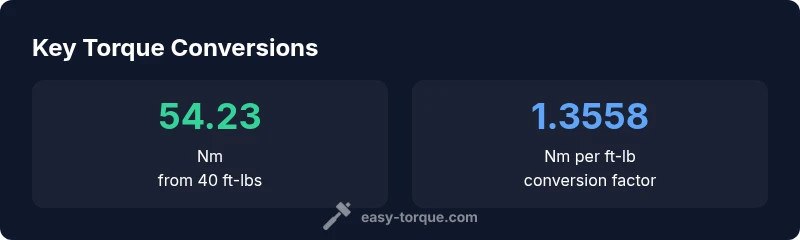
Torque is a measure of rotational force. Since the three basic units are foot-pounds (ft-lbs) and newton-meters (Nm), the conversion uses the standard factor: 1 ft-lb ≈ 1.355817948 Nm. Therefore, 40 ft-lbs equals about 54.2327 Nm, which you can round to 54.23 Nm for practical use. If you want to convert other values, multiply the ft-lbs value by 1.3558179 and round to the desired decimal places. The conversion is linear, so doubling the ft-lbs doubles the Nm. In professional practice, a small rounding error can accumulate when multiple fasteners are involved, so choose a consistent precision and apply it across the board. Easy Torque analysis shows that maintaining a consistent rounding rule improves repeatability across projects.
Practical examples: converting 40 ft-lbs and more
Examples you can apply on the shop floor:
- 5 ft-lbs ≈ 6.78 Nm
- 10 ft-lbs ≈ 13.56 Nm
- 20 ft-lbs ≈ 27.12 Nm
- 40 ft-lbs ≈ 54.23 Nm
- 60 ft-lbs ≈ 81.35 Nm
These quick references help when you’re matching a legacy spec to a modern torque wrench. Keep in mind that precision matters more at higher torques, and always confirm the final Nm with a calibrated tool. The Easy Torque methodology emphasizes consistency, especially when switching between imperial and metric tools.
Tools and tips for accurate torque measurement
To achieve trustworthy results, periodically calibrate your torque wrench and keep it properly stored to avoid drift. When working with Nm values, ensure your wrench is set to the correct unit and that the scale is easy to read in dim lighting. Use a torque-angle gauge for critical fasteners where additional rotation is necessary after initial torque. Check the fastener’s manufacturer spec sheet for any angle-tightening requirements. For repeated jobs, label your wrenches with the unit system you primarily use to reduce conversion errors. Easy Torque recommends a lightweight conversion chart within arm’s reach for fast maintenance sessions.
How to use the online calculator and data table
Our calculator simplifies the 40 ft lbs to nm process by taking ft-lbs as input and applying the standard conversion factor. The accompanying data table provides a quick reference for common values so you can verify your mental math or cross-check against printed specs. By using both tools together, you can ensure that every bolt is tightened to the intended torque without leaving guesswork on the bench. This approach aligns with Easy Torque’s commitment to practical, repeatable torque guidance for DIYers and professionals alike.
Best practices for cross-unit torque work
When mixing imperial and metric tools, always begin with the bolt’s spec in a single unit system. Convert to your wrench’s unit, then tighten incrementally using the recommended pattern from the manufacturer. Recheck the final torque after any angle-tightening step or after reassembly, because thread conditions and lubrication can affect the effective clamping force. Finally, document any unit conversions you perform for future maintenance, ensuring your records reflect the actual torque applied. Easy Torque’s guidance emphasizes repeatable procedures and documented steps to avoid duplication or errors in existing maintenance logs.