Calculate Torque from HP: A Practical Guide
Learn how to compute engine torque from horsepower and RPM with a clear formula, practical examples, and a ready-to-use calculator. Includes unit conversions and real-world caveats.


How horsepower and RPM relate to torque
In any internal-combustion engine, horsepower indicates the rate of work, while torque measures the turning force at the crank. The relationship between horsepower, torque, and RPM is governed by the engine's speed and power curve. When you increase RPM while holding horsepower constant, torque tends to decrease; conversely, higher horsepower can produce greater torque at a given RPM. To begin, understand that you can estimate torque from horsepower and RPM using the standard equation: torque = (HP × 5252) / RPM. This is the core idea behind the calculation you perform with this guide and calculator. Throughout this article, you will learn how to apply that equation to real-world scenarios and interpret the results for design, maintenance, and diagnostics.
The core torque-from-horsepower formula
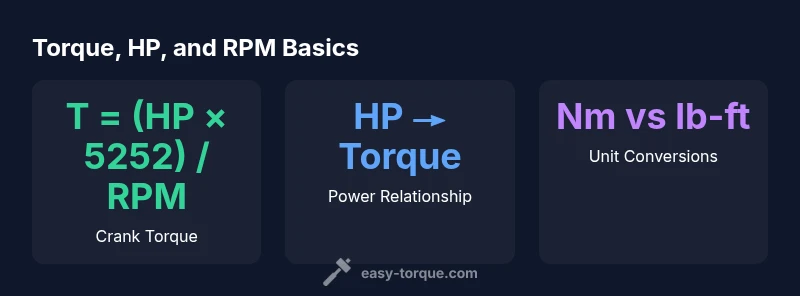
The widely used formula to compute crank torque in pound-feet (lb-ft) is T = (HP × 5252) / RPM. The constant 5252 comes from the unit conversions that connect horsepower, rotational speed (RPM), and crank torque. In practical terms:
- HP is the engine’s power output at a given RPM.
- RPM is how fast the engine crankshaft is turning.
- T is the torque at the crank in lb-ft.
This relationship assumes ideal mechanical efficiency and direct crank output. Real engines experience losses from friction, accessories, and drivetrain, which means wheel torque can be lower than crank torque. The calculator provided with this guide uses the standard formula to give you a solid starting point for comparison and design decisions.
Worked example: 150 HP at 3000 RPM
Let’s plug in typical values: HP = 150, RPM = 3000. Torque = (150 × 5252) / 3000 = 262.60 lb-ft (rounded). This demonstrates the scale: a modest horsepower figure at a moderate RPM can yield a substantial crank torque.
When you adjust HP or RPM, torque scales accordingly. For instance, increasing RPM while keeping HP fixed reduces torque; increasing HP with RPM fixed increases torque. The calculator also supports rounding to a chosen decimal precision, which helps present results clearly in reports or tuning notes.
The effect of rounding and decimals
Rounding your torque results is more than cosmetic. Real-world decisions—like gear selection, drivetrain sizing, or performance tuning—benefit from consistent numeric precision. The standard approach is to decide how many decimals you want and apply round(torque, decimals). Lower decimals yield more readable values on dashboards and charts, while higher decimals can improve precision in engineering analyses. Keep in mind that small changes in rounding can appear significant when comparing similar torque profiles.
Common pitfalls when calculating torque
Several common pitfalls can skew torque estimates. First, many people confuse crank torque (engine output) with wheel torque (what you actually feel). Drivetrain losses, transmission efficiency, and tire slip reduce wheel torque relative to crank torque. Second, using peak horsepower values at a different RPM than the engine’s peak torque can mislead comparisons. Finally, ensure you’re using consistent units (lb-ft vs Nm) and correct RPM references (engine RPM vs wheel RPM in gear). The standard formula is a baseline, not a guarantee of performance under all conditions.
Practical steps to use the calculator in projects
To get reliable estimates, gather the engine HP, the RPM at which you want torque, and your preferred rounding. Plug these into the calculator, read the torque output in lb-ft, and note the RPM context. Use the results as a baseline for selecting gears, estimating acceleration, or comparing different engines. When you need Nm, convert the output by multiplying by 1.3558. Remember that real-world results will differ due to efficiency losses, transmission gear ratios, and road load.
Units and conversions: lb-ft vs Nm
Torque is commonly reported in lb-ft in the United States and in Nm elsewhere. The conversion factor is approximately 1 lb-ft = 1.35581795 Nm. If you’re comparing specifications from different regions or equipment, convert to a common unit before analysis. The standard formula provides crank torque in lb-ft; converting to Nm is straightforward and helps with international projects or standardized documentation.
Real-world considerations: drivetrain losses and efficiency
Crank torque is the engine’s theoretical turning force. Wheel torque drops due to drivetrain losses—friction in the clutch or transmission, differential, driveshafts, and axles. Conversion from crank torque to wheel torque requires applying efficiency factors, which vary by component and operating conditions. For precise vehicle tuning or powertrain design, you’ll want to account for these losses using published efficiency curves or measured data. The baseline calculation remains essential, but it’s only part of the full picture.
Extending the calculation to related metrics
Beyond direct torque calculation, you can derive horsepower from torque and RPM using HP = (T × RPM) / 5252. This inverse relationship is useful when evaluating engine performance from torque curves. If you’re comparing motors or engines, plot torque vs. RPM and overlay horsepower curves to understand how each engine delivers power across the speed range. The calculator can serve as a quick-fire check during iterative design or tuning work.