Calculate Torque Wrench Extension: A Practical Guide
Learn how to calculate torque wrench extension using a simple inline-extension formula. This guide covers steps, math, and a calculator to ensure accurate fastener torque for DIY projects.


What calculating torque wrench extension means for DIYers
When you add an inline extension to a torque wrench, you alter the lever arm and, consequently, the torque delivered to a fastener. For DIY mechanics, understanding this relationship helps avoid under-tightening or over-tightening critical joints. At its core, calculate torque wrench extension using a simple lever-arm concept: the torque you set on the wrench is applied across the total effective length. By knowing the wrench length and the extension length, you can estimate the resulting fastener torque with a straightforward ratio. According to Easy Torque, most common inline extensions behave predictably: a longer extension increases the torque proportionally, while a zero extension yields exactly the setting you dial in. This means a small extension can make a noticeable difference, especially on high-torque fasteners. Practically, this calculation gives you a quick sanity check before you torque fasteners in service, saving time and preventing damage. The concept also translates to metric or imperial units, as the ratio applies regardless of unit, provided the lengths share the same unit system. In short, the goal of this calculation is to predict, not exceed, the fastener’s torque specification so you stay in spec on assembly jobs.
The inline extension formula and its intuition
The core idea is straightforward: when an inline extension e is added to a wrench of length L, the actual torque delivered scales by the factor (L + e) / L. If you dial a setting T on the wrench, the actual torque becomes T × (L + e) / L. This follows from the lever-arm principle: torque equals force times lever arm, and the lever arm increases with the extension. If the extension is zero, actual torque equals the setting. If you know the extension and wrench length, you can quickly estimate whether your fastener will reach the target torque. This relationship is independent of whether you measure in metric or imperial units, so long as you keep the units consistent throughout the calculation. Remember that real-world factors—like alignment, tool wear, and fastener condition—also influence the final torque. The formula provides a solid first-pass estimate that helps you plan and verify with a torque gauge when precision matters.
Practical examples: how extension changes torque in real life
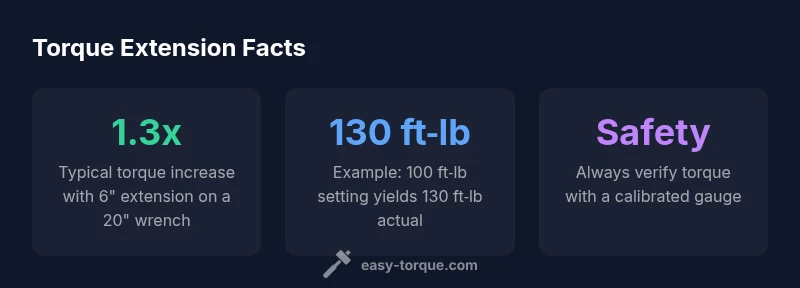
Consider a torque wrench with a 20-inch handle and an inline extension of 6 inches. If you set the wrench to 100 ft-lb, the estimated actual torque is 100 × (20 + 6) / 20 = 100 × 1.3 = 130 ft-lb. If you reduce the extension to 2 inches, the same setting yields 100 × (20 + 2) / 20 = 100 × 1.1 = 110 ft-lb. These examples illustrate how small extensions can meaningfully alter delivered torque. For technicians, this means you should adjust your settings or verify with a torque wrench after attaching an extension to stay within the specification. When working with high-torque fasteners, the margin between spec and over-torque can be narrow, so use the extension calculation as part of a broader torque-management plan. Always maintain unit consistency; if you prefer Newton-meters, convert the resulting ft-lb with a standard conversion factor after calculating.
Crowfoot and angle: when the extension isn't inline
If you’re using a crowfoot wrench or an extension that is not perfectly inline, the effective lever arm changes with the angle θ between the extension and the wrench. The closer the angle is to 0 degrees (inline), the greater the torque increase; as θ grows toward 90 degrees, the extension contributes less to torque. In practice, that means you cannot rely on the simple (L + e)/L ratio for non-inline configurations. The safe approach is to either align the extension as closely as possible or use a calibrated torque meter to verify the actual torque at the fastener. For consistent results, keep extensions inline and check with a torque wrench when accuracy is critical.
Using the calculator: steps to input and interpret results
To get a quick, reliable estimate, plug three values into the calculator: wrench length (inches), extension length (inches), and torque setting (ft-lb). The formula will compute the actual torque in ft-lb. Interpret the result as a guide: if the calculated torque exceeds the fastener’s specification, reduce the setting or remove the extension if possible. If it’s below target, adjust accordingly and recheck. The calculator makes it easy to compare scenarios—try different extension lengths to see how the actual torque shifts before you work on your project. Remember to document the settings you used for future maintenance.
Common mistakes and tips for accuracy
Misunderstanding the effect of extension length is one of the most common errors. Always ensure the extension is perfectly aligned with the wrench and the fastener axis. Do not mix units mid-calculation—convert to a single system before computing. If you use a crowfoot, be mindful of angle; align it as closely as possible to inline, and verify torque with a secondary gauge. Keep your torque wrench calibrated and periodically tested against a known standard. Finally, treat the calculator as a planning tool, not a guarantee—verify critical fasteners with a calibrated tester in the field.
Safety and maintenance when torque matters
Torque control is a safety and reliability issue. Always follow the manufacturer’s torque specifications and torque-angle sequences when required. Inspect the wrench, extension, and fastener for wear or damage before use. Store tools properly to avoid bending or misalignment, and keep your torque testing equipment calibrated according to a recommended schedule. If in doubt, perform a live test with a representative sample of fasteners on a scrap part to validate your settings before committing to the final assembly.
Real-world scenarios and tips for DIYers
For home projects, the inline extension calculator helps you quickly compare how different extensions affect torque. Use it when assembling components with precise torque requirements, like braking systems or bolt-on components. Keep a log of extensions and settings that worked well for your vehicle or project type. This habit will reduce guesswork and improve repeatability across jobs, especially when you’re working on similar assemblies over time.