How to Get Torque from HP and RPM: A Practical DIY Guide
Learn to convert horsepower and engine RPM into torque with clear formulas, essential conversions, and practical step-by-step examples for DIY mechanics and automotive enthusiasts.


To get torque from horsepower and RPM, use the standard formula: T(lb-ft) = HP × 5252 / RPM. For SI units, T(Nm) ≈ HP × 7120 / RPM. Convert as needed (1 hp ≈ 745.7 W; 1 lb-ft ≈ 1.356 Nm). This guide walks you through the steps with worked examples.
Why torque and horsepower matter in the real world
Understanding how to get torque from hp and rpm starts with clarifying what torque, horsepower, and RPM represent in a mechanical system. Torque is the instantaneous turning force you feel when an engine accelerates, horsepower is the rate at which that work is done, and RPM is how fast the engine is spinning. According to Easy Torque, the relationship among these quantities is foundational for diagnosing performance, selecting the right gears, and sizing drivetrains. When you know how to convert horsepower and RPM into torque, you gain a practical tool for predicting acceleration, ensuring safe torque levels in fasteners, and communicating performance specs across different units. This section lays the groundwork for the math you will apply in real tasks and reminds you why precise torque figures protect components and improve reliability.
The core formulas you need to know
The primary equation that links horsepower, torque, and RPM is: T(lb-ft) = HP × 5252 / RPM. This comes from the definition of horsepower as a unit of power over time and the rotational equivalent of work. To work in SI units, convert horsepower to watts (1 HP ≈ 745.7 W) and torque to newton-meters, using T(Nm) = T(lb-ft) × 1.356. A convenient hybrid form is T(Nm) ≈ HP × 7120 / RPM. These formulas assume peak horsepower and constant efficiency for an idealized scenario, which gives you a solid starting point for estimates.
Step-by-step workflow for a quick calculation
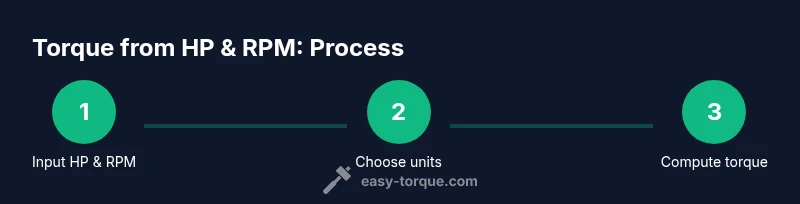
- Gather inputs: horsepower (HP) and engine speed (RPM). 2) Decide desired unit: lb-ft or Nm. 3) Apply the lb-ft formula if using imperial units: T(lb-ft) = HP × 5252 / RPM. 4) If you need Nm, convert the result: T(Nm) = T(lb-ft) × 1.356, or use the direct Nm form T(Nm) ≈ HP × 7120 / RPM. 5) Round to a practical value and record the assumptions (peak HP, steady RPM, and drivetrain losses in play). 6) Validate with real-world measurements when possible.
How to handle unit conversions and rounding
Accuracy matters: the 5252 constant comes from unit definitions, and the 1.356 conversion from lb-ft to Nm is exact for engineering practice. When presenting results, show both units if your audience spans multiple regions. Round torque to a sensible precision (e.g., ±1 or ±0.1 Nm) to avoid overconfident claims, especially in safety-critical applications like fastener tightening or drivetrain design.
Practical notes for DIY use
In a workshop, you’ll often use a torque wrench calibrated in Nm or ft-lbs. If you know the engine’s peak HP and the RPM at which it occurs, you can estimate peak torque with the formulas above. Remember that drivetrain losses (in transmissions, differentials, belts, and pulleys) reduce the torque that actually reaches the wheel or fastener, so your calculated value is often a starting point rather than a precise operating figure.
Common units and conversions you should memorize
- 1 HP ≈ 745.7 W; 1 lb-ft ≈ 1.356 Nm. 5252 is the constant that ties HP, torque, and RPM in imperial units. - If you work in metric, use T(Nm) = Power(W) × 60 / (2π × RPM) to derive torque directly from power and RPM. - For quick checks, T(lb-ft) ≈ HP × 5252 / RPM and T(Nm) ≈ HP × 7120 / RPM.
Tools & Materials
- Scientific calculator or calculator app(Enter HP, RPM; perform division and multiplication precisely to avoid rounding errors.)
- HP and RPM data source(Use a spec sheet or measured dyno data for accurate inputs.)
- Unit conversion reference(A quick reference chart helps when switching between lb-ft and Nm.)
- Notebook or digital note(Record assumptions, results, and notes about drivetrain losses.)
Steps
Estimated time: 5-15 minutes
- 1
Identify inputs
Collect the horsepower (HP) and engine speed (RPM) data you will use. Decide whether you want the torque in lb-ft or Nm from the outset to avoid conversion errors.
Tip: If you’re not sure about peak horsepower, use the rated peak HP value from the manufacturer or a reliable dyno result. - 2
Choose your units
Decide whether to report torque in imperial (lb-ft) or metric (Nm) units. This choice will determine which formula you apply.
Tip: A quick mental check: Nm is roughly 1.356 times lb-ft for unit conversions. - 3
Apply the lb-ft formula
If using lb-ft, compute T(lb-ft) = HP × 5252 / RPM. This gives the peak torque in imperial units under ideal assumptions.
Tip: Keep track of the RPM value used; a small change in RPM can cause large torque differences at high power. - 4
Convert to Nm (if needed)
If Nm is required, convert the result: T(Nm) = T(lb-ft) × 1.356, or use T(Nm) ≈ HP × 7120 / RPM directly.
Tip: Direct Nm form avoids two-step rounding errors; use it when you plan to publish metric torque values. - 5
Account for drivetrain losses
Real torque at the wheels or at fasteners is lower due to transmissions, gearboxes, and belt losses. Use a typical loss factor (e.g., 5–15%) if you need practical estimates.
Tip: If uncertain, measure wheel torque with a torque sensor or dyno to validate calculations. - 6
Validate with real-world data
Compare your calculated result with measured torque under known loads. Adjust for efficiency, gearing, and mechanical losses to refine the estimate.
Tip: Document the test conditions so others can reproduce your results.
Your Questions Answered
What is the difference between torque and horsepower?
Torque is the instantaneous turning force at the crank, while horsepower is the rate at which work is done. Horsepower determines how quickly torque can be applied over time, especially as RPM changes.
Torque is the turning force you feel, and horsepower is the rate that force is applied. Together, they describe engine performance.
Why does RPM matter when calculating torque?
RPM sets the denominator in the torque equation. Higher RPM with the same HP yields lower torque, while lower RPM yields higher torque. Torque peaks near the engine’s highest usable RPM range.
RPM is key because it scales the torque output for a given power level; changing RPM changes the torque.
Can I rely on these formulas for real-world measurements?
The formulas provide ideal estimates using peak horsepower and no losses. Real-world results differ due to drivetrain losses, efficiency, and load. Use measurements to validate and adjust your calculations.
These formulas give good starting points, but expect differences in practical setups.
How do I convert between lb-ft and Nm accurately?
1 lb-ft ≈ 1.356 Nm. Use T(lb-ft) × 1.356 to convert to Newton-meters, or use the direct Nm form T(Nm) ≈ HP × 7120 / RPM.
Multiply by about 1.356 to switch from lb-ft to Nm.
What about engine losses when applying torque numbers?
Engine torque numbers assume the crank output. Real-world torque at wheels or fasteners is reduced by transmission and drivetrain losses, often 5–15% or more depending on setup.
Drivetrain losses reduce the torque you actually experience.
Is there a quick way to estimate torque for a given HP and RPM range?
Yes. Use T(lb-ft) ≈ HP × 5252 / RPM for imperial units, then convert to Nm if needed. This gives a fast check before more detailed analysis.
Use the basic formula for a fast estimate, then refine with measurements.
When should I use Nm instead of lb-ft?
Choose Nm when working with metric bolts, torque wrenches, or standards in countries using the metric system. Keep consistency across the project.
Pick the unit that matches your fasteners and tools.
Watch Video
Top Takeaways
- Calculate torque from HP and RPM using T(lb-ft) = HP × 5252 / RPM.
- Convert to Nm with T(Nm) ≈ HP × 7120 / RPM for a direct estimate.
- Account for drivetrain losses when applying ideal torque values.
- Validate calculations with real-world measurements when possible.