How to Tell If Torque Converter Is Locking Up: Quick Guide
Learn how to tell if your torque converter is locking up with a practical, step-by-step approach. Quick checks, diagnostics, and maintenance tips from Easy Torque.


Torque converter lock-up occurs when the converter’s clutch engages to create a direct drive between engine and transmission during steady cruising. The quickest signs are a return to a steady engine RPM at speed, reduced vibration, and improved fuel economy after a quick acceleration. To verify, monitor live transmission data with a scan tool and perform a controlled road test to confirm lock-up engagement and release points.
How torque converter lock-up works
In an automatic transmission, the torque converter uses a lock-up clutch to create a near-direct connection between the engine and the transmission. This minimizes slip, reduces heat, and improves fuel efficiency at steady speeds. Lock-up typically engages in cruising ranges and light-to-moderate throttle, then releases briefly during heavy acceleration or rapid throttle changes. Modern systems may use multiple strategies, including full lock-up and controlled slip, managed by the transmission control module (TCM) and engine ECU. For DIY enthusiasts, understanding the basics helps you recognize when behavior is normal versus when it hints at a fault. According to Easy Torque, most implementations aim for smooth engagement around typical highway speeds, but irregular engagement points can signal sensor, wiring, or hydraulic issues rather than a simple mechanical failure.
Signs that torque converter lock-up is engaged
- Steady RPM at a given road speed with minimal engine fluctuation.
- Noticeable decrease in engine vibration and noise once cruising is established.
- Improved fuel economy during prolonged steady driving compared to stop-and-go conditions.
- A brief ignition or transmission light behavior change when lock-up engages or disengages, as the ECU adjusts the clutch.
- Occasional shudder or harsh feel if the lock-up transitions at a wrong throttle position.
Distinguish lock-up from slipping; a slipping converter generally shows persistent RPM mismatch and more heat, while lock-up reduces slip and stabilizes RPM. If in doubt, use a diagnostic tool to correlate TCC status with engine RPM and vehicle speed.
Safe, practical checks you can perform
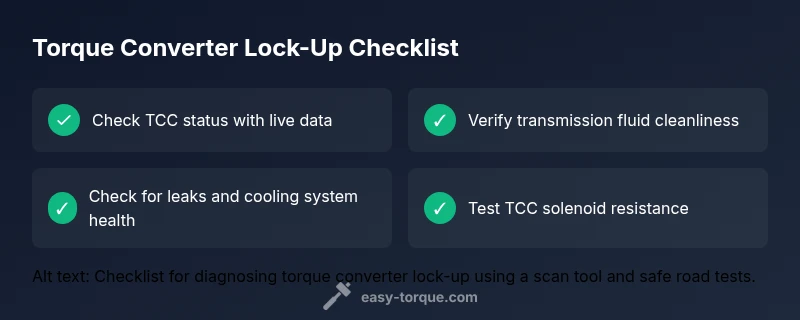
- Park on level ground, check the transmission fluid level and condition, and ensure the vehicle is cool before inspecting the pan area for leaks.
- On a safe highway, drive at a steady speed (typically highway speeds) and monitor live data with a scan tool to see if the TCC status toggles on and off predictably.
- Verify that the cooling system is working well, since excessive transmission heat can affect the lock-up function and overall transmission life.
- Check for transmission codes related to the torque converter clutch and inspect wiring/connectors for signs of wear or damage.
- If possible, perform a controlled throttle test: accelerate from a constant speed to a higher speed and observe whether RPM settles into a steady range, indicating lock-up engagement.
Diagnostic approach you can follow (flow you can trust)
This section outlines a practical approach you can take in a typical driveway or shop setting. Start with the simplest checks and progress to more involved tests only if the symptoms persist.
- Confirm the symptom: steady RPM at cruising speed with minimal acceleration.
- Check codes: scan for torque converter clutch or transmission-related DTCs and review live data.
- Inspect wiring and solenoids: test the TCC solenoid resistance and look for harness damage.
- Verify fluid condition and pressure: ensure the fluid is clean and pressures are within spec.
- Road test: observe lock-up engagement at different throttle and speed ranges to map engagement and release points.
- If unanswered, escalate: possible valve body or internal hydraulic issues may require a professional.
Safety first: never work under a car that is not properly supported, and always use proper protective gear when inspecting components or test-driving.
When to involve a professional and maintenance tips
If you repeatedly notice inconsistent lock-up engagement, or if the vehicle enters limp mode or throws transmission codes, it’s time to involve a qualified technician. A trained pro can test hydraulic pressures, valve body operation, and the TCC circuit with specialized tools. Regular maintenance helps prevent lock-up issues: use the correct transmission fluid, change it at recommended intervals, ensure the cooling system is intact, and address leaks promptly. Early diagnosis saves heat, wear, and potential repairs down the line.
Steps
Estimated time: 60-90 minutes
- 1
Prep and safety check
Park on level ground, engage the parking brake, and allow the transmission to cool. Gather the toolset: OBD-II scanner, basic multimeter, and a clean container for fluid sample if needed. Inspect for leaks and ensure adequate lighting to work safely.
Tip: Never work under a vehicle supported only by a jack; use stands. - 2
Connect diagnostic tool
Connect the OBD-II scanner to read PCM/TCM data and check for any torque converter clutch related codes. Record live data for RPM, vehicle speed, and TCC status while cruising at a steady speed.
Tip: Note the exact gear and cruise speed when lock-up is observed. - 3
Perform a controlled road test
Drive on a safe, flat highway at a steady speed and moderate throttle. Observe whether RPM stabilizes in a narrow band and if TCC turns on or off predictably. Document wheel speed vs engine RPM to map engagement.
Tip: If you can, repeat at different speeds within the manufacturer’s recommended ranges. - 4
Isolate the TCC circuit
If no clear lock-up signal appears, test the TCC solenoid by resistance or with a bench test if accessible. Check wiring continuity from the solenoid to the PCM/TCM and verify grounds.
Tip: Avoid forcing signals; rely on proper test equipment and service manual specs. - 5
Inspect fluid and valve body health
Check transmission fluid for correct level and condition. If the fluid is dark or smells burnt, perform a fluid service and inspect valve body area for deposits or clogging that could affect hydraulic pressure.
Tip: Never mix old and new fluid; use the exact spec recommended by the OEM. - 6
Decide on next steps
If symptoms persist after checks, plan a professional inspection focusing on valve body, clutch packs, or potential mechanical wear. Document all test results to aid diagnosis.
Tip: Prevent future issues with routine maintenance and early detection.
Diagnosis: Cruise at highway speeds with RPM stabilizing while speed continues to rise, or abrupt changes in feel during steady-state driving
Possible Causes
- highTCC solenoid or clutch circuit fault
- mediumWiring harness fault or poor connections
- mediumHydraulic pressure issue in the valve body
- lowECU/TCM miscalibration or software issue
Fixes
- easyScan for DTCs and monitor live data; inspect TCC solenoid resistance and harness continuity
- mediumRepair or replace faulty wiring, connectors, or the solenoid; verify voltage supply and ground paths
- mediumCheck hydraulic pressures, replace valve body seals if needed, and ensure proper fluid condition
- hardUpdate or recalibrate ECU/TCM; confirm the transmission fluid is clean and at correct level
Your Questions Answered
What is torque converter lock-up and why is it used?
Torque converter lock-up is a mechanism that locks the torque converter for a direct engine-to-transmission drive. It improves efficiency during steady cruising by reducing slip and heat buildup. The locking mechanism is controlled by the transmission’s ECU/TCM and varies by model.
Lock-up is when the torque converter locks for a direct drive to improve efficiency during cruising.
How can I tell if the converter is locking up while driving?
Watch for a stable engine RPM at a constant speed, reduced vibration, and steady fuel economy while cruising. Use a scan tool to confirm TCC on/off status and correlate it with road speed.
Look for steady RPM and less vibration when cruising; confirm with a scan tool.
Can a failing torque converter prevent lock-up?
Yes. A failing converter can prevent lock-up from engaging, cause slipping, overheating, and poor fuel economy. Diagnosis often starts with electrical tests and live data before inspecting hydraulic components.
A bad converter can stop lock-up from engaging and cause slipping and overheating.
Is lock-up the same as transmission slipping?
No. Lock-up is a controlled engagement to minimize slip. Slipping is a symptom of wear or hydraulic issues that keep the converter from maintaining a solid connection.
Lock-up is intended to stop slipping; slipping means the connection isn’t solid.
Should I always expect lock-up at highway speeds?
Most vehicles use lock-up at cruising speeds, but the exact engagement range varies by make and model. Some systems may show intermittent slip during certain throttle conditions.
Lock-up usually happens at cruising speed but varies by model.
What maintenance helps ensure reliable lock-up?
Keep transmission fluid clean and at the correct level, ensure the cooling system works, and schedule regular service intervals. Address leaks and replace worn components promptly to maintain proper hydraulic pressure.
Regular service and proper fluid levels help keep lock-up reliable.
Watch Video
Top Takeaways
- Understand lock-up as a controlled clutch engagement for efficiency.
- Use live data to verify TCC status during cruising.
- Differentiate lock-up from slipping by RPM stability and heat signs.
- Start with simple electrical checks before hydraulic inspections.
- Consult a professional for valve body or clutch issues.