Signs of a Failed Torque Converter: Troubleshooting Guide
Identify and fix signs of a failed torque converter with a practical troubleshooting guide. Learn common causes, safe checks, diagnostic flow, and step-by-step fixes to protect your transmission.


Most signs point to the torque converter clutch or fluid problems. The most likely cause is worn clutch materials or contaminated transmission fluid, which causes slipping, shuddering, or hard shifting. Quick fixes: check transmission fluid level and condition, replace dirty or burnt fluid, and avoid heavy towing until a professional can diagnose and, if needed, replace the converter.
Signs of a Failed Torque Converter
The primary signs of a failed torque converter are often dramatic and affect drivability. You may notice slipping where the engine revs rise without a corresponding increase in vehicle speed, shuddering when accelerating from a stop, or hard, delayed, or erratic shifts between gears. Overheating can trigger a transmission temperature warning, and the transmission may feel briefly locked in a gear at low speeds. In many vehicles the Check Engine light or a transmission fault code appears, signaling a problem in the transmission system—not just a single worn part. The keyword signs of a failed torque converter should be understood as a problem that can mimic other transmission faults, such as a failing solenoid or a damaged valve body. According to Easy Torque, these symptoms often indicate a torque converter clutch or fluid issue rather than a pure mechanical failure, which guides how you approach diagnosis and repairs. If you experience persistent symptoms, treat it as urgent and seek a professional assessment soon to avoid cascading damage.
Why symptoms occur and how to interpret them
A torque converter is a fluid-coupled device that transmits engine torque to the transmission. When its clutch plates or turbine resistors wear, you lose smooth torque transfer, which manifests as slipping and late engagement. Contaminated or burnt transmission fluid reduces hydraulic pressure, leading to inconsistent shifts and poor response. Excessive heat from heavy towing, aggressive driving, or a restricted cooling system accelerates wear. The net effect is a symptom set that looks like many possible issues, which is why a systematic diagnosis matters. While some fixes can be performed at home (for example, a fluid change if the fluid is old or degraded), most deeper issues require professional tools and service to return the system to health.
Common culprits behind the signs of a failed torque converter
The most common root causes include worn clutch materials inside the converter, contaminated or burnt transmission fluid, and overheating due to heavy loads or an underperforming cooler. Less frequent but important factors are a faulty torque converter solenoid, debris in the transmission fluid, and a degraded transmission filter. In extreme cases, the torque converter may fail due to a defect in the stator or lock-up mechanism. Distinguishing these causes helps prioritize corrective actions and avoid unnecessary replacements.
Safe checks you can perform before a diagnosis becomes expensive
Before pulling apart the transmission, perform non-destructive checks: verify transmission fluid level with the vehicle on level ground and the engine warmed up; inspect the fluid color and smell (burnt or metallic notes signal degradation); look for external leaks and a clogged or damaged cooler. If you have access to an OBD-II scanner, pull transmission codes related to pressure, solenoids, and generic powertrain faults. Document when the symptoms occur (idle, acceleration, cruising, or cold starts) to help a technician. Remember, working with transmissions can involve high pressures; if you’re unsure, stop and call a professional.
How to approach the diagnostic flow when symptoms appear
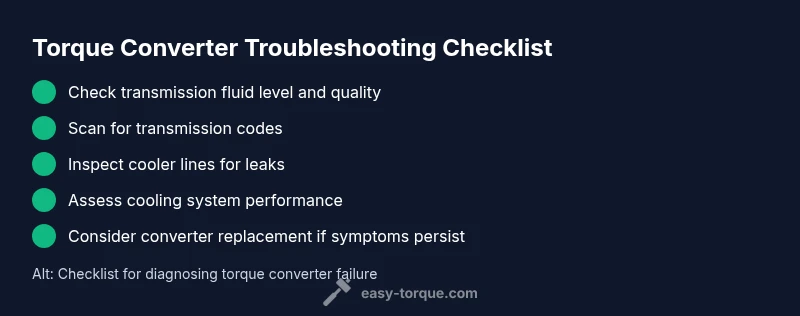
Treat these signs as a signal to step through a diagnostic flow rather than guessing. Start with the simplest checks: fluid level and condition; then scan for codes; next, perform a hands-on check of transmission lines and the cooler circuit. If you find abnormal codes or persistent symptoms, advance to more in-depth testing such as pressure readings and a stall test performed by an experienced technician. The goal is to confirm whether the fault is within the torque converter, the valve body, or the overall transmission.
When the most common cause is confirmed, a practical fix path
If the fluid is degraded or contaminated, perform a controlled drain and refill with the correct specification. If transmission fluid is burnt, a full fluid change is essential, but this alone rarely resolves a converter problem. The most common repair is a torque converter replacement or rebuild, which should be performed by a qualified technician given the complexity and the risk of further damage. In some cases a conjunction of fixes—fluid refresh, cooler repair, and valve body inspection—produces a reliable outcome. Always verify your repair with a road test and data logging to ensure the issue is resolved.
Prevention tips to minimize future signs
Practice proactive maintenance: follow the manufacturer’s service intervals for transmission fluid changes, use the correct spec fluid, and keep the transmission cooler clean and unobstructed. Avoid lugging the engine, towing beyond rated capacity, and driving with a slipping or overheating system for long periods. Regular fluid tests and professional inspections after heavy use help catch wear before it becomes costly.
Steps
Estimated time: 1-3 hours
- 1
Check fluid level and condition
With the engine warm and the vehicle on a level surface, locate the transmission dipstick (or fill port) and verify fluid level. Inspect color and smell; burnt fluid indicates deeper problems. If it’s low or dirty, perform a safe fluid drain-and-fill using the manufacturer-recommended specification.
Tip: Use the vehicle’s service manual fluid spec and a clean funnel to avoid contamination. - 2
Scan for codes and review live data
Connect an OBD-II scanner or professional transmission tool to read trouble codes related to the transmission. Note any codes for pressure, solenoids, and temperature. Record live data such as fluid temperature, line pressure, and gear state for later comparison.
Tip: Save screenshots or a data log to share with a technician. - 3
Perform a non-destructive pressure check
If you have the equipment, check transmission line pressures at idle and at a few RPM points. Look for pressures that are significantly lower than the spec; inconsistencies can point to a fluid or valve problem rather than a mechanical failure in the converter.
Tip: Only perform this if you’re trained and equipped; incorrect testing can cause damage. - 4
Inspect the cooler and fluid path
Inspect transmission cooler lines for leaks and signs of contamination (milky fluid suggests coolant crossover). Ensure the cooler is not clogged and that the fluid path is free of obstructions. A cooler leak can rapidly degrade fluid quality.
Tip: A simple radiator pressure test can help confirm leaks. - 5
Decide on repair approach
If the issue follows fluid problems, perform a controlled drain and fill and monitor. If symptoms persist, plan for a converter inspection or replacement by a qualified shop. Document findings for the technician.
Tip: Torque converter replacement is a major job; budget for labor and parts. - 6
Road test and verify repair
After the repair or fluid service, take a controlled test drive to verify smooth shifts, consistent temperatures, and no residual codes. Check for leaks and re-check fluid level after the drive.
Tip: Keep notes on shifting behavior so you can compare with post-repair behavior.
Diagnosis: Vehicle exhibits slipping, shuddering, or hard shifts indicating a potential torque converter issue
Possible Causes
- highLow or degraded transmission fluid
- highWorn torque converter clutch or internal wear
- mediumFaulty solenoids or valve body affecting fluid pressure
- mediumOverheating or drag on the converter due to cooling issues
- lowContaminated cooler lines leading to fluid contamination
Fixes
- easyTop up/replace transmission fluid with the correct spec
- hardInspect and replace worn torque converter or clutch assembly
- mediumTest and repair faulty solenoids or valve body
- mediumImprove cooling and eliminate overheating
- easyReplace damaged cooler lines or fix leaks to prevent contamination
Your Questions Answered
What are the most common signs of a failed torque converter?
Common signs include slipping, shuddering, overheating, and hard or delayed shifts. You may also see a transmission warning light. These symptoms can resemble other transmission problems, so a systematic check is essential.
Common signs are slipping, shuddering, overheating, and hard shifts. If you notice these, get a proper diagnosis soon.
Can I drive with a suspected torque converter problem?
Driving with suspected torque converter issues risks further damage to the transmission and converter. If you notice symptoms, limit driving and seek professional diagnostics.
It’s risky to keep driving. Limit use and get a professional diagnosis as soon as possible.
Is a torque converter failure the same as a transmission failure?
Not exactly. A converter failure is within the automatic transmission system but is distinct from issues like worn gears or valve bodies. The symptoms can overlap, which is why testing matters.
They're related, but a converter failure is not the same as a full transmission failure. Testing helps tell them apart.
What tests confirm torque converter problems?
Tests include fluid analysis, electrical/solenoid checks, diagnostic trouble codes, and, in some cases, a stall or pressure test performed by a professional.
Tests involve codes, fluid checks, and sometimes a stall or pressure test by a pro.
What should I do if I suspect a torque converter problem?
Schedule a professional inspection promptly. In the meantime, avoid heavy towing, monitor fluid levels, and maintain a log of symptoms to aid diagnosis.
See a professional soon and avoid heavy loads until it’s checked.
Can a simple fluid change fix a failing torque converter?
A fluid change can improve conditions if the fluid is old or degraded, but it rarely resolves a converter with internal wear or mechanical failure.
A fluid change helps if fluid is the issue, but it won’t fix worn or broken internal parts.
Watch Video
Top Takeaways
- Inspect fluid first to rule out fluid-related causes.
- Symptoms can mirror other transmission issues—confirm with tests.
- Professional service is often required for torque converter replacement.
- Regular maintenance reduces the chance of fluid-related signs.
- Address overheating promptly to protect the converter.