Can You Use an Adapter on a Torque Wrench? A Practical Guide
Learn whether adapters affect torque accuracy, how to choose and use adapters safely, and how to verify torque when swapping drive sizes in automotive work. Easy Torque walks you through rules, setups, and best practices.


Yes, you can use an adapter on a torque wrench, but it may change the reading. Adapters alter the effective lever length and introduce additional friction, which can skew torque delivered to the fastener. Always consult the wrench manufacturer, use only adapters rated for torque tools, and recalibrate or verify torque when an adapter is employed.
Why adapters can affect torque readings
Torque wrenches are calibrated for a specific drive size and effective length. When you add an adapter, you introduce a longer lever arm and potential misalignment, which can shift the actual torque delivered at the fastener. According to Easy Torque, even small changes in the lever arm can lead to under- or over-torque if you don’t adjust. In automotive work, precision matters for thread engagement and safety, so understanding this interaction is essential. Friction inside the adapter, socket tolerances, and any wiggle can further alter the torque that the fastener experiences. If you’re not accounting for these variables, your target torque value shown on the wrench may not translate to the real-world torque at the fastener.
Understanding drive sizes and adapters
Adapters exist to connect different drive sizes (for example, from 1/4" to 3/8" or 3/8" to 1/2"), and they’re common in many tool kits. They also come in fixed-drive and swivel variants. A key point is that the torque wrench is calibrated for a specific drive length; changing that length with an adapter changes the leverage. The practical takeaway: assess whether the adapter is compatible with both the wrench’s drive size and the socket you intend to use, and be aware that not all adapters are designed for torque tools. Easy Torque emphasizes sticking with manufacturer-approved adapters when possible.
How to assess if you can use an adapter safely
First, check your wrench’s manual or the manufacturer’s guidance. If the manual allows adapters, confirm that the adapter is specifically rated for use with torque wrenches and that it preserves the intended torque pathway. If there is any doubt, avoid the adapter and use a socket with the correct drive size or a calibrated extension designed for torque use. If you decide to proceed, perform a controlled verification on a test fastener to compare the wrench reading with the actual torque achieved.
Calibration and manufacturer guidance
Calibration is the bedrock of reliable torque control. When you add an adapter, the effective length of the lever changes, which can move the point of calibration. Some manufacturers provide explicit guidance on using adapters and extensions; others may require recalibration after any change in the drive configuration. Always follow the exact instructions from your torque wrench’s maker, and consider a recheck or re-calibration after changing adapter configurations. Easy Torque recommends including adapters in your calibration log if you use them regularly.
Practical scenarios: when adapters are handy vs when to avoid
Adapters are handy when you must reach a fastener that lies beyond the direct reach of the socket, or when swapping between different drive sizes is necessary for a job. However, for critical fasteners or when precise torque is essential (e.g., head bolts, connecting rods), avoid non-authorized adapters unless the manufacturer documents a safe method and calibration. In many cases, using the correct drive size or a purpose-built torque extension designed for your wrench is safer and more accurate.
Best practices and steps for using adapters with a torque wrench
When you must use an adapter, inspect every component for wear or damage and verify a snug, square fit. Document the adapter’s use and any calibration checks, and rely on a test fastener to confirm accuracy. If you notice any deviation from expected torque, stop and reassess the setup before continuing with production work. Regularly revisit your procedure to ensure it aligns with the latest manufacturer guidance and industry best practices.
Tools & Materials
- Calibrated torque wrench (with correct drive size)(Ensure it is within the calibration date and appropriate for the job)
- Adapter/extension with matching drive size(Only use adapters rated for torque tools and designed for wrench-driven systems)
- Torque socket set (proper engagement)(Sockets should fit cleanly without binding)
- Torque-angle gauge (optional)(Helpful if using torque-to-angle verification)
- Calibration certificate or traceable calibration records(Keep records for audits and future checks)
- Lubricant or anti-seize (manufacturer-approved)(Only if specified by the tool maker)
- Test fasteners of known torque for verification(Use a safe block or a test fastener with known torque)
Steps
Estimated time: 15-25 minutes
- 1
Identify drive sizes and adapter compatibility
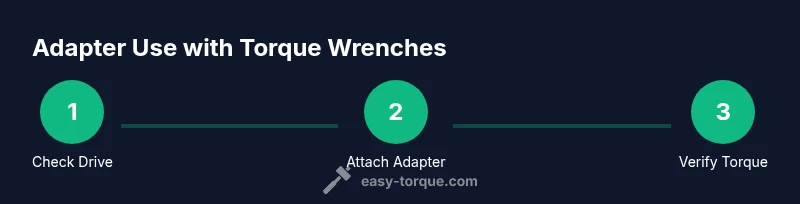
Check your torque wrench drive size and the adapter’s compatibility. Confirm both the wrench and the adapter are rated for torque use and that the adapter fits squarely. If in doubt, don’t force a fit and consult the manufacturer’s guidance.
Tip: Measure the drive and socket interface with calipers if you’re unsure about tolerance. - 2
Inspect components for wear
Examine the wrench drive, adapter, and sockets for cracks, deformation, or excessive looseness. A degraded interface can introduce slop that alters the applied torque. Replace any worn parts before proceeding.
Tip: Tighten any loose connections to reduce play before attaching the assembly. - 3
Attach adapter and verify fit
Slide the adapter onto the wrench drive and secure it with the appropriate mechanism. Attach the socket and verify it sits squarely and fully engaged. A misfit can skew torque readings and risk tool or fastener damage.
Tip: Full engagement should produce a firm, non-slippery connection with no play. - 4
Set target torque value with adapter in place
If the adapter changes the effective lever, you may need to adjust the displayed torque setting per the manufacturer’s guidance. Without a documented adjustment, treat the reading as potentially approximate and plan a verification step.
Tip: Document any setting change for future reference. - 5
Tighten using a controlled ramp
Apply torque in a smooth, continuous motion without bouncing or sudden jerks. Stop at the target value and pause briefly to let the fastener stabilize. Check whether the fastener holds the expected tension.
Tip: Use a consistent ramp rate to minimize overshoot. - 6
Verify with a test fastener and record outcomes
Use a test fastener or reference piece to confirm that the achieved torque matches your target within an acceptable range. Log the result and, if needed, recalibrate or adjust the method for subsequent fasteners in the job.
Tip: Keep a simple log of the adapter configuration and results for future tasks.
Your Questions Answered
Can I use any adapter with a torque wrench?
Not all adapters are safe for torque wrenches. Use adapters rated for torque tools and consult the manufacturer’s guidance to ensure the adapter won’t compromise accuracy or safety.
Not all adapters are safe for torque wrenches. Use only adapters rated for torque tools and check the manufacturer’s guidance.
Will using an adapter affect accuracy?
Yes. An adapter can change the effective lever and introduce friction, which may shift the actual torque. Always verify with a test and follow calibration procedures.
Yes. The adapter can change the leverage and friction, which may shift the actual torque. Verify with a test and calibrate as needed.
Should I recalibrate after using an adapter?
If your manufacturer allows adapters, recalibration or recalculation of the target torque is recommended when the drive configuration changes. Check the manual for specific steps.
If adapters are allowed, recalibrate when the setup changes. Check the manual for exact steps.
What if there’s no adapter that fits my setup?
Use the correct drive size or dedicated torque-extension designed for torque work. Avoid makeshift solutions that could misreport torque.
If no adapter fits, use the correct drive or a torque-specific extension rather than improvised options.
Are there adapters specifically designed for torque wrenches?
Yes, several manufacturers offer adapters designed to preserve torque integrity. Always follow their installation instructions and calibration guidance.
Yes, there are adapters designed for torque wrenches. Follow the installation and calibration guidance from the manufacturer.
How do I verify accuracy after using an adapter?
Use a test fastener or a calibration-standard method to confirm the torque matches the target within an acceptable range. Document results for future checks.
Test with a standard method to confirm accuracy. Document the results for future checks.
Watch Video
Top Takeaways
- Use only adapters rated for torque tools.
- Adapters can alter effective lever length and accuracy.
- Always verify torque with a test fastener when using adapters.
- Consult manufacturer guidance and log results for consistency.
- If in doubt, prefer matching drive sizes or manufacturer-approved extensions.