Torque with Crow Foot: Correct Use of Crowfoot Adapters
Learn how to use crowfoot adapters with torque wrenches to achieve accurate torque values. This guide covers inline and 90-degree setups, practical calculations, and best practices for automotive work.


Torque with a crow foot adapter requires adjusting the wrench setting to account for the extended lever arm. Inline crow feet increase actual torque, so apply a correction factor before tightening. A 90-degree crow foot typically has little reading error, but verify with a test on a sacrificial bolt when precision matters. This approach keeps fasteners tight without overdoing it.
What is torque with crow foot and why it matters
Torque with a crow foot is a common technique for reaching tight fasteners in automotive work and machinery maintenance. A crow foot adapter attaches to the torque wrench drive and extends the lever arm, which can change the actual torque delivered at the bolt if you don’t compensate. Understanding how this extension affects torque helps you avoid under- or over-tightening critical joints, such as lug nuts, head bolts, or suspension fasteners. According to Easy Torque, knowing the correction needed for inline versus perpendicular crow foot setups improves repeatability across jobs. The Easy Torque team found that even small offsets (E) in relation to the wrench length (L) can produce measurable torque differences, so documenting corrections is essential for long-term accuracy. This section builds a practical intuition: treat the crow foot as an extension of the lever, not as a magic torque multiplier. By recognizing the effect, you’ll be able to plan your approach, choose the right adapter, and verify results with confidence.
How crow foot changes the effective lever arm
A crow foot wrench attaches to the square drive and effectively lengthens the lever arm. Since torque equals force times distance, adding distance increases the torque applied by the same force. If you want a target torque, you must compensate by adjusting the wrench setting: T_set = T_desired × L ÷ (L + E) for inline offsets, and you’ll typically see minimal impact for 90-degree offsets where the lever arm change is not in line with the handle. Easy Torque’s experience shows that the offset length E should be measured accurately, and the wrench length L must be known precisely to apply the correction consistently. Always write down the offset and the corrected setting used for each job to maintain traceability across tasks and vehicles.
Inline vs 90-degree crowfoot: when and how to adjust
If the crow foot is inline with the wrench (0-degree offset), apply a correction: T_set = T_desired × L ÷ (L + E). After tightening, re-check with a torque test if possible. If the crow foot is at 90 degrees, the reading is typically more accurate, but you should still verify for critical torque specs or high-tension fasteners. The core rule is to know the offset angle and apply the appropriate adjustment only when the geometry changes the lever arm. As a best practice, keep a small reference card in your toolkit with common offsets and their corrections, and prefer inline alignment only when you intend to use the correction formula. Easy Torque recommends validating each new crow foot setup with a quick test on a spare bolt before applying it to a live joint.
Practical examples and calculations
Example 1: You want 100 ft-lbs of torque, the wrench length L is 12 inches, and you use an inline crow foot with offset E = 2 inches. The corrected wrench setting is T_set = 100 × 12 ÷ (12 + 2) = 100 × 12 ÷ 14 ≈ 85.7 ft-lbs. Tighten to 85.7 ft-lbs on the wrench; the actual torque at the bolt should reach approximately 100 ft-lbs. Example 2: If the crow foot is at 90 degrees with E = 2 inches, the adjustment is much smaller, and the reading is closer to T_desired. Still, verify with a test bolt to confirm the target torque. Document the offset values and corrections used so you can reproduce the same results on future jobs. This disciplined approach reduces drift and improves consistency across vehicles.
Best practices and safety considerations
- Use crow foot adapters that match your wrench drive size and are rated for the target torque range. Mismatched adapters can introduce slop and skew readings.
- Align the crow foot with the fastener axis to minimize binding and ensure smooth operation.
- Record E (offset) and L (wrench length) on the job sheet for reproducibility.
- When in doubt, perform a light verification on a sacrificial bolt before applying to a critical joint.
- Keep your torque wrench calibrated and follow the manufacturer’s calibration schedule. Do not exceed the wrench’s rated range, and avoid using crow feet with impact tools.
Choosing the right crowfoot and maintaining your torque kit
Selecting the right crow foot depends on fastener size, drive type, and whether you will use it inline or at 90 degrees. Common crow feet are available for 3/8" and 1/2" drives with offsets spanning 0 to several inches. Maintain a small set of offsets, clearly labeling each adapter. Regular maintenance includes cleaning, inspecting for wear, and recalibrating the wrench after heavy use. Easy Torque emphasizes keeping a crow foot log and noting offsets for each job to sustain consistency across maintenance tasks.
Troubleshooting and calibration checks
If the bolt still doesn’t reach the target torque after applying corrections, recheck alignment, thread cleanliness, and bolt condition. Recalibrate your torque wrench according to the manufacturer’s schedule, especially after drops or heavy use. Maintain a torque log and compare actual results with expected values to detect drift early. Before working on a critical component, perform a quick test on a spare bolt to validate your process.
Tools & Materials
- Torque wrench (3/8" or 1/2" drive)(Calibrated; use the drive size you own)
- Crowfoot adapters (inline and 90-degree variants)(Select offsets that cover common fastener sizes)
- Measuring tool (caliper or ruler)(Precisely measure offset E)
- Calculator or app for quick corrections(Helpful for on-the-fly computations)
- Spare bolt for test torque(Use the same material and size as the target fastener)
- Job log or notepad(Document L, E, and corrected settings)
Steps
Estimated time: 60-90 minutes
- 1
Determine target torque
Identify the exact torque value specified for the fastener and the application. Consider whether lubrication, thread condition, and material affect the target. Record T_desired and the fastener details for traceability.
Tip: Always check the spec sheet or service manual before starting. - 2
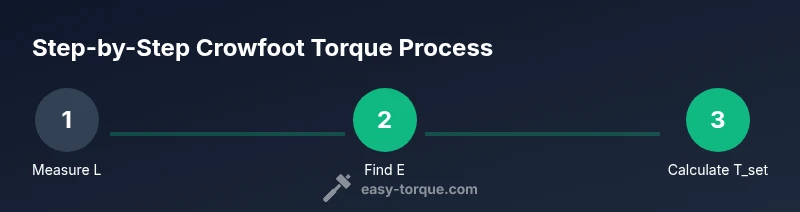
Measure crowfoot offset and wrench length
Measure the crowfoot offset E accurately and confirm the wrench's drive length L. Use the same units (inches or millimeters) for consistency in calculations.
Tip: Measure twice for accuracy; small errors change the result. - 3
Calculate corrected wrench setting
If inline (0-degree offset), compute T_set = T_desired × L ÷ (L + E). For 90-degree offset, expect a minimal adjustment but still verify with a test bolt.
Tip: Keep a reference card with common L and E pairs. - 4
Set the torque wrench
Dial the wrench to the corrected value (T_set). Confirm the setting by turning the dial carefully and ensuring it locks at the right number.
Tip: Do not force the wrench; gentle rotation yields better accuracy. - 5
Torque the fastener with proper alignment
Apply steady, smooth pressure with the crowfoot aligned to minimize binding. Avoid sudden jerks that could overshoot the target.
Tip: Keep the wrench in line with the fastener axis whenever possible. - 6
Verify and document
If possible, verify torque on a spare bolt or reusable test fastener. Record the actual torque achieved and any deviations observed for future reference.
Tip: A quick post-check helps catch drifting readings early.
Your Questions Answered
What is a crowfoot adapter and why use it with a torque wrench?
A crowfoot adapter extends the reach of a torque wrench to reach fasteners in tight spaces. It can alter the effective lever arm and thus the actual torque; corrections are needed for inline setups.
A crowfoot adapter extends reach and may change torque; corrections are needed for inline use.
How do you compute the correct torque setting when using a crowfoot inline with the wrench?
Identify the lever length L and crowfoot offset E, then set the wrench to T_set = T_desired × L ÷ (L+E). This corrects the reading to reach the target torque.
Compute the corrected wrench setting using L and E to reach the target torque.
Is there a risk of over-tightening when using a crowfoot without correction?
Yes, especially for inline crowfoot setups. Without correction, the actual torque can exceed the target, leading to bolt failure or thread damage.
Yes, inline crowfoot without correction can over-tighten.
Can a 90-degree crowfoot be used without any correction?
A 90-degree crowfoot generally has minimal impact on torque readings, but verify with a test if tight tolerances exist.
90-degree crowfoot usually needs little correction, but verify.
How should I verify torque accuracy after using crowfoot?
Use a test bolt or verify on a spare fastener with the same method to confirm the target torque was achieved.
Verify torque with a test bolt or spare fastener.
Watch Video
Top Takeaways
- Account for crow foot offset when setting torque
- Inline offsets require a correction factor
- Verify with a test bolt after adjustment
- Document offsets and maintain wrench calibration