How to Use a Torque Wrench Nm: Practical DIY Guide
Learn how to use a torque wrench in newton-meters (Nm) with clear steps, tips, and safety notes. Easy Torque guides setup, calibration, and proper technique for precise fasteners.


Goal: accurately tighten fasteners to the specified Nm with a calibrated torque wrench. You’ll learn how to read Nm specs, set the wrench, apply steady torque, and verify the result. This quick guide also covers safety considerations, common mistakes, and practical tips for reliable, repeatable results. By following these steps, you’ll be better equipped to handle automotive maintenance with confidence. how to use torque wrench nm is the core skill you’ll develop here.
The Nm Concept and Why It Matters for Every DIYer
Newton-meters (Nm) are the standard unit for torque in automotive work. When you tighten a bolt to the specified Nm, you ensure the fastener has enough clamping force without risking thread stripping or bolt failure. A torque wrench is designed to measure this force so you can apply precise torque. For enthusiasts seeking to master practical maintenance, knowing how to use torque wrench nm is a foundational skill. According to Easy Torque, accuracy begins with understanding the spec, selecting the right wrench, and performing a calm, controlled tightening cycle. In this section, you’ll learn what Nm means in real terms, how to read the spec on a parts sheet, and why this value matters across different components. The goal is not just to reach a number but to achieve repeatable, safe results across your projects. As you gain experience, you’ll recognize that the Nm target is a guardrail—too little leads to looseness, too much risks damage, and the correct amount ensures reliability. The guide below translates the theory into practical steps you can apply on wheels, engines, and chassis hardware. Let’s start by clarifying the two big ideas: what the Nm value represents and how the torque wrench communicates that value to you. If you’re wondering how to use torque wrench nm in practice, this guide will break down the approach into actionable steps you can perform in your shop.
Reading Specifications and Interpreting Nm Values
Torque specifications tell you how tight a fastener should be. The key symbol you’ll see is N·m or Nm. The value tells you the torque to apply, not the force you feel in your arms. When you read the spec, locate the Nm that matches the fastener size and the component being fastened. If the spec provides a range (e.g., 20-25 Nm), tighten toward the upper end only after confirming the pattern sequence. If you need to convert to other units, remember that 1 Nm is roughly 0.7376 ft-lbs, but you should rely on your wrench’s Nm readout for accuracy. For the question how to use torque wrench nm effectively, the most reliable path is to use the Nm value exactly as stated by the manufacturer, not a rough estimate from feel. The Nm specification may appear on the part, the vehicle’s service manual, or a repair sheet. Always double-check that you’re using the exact value for your application, since small bolts and critical assemblies (engine, braking, suspension) require precise torque. If you can’t locate a value, do not guess—consult the manufacturer or a trusted repair guide. The goal here is to interpret Nm values correctly so your wrench translates the spec into real-world clamping force.
Choosing the Right Type of Torque Wrench
Not all torque wrenches are created equal, and choosing the right type can save you time and frustration. The most common is the click-type torque wrench, which emits a crisp audible click when the preset Nm value is reached. This model is reliable and simple, making it a favorite for DIYers who work with dozens of fasteners across projects. Digital torque wrenches, on the other hand, provide a numeric readout and can log values, which is useful for repeatable jobs or documentation. Beam-type wrenches are affordable and transparent—the metal scale is visible as you tighten—but require practice to stop exactly at the target Nm. Dial-type wrenches offer precision with a dial indicator and can be helpful where space is limited. Each style has trade-offs: accuracy, cost, ease of use, and maintenance. For a typical workshop focused on automotive repairs, a good approach is to own a primary click-type wrench for accuracy and a secondary beam or digital model for specialized tasks. When you’re wondering how to use torque wrench nm, the selection matters because the wrong tool can lead to under-torqued or over-torqued fasteners. In every case, ensure the wrench’s range covers the Nm values you expect to encounter and that you read the scale or display straight-on to avoid parallax errors.
Calibration, Maintenance, and Reliability
Calibration is the heartbeat of torque accuracy. A wrench can drift over time, and a simple drop, a jammed handle, or sustained heavy use can shift its zero point. Regular checks with a calibration torque tester or by a trusted service can keep your Nm readings honest. Easy Torque Analysis, 2026, notes that most DIY setups should schedule a calibration at least annually or after a drop or obvious torque discrepancy. If you share your workspace with humidity, temperature swings, or heavy dust, consider more frequent checks. To maintain reliability, store the wrench unloaded, with the setting at zero or a mid-point for your typical work range. Always lock a setting on a click-type wrench once set, so it can’t be accidentally changed during use. For digital models, keep the battery fresh and update any firmware as recommended by the manufacturer. When you plan maintenance, create a simple calendar reminder: calibration date, last torque value verified, and any noted drift. This routine helps you sustain accuracy across dozens of projects and extends the life of your tool.
Technique and Practical Application
Using a torque wrench correctly means more than dialing in a Nm value; it requires a smooth, controlled action and proper alignment. Begin by cleaning the fastener and its threads, then place the wrench so the handle and drive are in line with the bolt’s axis. Stand in a stable position and apply even pressure; avoid pushing with your body weight or twisting the wrench sideways. The moment you approach the target Nm, ease into the final portion of the turn and listen or watch for the torque indicator. With click-type wrenches, stop at the audible signal; with digital models, rely on the numeric readout. After reaching torque, give the fastener a small, final check by re-reading the Nm or performing a light turn to confirm the clamp. When you’re learning how to use torque wrench nm, practice on non-critical bolts first to develop feel without risking important components. Remember to reset the wrench to its zero or mid-range after use so the calibration stays accurate for your next job.
Common Mistakes and How to Avoid Them
One of the most common mistakes is torquing by feel instead of the Nm value. Always trust the wrench’s readout or click. Another error is starting with the wrench in mid-range or holding the wrench at the end of its reach; both actions compromise accuracy. A third pitfall is ignoring cross-threading or misalignment: ensure the fastener threads cleanly before applying torque. If you’re in a hurry, you may skip rechecking torque after the initial pass, which increases the risk of under- or over-torque. Finally, never use a torque wrench as a breaker bar or impact tool; this damages the mechanism and invalidates calibration. If a fastener is unusually stiff, back off and use penetrating oil or proper leverage to free it before applying torque. Using the Nm value consistently across repeated jobs will improve your results and reduce guesswork in tough assemblies.
Real-World Scenarios: Lug Nuts, Engine Bolts, and More
Torque wrench nm practices apply across many automotive tasks. For lug nuts, you’ll often follow a star or crisscross pattern to evenly distribute tension, then re-check after all fasteners are snug. For engine or transmission bolts, you must rely on the manufacturer’s Nm specs and the correct sequence to avoid warping or gasket leaks. On suspension components, pay careful attention to the torque pattern and ensure washers, nuts, and studs are clean. In every case, document the Nm value you used and the date of the torque check, so you can compare it against service records later. If you work on a high-mileage vehicle, consider verifying torque values after the first 50-100 miles (or as recommended by the vehicle’s service manual) to catch any relaxation. This approach reduces the chance of failure caused by thermal cycling and vibration. Whether you’re tightening small diameter fasteners or heavy-duty bolts, the underlying principle remains: use the Nm specification, maintain alignment, and re-check to confirm accuracy.
Tools & Materials
- Torque wrench with Nm scale(Choose a digital or click-type wrench; ensure range covers target Nm values and has a recent calibration date.)
- Socket set and adapters(Match drive size to fastener; include deep sockets for recessed bolts.)
- Torque chart or manufacturer specs(Have the exact Nm value on hand for each fastener.)
- Calibration reminder label(Keep track of last calibration date if available.)
- Torque angle gauge (optional)(Needed for angle-torque methods; not required for simple torque.)
- Safety gear(Gloves and eye protection as needed.)
- Torque log(Record readings and dates for your maintenance log.)
Steps
Estimated time: 15-25 minutes
- 1
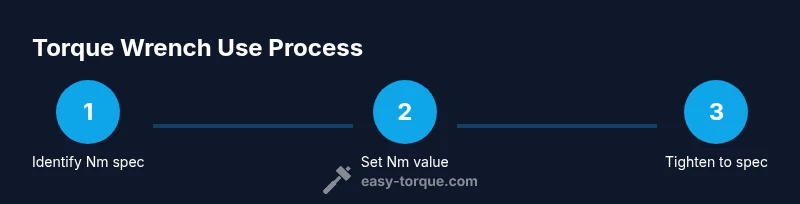
Identify the Nm specification
Find the exact Nm value from the manufacturer’s spec for the specific fastener and component. If there’s a range, start with the lower bound and confirm in a follow-up pass if required. This establishes your tightening target before you touch the fastener.
Tip: Always verify the source of the Nm value (manual, sticker, or OEM doc). - 2
Select the correct socket and attach
Choose a socket that fits the bolt head snugly and attach it to the torque wrench base. Make sure the drive is secure and free of rust or debris that could slip during tightening.
Tip: A loose connection can introduce backlash and inaccurate readings. - 3
Set the wrench to the target Nm
Rotate the handle to the exact Nm value before placing it on the fastener. For digital wrenches, confirm the displayed number; for click-type, set with the dial and lock if your model supports it.
Tip: Double-check the display or dial after adjusting the setting. - 4
Position and align
Place the wrench straight along the fastener’s axis. Ensure the handle is level and you’re balanced to apply force smoothly, not in a twisting motion that offsets the reading.
Tip: Avoid side loads; even misalignment can skew readings. - 5
Apply torque until the wrench signals
Apply steady pressure until the wrench signals a set Nm (click, beep, or digital alert). Do not push past the signal or yank the wrench away; maintain constant contact until the target is reached.
Tip: Pause briefly to avoid overshoot if the signal is delayed. - 6
Recheck torque
If multiple fasteners are involved or if a critical joint is tightened, re-check the torque after initial tightening, following the pattern recommended by the manufacturer.
Tip: Use the star/crisscross pattern for multi-fastener assemblies. - 7
Record and reset
Log the Nm value used and reset the wrench to zero or a safe mid-range. Storing with an uncertain setting can drift calibration over time.
Tip: Keep a simple maintenance log for future reference. - 8
Store properly and review
Store the wrench unloaded in a clean, dry place away from moisture and direct heat. Periodically review calibration dates and any drift notes from recent work to improve accuracy over time.
Tip: Avoid exposing the tool to extreme temperatures; store at room temperature.
Your Questions Answered
What does Nm stand for and why is it important?
Nm stands for newton-meters, a unit of torque. It defines how tightly a fastener should be tightened. Using the correct Nm ensures proper clamping force, avoiding loose joints or damaged threads.
Nm means newton-meters, the torque value you should hit for each fastener. It’s what keeps assemblies secure without overstraining parts.
How do I set the Nm value on a torque wrench?
Turn the wrench’s adjustment dial or input the number on a digital model until the readout shows the target value. Lock the setting if your tool has a lock feature, then verify the display is stable before using it.
Turn or input the Nm value until you see the target number, and lock it if available.
Can I loosen bolts with a torque wrench?
Torque wrenches are designed to tighten to a specific Nm. For loosening, use the wrench in reverse by hand or with a breaker bar, but avoid applying force that exceeds the wrench’s design. Check the manual for guidance.
You should loosen bolts with a method appropriate for removal, not by forcefully twisting a torque wrench.
How often should a torque wrench be calibrated?
Calibration should be performed according to the manufacturer’s recommendations, typically after heavy use, accidental drops, or at least once a year for DIY use. More frequent checks are prudent in harsh environments.
Have your torque wrench calibrated at least annually or after any damage or suspected drift.
What if the bolt is too tight to reach the Nm value?
If a fastener is stiff, apply penetrating oil, wait, and use proper leverage without forcing past the Nm. Don’t skip the torque target—address the obstruction and then re-evaluate torque.
Don’t force it. Clean and apply lubricant, then attempt again, keeping to the Nm target.
Should I re-torque after the vehicle has run?
Some critical joints benefit from a re-check after running the vehicle, especially engine and suspension components. Always follow the vehicle’s service manual for specific guidance on re-torquing.
Check the torque after the initial drive if the manual calls for it, to ensure the joint stays within spec.
Watch Video
Top Takeaways
- Set the Nm value exactly from the spec
- Use the proper socket and alignment
- Tighten smoothly and verify with a recheck
- Document torque values for traceability
- Store and maintain the tool to preserve accuracy