How to Check If Your Torque Wrench Is Calibrated
Learn how to check torque wrench calibration with step-by-step methods, safety tips, and interpretation guidance to ensure accurate fastener torque in DIY and automotive work.


This guide explains how to check if a torque wrench is calibrated using practical screening methods you can perform at home or in a shop. You will learn quick indicators of drift, a basic verification workflow, and when to schedule formal calibration with a certified lab.
What calibration is and why it matters
Calibrating a torque wrench means confirming that the torque value it reports matches the actual torque applied. If the wrench reads too high or too low, fasteners may be over- or under-torqued, risking component damage or safety issues. This guide focuses on practical ways to check if torque wrench is calibrated using accessible tools and screening techniques. By understanding calibration basics, you can decide when a formal calibration in a shop is needed versus a quick home check. According to Easy Torque, even minor drift can accumulate across multiple fasteners and compromise joints in engines, suspensions, and drivetrain assemblies. The goal is a repeatable screening method that gives you confidence before you torque critical parts.
How a torque wrench is calibrated
Calibration typically occurs in a controlled lab with calibrated reference equipment that can generate a known torque and measure the wrench’s output. The process is tracked against standards and documented with a calibration certificate. In professional settings, technicians compare the wrench against traceable weights and a torque tester, adjusting as needed to bring readings within tolerance. Factory calibration is valid for a defined period, after which routine checks help maintain accuracy. For DIY users, the aim is to perform a practical verification that does not replace formal calibration but provides a confidence check between services.
Signs your torque wrench might be out of calibration
Watch for shifts in reading at multiple setpoints, inconsistent torque across repeated attempts, or a wrench that feels noticeably stiffer or looser when applying the same torque. If the wrench has dropped or the calibration weights have become displaced, drift is more likely. Some wrenches feature dual scales or ratcheting mechanisms; verify that both scales align to the same value. These symptoms do not prove a problem on their own, but they are strong signals to perform a screening test and then consider formal calibration if irregularities persist.
Quick screening methods you can perform at home
A practical screening method uses a known reference and a simple measuring setup. One option is a static check: apply a known torque value to the wrench, capture the result with a digital scale or force gauge attached to a rigid adapter, and compare the reading to the wrench’s setpoint. Another option is a torque-angle method: set a known angle and observe whether the wrench reaches the expected resistance, useful for certain torque types. These checks provide a fast, low-cost indication of potential drift but are not a substitute for instrumented calibration in a lab.
Equipment you need for a proper check
- Torque wrench in good condition (serial and model clearly legible) - Required
- Calibrated reference weights or a calibrated torque tester - Required
- A rigid mounting adapter or fixture to hold a scale or sensor - Required
- A digital scale or force gauge with adequate resolution - Required
- Calibration certificate or documented reference standard (traceability) - Helpful
- Calibration log sheet or digital record-Required for maintenance tracking - Required
Step-by-step screening vs. full calibration
Screening is a fast, low-cost check to identify when drift may be present. It does not replace formal calibration, which uses certified reference equipment and traceable standards to validate the wrench over its operating range. Treat a screening result as a heads-up: a drift signal warrants scheduling a full calibration with a certified lab or the manufacturer’s service center. In busy shop environments, use screening as a quarterly sanity check and after any impact or suspected drop.
Interpreting test results and tolerance windows
Interpret results by comparing the test reading to the wrench’s nominal setting. Look for consistent errors across multiple setpoints; a single anomalous reading may be due to setup rather than true drift. Always refer to the manufacturer’s tolerance specifications in the calibration certificate. If you cannot locate an exact tolerance, contact the manufacturer or your service provider. Easy Torque analysis emphasizes that repeatable, small deviations across multiple tests are more informative than a single reading.
Documentation and scheduling future calibrations
Document each check in your maintenance log, including date, wrench model, serial number, test method, setpoints used, readings, and interpretation. Create a calibration schedule based on usage, criticality of assemblies, and any incidents like drops or exposure to extreme temperatures. Most manufacturers recommend calibrating after a certain period or a defined number of hours of operation; capture this in your plan to ensure ongoing accuracy and safety.
Common mistakes to avoid and best practices
Avoid relying on a single data point or a casual “feels right” check. Always use proper fixtures and traceable references. Ensure the wrench is within its service life and free from damage before testing, and avoid performing tests near the wrench’s lower or upper limits, which can amplify measurement variance. Keep test setup aligned and level, and document any environmental factors such as temperature and vibration that could influence results. Regular rechecks help maintain reliability over time.
Tools & Materials
- Torque wrench(Ensure it’s clean, undamaged, and within service life; verify calibration is not lapsed.)
- Calibrated reference weights or torque tester(Traceable to a known standard; used for known-torque tests.)
- Rigid mounting adapter or fixture(Prevents lever flex during measurement.)
- Digital scale or force gauge(High resolution to detect small changes; calibrate the scale if needed.)
- Calibration certificate or reference standard(Provides traceability and tolerance limits.)
- Calibration logbook or software(Record tests, readings, and dates for future reference.)
- Torque test fixture or bench vise(Optional helper for stability during tests.)
Steps
Estimated time: 45-90 minutes
- 1
Gather and inspect equipment
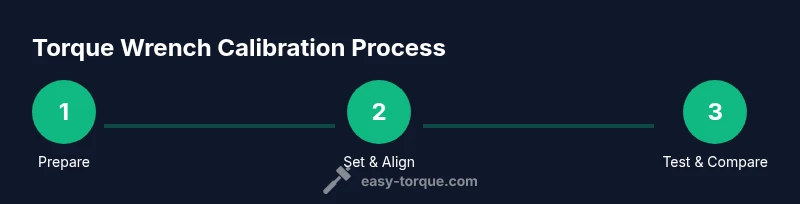
Collect the torque wrench, calibration weights, and reference scale. Inspect all tools for cracks, wear, or corrosion. Any damage requires service before attempting a check.
Tip: Verify the wrench's calibration history and ensure it is within its service life. - 2
Set up the measurement fixture
Mount the adapter and scale securely to minimize movement. Confirm alignment so the torque path is direct and not affected by leverage errors.
Tip: Use a stable bench or stand to prevent wobble during loading. - 3
Zero the measuring instrument
Zero the digital scale or force gauge according to its manual. Confirm there is no pre-load or tare that skews readings before applying torque.
Tip: Record the zero value in your log for reference. - 4
Apply known torque at a mid-range setting
Attach the calibration weight and apply torque to the wrench at a comfortable, mid-range setting. Hold steady until the reading stabilizes, then record the measured torque.
Tip: Use slow, steady force to avoid impulse that can spike the reading. - 5
Cross-check at a high setting
Repeat the test at a higher torque setting to verify linearity. A consistent drift across settings indicates calibration drift.
Tip: If readings diverge significantly, suspect calibration drift. - 6
Compare readings to nominal values
Compare measured values to the wrench’s nominal settings. Note any discrepancy and its direction (over-reading or under-reading).
Tip: Small discrepancies are common; focus on repeatability and trend. - 7
Assess if results warrant formal calibration
If readings are outside manufacturer tolerance or inconsistent, schedule formal calibration with a certified lab or the supplier.
Tip: Keep a service window and plan downtime for calibration. - 8
Document findings
Log date, model, serial, test method, readings, and conclusions. Include recommended follow-up actions and the next calibration date.
Tip: Use a consistent template to simplify future audits.
Your Questions Answered
How often should I calibrate my torque wrench?
Calibration frequency depends on usage, environment, and manufacturer recommendations. For critical work, schedule regular checks and after any impact. Always consult the certificate for guidance and maintain a calibration log.
Calibration is recommended on a schedule based on use and conditions, and after any impact. Check the manufacturer’s guidance and keep a maintenance log.
Can I calibrate a torque wrench at home?
You can perform screening checks at home, but formal calibration should be done by a certified lab or the manufacturer when accuracy matters. Home methods help flag potential drift but do not replace lab-grade validation.
You can screen at home, but formal calibration should be done by a lab or the manufacturer when precision matters.
What are common signs of a drifted torque wrench?
Common signs include repeating different readings at the same setting, inconsistent results across multiple tests, or readings that don’t align with the wrench’s spec across its range.
Look for inconsistent readings or drift across different tests at the same setting.
Is a digital torque wrench more stable than a mechanical one?
Digital wrenches can offer easier readings and logging, but stability depends on the device design and calibration history. Both types require periodic calibration.
Digital wrenches are convenient for readings and logs, but both need regular calibration.
What should I do if readings are outside tolerance?
If readings fall outside tolerance, stop using the wrench for critical work and arrange formal calibration with a certified service. Document the incident and schedule the next check.
If readings exceed tolerance, stop using it for critical work and get formal calibration soon.
Watch Video
Top Takeaways
- Verify calibration with traceable references.
- Screening tests are informative but not a substitute for formal calibration.
- Document results and schedule future checks.