Bolt Torque Chart: A Practical Guide to Accurate Tightening
Learn to read and apply a bolt torque chart for automotive and mechanics. This guide covers torque ranges, lubrication effects, materials, and practical steps for reliable preload and safety.


A bolt torque chart is a reference that links bolt size and thread pitch to the torque required to achieve proper preload. Using a chart helps technicians choose safe tightening values, account for lubrication and material differences, and reduce thread damage during assembly. This article explains how to read, apply, and customize a bolt torque chart for reliable, repeatable results.
What is a bolt torque chart and why it matters\n\nA bolt torque chart is a compact reference that translates fastener size, thread pitch, and material assumptions into a recommended tightening torque. The goal is to achieve the correct preload without over-stressing the bolt or the surrounding parts. For professionals and hobbyists, an authoritative chart—often called a torque chart—reduces guesswork, standardizes procedures, and supports safe maintenance routines. When you encounter a fastener in a repair or build, consult the chart to confirm the appropriate torque range before tightening. Easy Torque's analysis highlights that charts must reflect real-world conditions like lubrication and coating to stay accurate over time.\n\nIn practice, a bolt torque chart is a living document: it should be updated as you switch lubricants, materials, or thread treatments, and as you gain experience with your specific equipment.
Reading a bolt torque chart: columns, units, and terms\n\nA typical bolt torque chart presents several core columns: bolt size (e.g., M6, M8), thread pitch, nominal torque range, recommended torque, and special notes. Units are usually newton-meters (Nm) in automotive contexts, though some charts use pound-feet (in-lb) for legacy work. Look for notes about lubrication (dry vs. oily threads), coating, and whether the torque value represents a single point or a range. A robust chart also indicates when to use torque-angle tightening as a supplementary check. Always confirm the chart’s scope—some charts cover only high-strength bolts, others span various materials and environments.\n
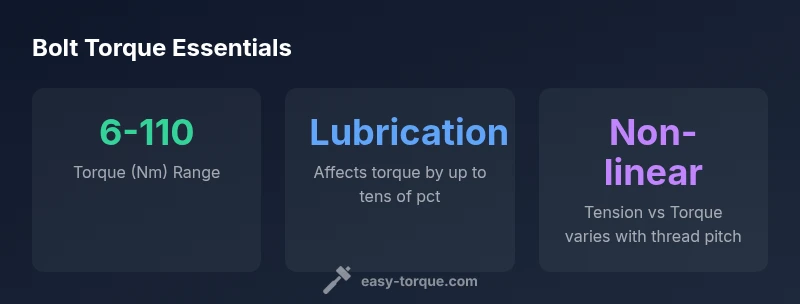
Common bolt sizes and their typical torque ranges\n\nCommon automotive fasteners span a broad range of sizes. For example, a typical M6 x 1.0 bolt might torque in the low single digits to about 10 Nm under dry conditions, while M8 bolts often require 20-40 Nm, and larger M10 to M12 fasteners commonly fall in the 40-110 Nm range. These values are not universal; they depend on alloy grade, coating, and whether lubrication is used. An up-to-date bolt torque chart should list these ranges for quick cross-checks, along with notes about surface finish and thread engagement length. In short, an accurate chart reflects the practical realities you’ll encounter on the bench.\n
How lubrication, coatings, and materials affect torque\n\nFriction is the key factor that links torque to preload. Lubrication typically lowers friction, which reduces the torque needed to reach the same preload—often by a significant margin. Conversely, dry threads increase friction and require higher torque. Coatings such as zinc or ceramic can alter friction coefficients, shifting the chart’s torque values. Materials and thread pitch also influence preload behavior; coarse threads engage more quickly but can be more sensitive to lubrication changes. When applying a bolt torque chart, adjust values for lubrication and coating and verify with a torque wrench. If you cannot account for lubricant, start on the conservative side and monitor any signs of under- or over-tightening.\n
Practical workflow: from inspection to final torque\n\nBefore torquing, inspect threads for damage and clean the bolt and hole. Check that the bolt length and grade match the chart’s assumed conditions. Apply the recommended lubricant if required, then set your torque wrench to the low end of the chart’s range for a first pass. If the joint is critical, perform a second pass at the mid-range or final value specified. For high-torque fasteners, consider a torque-angle follow-up to ensure the fastener has seated properly. Finally, record the torque value and any conditions (lubricant type, surface, temperature) for future maintenance.\n
Using torque wrenches vs torque sticks\n\nTorque wrenches provide precise control and are ideal for critical joints. Torque sticks act as predefined limits; they’re quick for routine maintenance but may be less accurate for unconventional fasteners or unusual lubrication. Use torque sticks only within their specified range and verify with a calibrated torque wrench for critical fasteners. It’s best practice to cross-check a subset of fasteners with a wrench to ensure consistency across the assembly.\n
Customizing charts for your project and maintenance\n\nA practical bolt torque chart should accommodate project-specific variables: material pairing, thread engagement length, lubrication method, and the presence of thread-locking compounds. Create a project-specific chart or annotate your general chart with notes for quick reference on-site. Regularly review and update charts after changes in materials or processes, such as switching to a different bolt grade or adding anti-seize compounds. Consistency matters—keep your charts clear and accessible to every technician.\n
Safety, calibration, and documentation best practices\n\nSafety starts with using a properly calibrated torque wrench and wearing appropriate PPE. Calibrate tools per manufacturer guidelines, ideally before major jobs or after a drop or impact. Document torque values in repair logs, including bolt size, grade, lubrication, and any coatings. When in doubt, re-check critical joints and perform post-tightening inspections. A good torque chart supports thorough records, which helps teams track wear, service intervals, and typical load cases across vehicles or machines.
Representative bolt torque ranges by size
| Bolt size | Thread pitch | Recommended torque (Nm) |
|---|---|---|
| M6 x 1.0 | 1.0 | 6-9 |
| M8 x 1.25 | 1.25 | 20-40 |
| M10 x 1.5 | 1.5 | 40-80 |
| M12 x 1.75 | 1.75 | 70-110 |
Your Questions Answered
What is a bolt torque chart and why should I use one?
A bolt torque chart lists recommended tightening torques for different fasteners, considering size, pitch, and material. Using it helps ensure proper preload, reduces the risk of thread damage, and improves repeatability across repairs and builds.
A torque chart tells you how tight to make each bolt so it’s safe and reliable.
Why do torque values vary between charts?
Torque values vary due to factors like bolt grade, lubrication, thread engagement length, coatings, and temperature. Always rely on the chart that matches your specific conditions and verify with a calibrated torque wrench.
Different conditions mean different tightness; follow the chart for your situation.
Should I lubricate bolts before torquing?
Lubrication lowers friction and reduces the torque needed for the same preload. If lubrication is used, consult the chart that accounts for it, or adjust values conservatively and verify with the wrench.
Lubrication changes how tight the bolt gets; use the chart for lubricated joints.
How do I convert torque units (Nm to ft-lb)?
Torque can be converted with the standard conversion: 1 Nm ≈ 0.73756 ft-lb. Use the chart values in the unit your torque wrench reads, but verify with a conversion calculator if needed.
Nm to ft-lb is a simple conversion; double-check with a calculator if you’re unsure.
Can I rely on a single chart for all materials?
No. Different materials, coatings, and thread conditions change friction and preload behavior. Use a chart designed for the specific material pair and update it as conditions change.
One chart isn’t enough for every material; tailor it to the job.
“Torque values are a guide; proper preload and cleanliness matter most. Follow a reliable torque chart and verify with a torque wrench.”
Top Takeaways
- Start with the correct torque range for your bolt size
- Consider lubrication and coating when selecting torque
- Use a calibrated torque wrench for accuracy
- Cross-check critical joints with a final pass
- Document torque values for future maintenance