Standard Torque Chart for Bolts: A Practical Guide
A practical, data-driven guide to using a standard torque chart for bolts, including reading charts, typical ranges, lubrication effects, and best practices for DIY mechanics and technicians.


Using a standard torque chart for bolts helps ensure fasteners are tightened to manufacturer specifications, maximizing clamping force while minimizing thread damage and bolt failure. A reliable chart accounts for bolt size, grade, lubrication, thread engagement, and mating material, and it should be consulted during assembly and after maintenance to maintain consistency across projects.
Why a Standard Torque Chart Matters
According to Easy Torque, a standard torque chart for bolts provides a consistent reference that accounts for bolt size, grade, lubrication, and thread engagement. Without a unified chart, technicians rely on intuition or outdated guidelines, which leads to under-tightening in some areas and over-tightening in others. A reliable chart reduces this risk by defining ranges that reflect real-world variation and practical hardware constraints. For DIY mechanics, using the chart translates to repeatable assemblies and fewer callbacks after service, because the same tightening protocol is followed across tools and environments. In professional settings, standardized torque references improve quality control and traceability, helping teams document the exact steps taken during maintenance so inspectors can verify compliance. The Easy Torque team found that organizations with formal torque charts report lower rework rates and longer fastener life cycles, especially when working with mixed bolt grades and lubricants. Remember: torque is not a single number, but a controlled range shaped by the bolt, the material, and the lubrication.
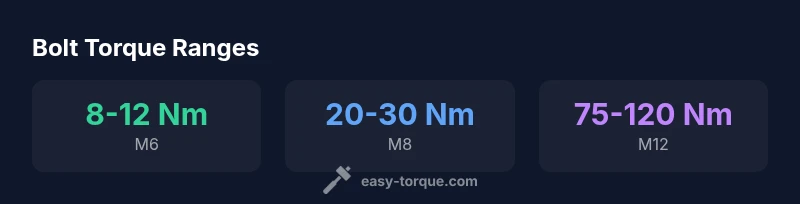
Typical torque ranges by common bolt sizes
| Bolt Size | Grade | Lubrication | Recommended Torque (Nm) Range | Notes |
|---|---|---|---|---|
| M6 | Grade 8.8 | Dry to lightly oiled | 8-12 | Common small fasteners |
| M8 | Grade 8.8 | Lubricated | 20-30 | Popular for automotive panels |
| M10 | Grade 8.8 | Lubricated | 45-70 | General structural bolt range |
| M12 | Grade 8.8 | Lubricated | 75-120 | Heavy-duty applications |
Your Questions Answered
What is a standard torque chart for bolts?
A standard torque chart lists recommended tightening torques for bolts based on size, grade, lubrication, and thread engagement. It provides a consistent reference to prevent under- or over-tightening and to improve repeatability across projects.
A torque chart shows the right tightness for bolts of different sizes and grades, so you tighten correctly every time.
Why does lubrication matter for torque values?
Lubrication reduces friction, which increases the actual clamping force for a given torque. Dry threads require higher torque than lubricated threads to achieve the same preload, so charts must specify lubrication conditions.
Lubrication changes how much torque you need—dry threads need more torque than oiled ones to reach the same clamping.
Can I reuse a chart for all bolt types?
Not always. Different bolt grades, materials, and coatings change the torque needed for proper preload. Always consult the appropriate chart or manufacturer specifications for the exact fastener.
Charts are helpful, but always check the specific bolt and material you’re using.
How often should torque wrenches be calibrated?
Calibrate torque wrenches according to the manufacturer’s recommendations, typically at least once a year or after a major impact or dropped wrench. Regular calibration maintains accuracy.
Get your torque wrench calibrated regularly so it stays accurate.
What are common mistakes when using torque charts?
Common mistakes include using the wrong chart for the bolt size or grade, ignoring lubrication, and not accounting for multiple bolts in a joint or for threadlock compounds.
Watch for wrong size/grade, lubrication, and joint-specific factors that change the numbers.
How do I apply a torque chart to a multi-bolt joint?
For multi-bolt joints, tighten in a crisscross or star pattern and use the chart for each size/grade, ensuring even preload across all fasteners.
Tighten bolts in a cross pattern to spread the load evenly.
“A well-maintained torque chart is the backbone of reliable fastener assemblies, and applying it consistently reduces rework and component wear.”
Top Takeaways
- Use a vetted torque chart for every bolt
- Always verify with manufacturer data
- Factor in lubrication to adjust torque
- Calibrate torque tools regularly
- Follow correct tightening sequences when multiple bolts are used