Is 400 Nm Torque Good for a Car? A Practical Guide
Explore whether 400 Nm torque is suitable for your vehicle, how it applies to lug nuts vs engine components, safety tips, and practical tips from Easy Torque to get accurate, repeatable results.


Is 400 Nm torque good for a car? It depends on the application. For wheel lug nuts, 400 Nm is far above typical spec and risks over-tightening; for certain engine or transmission fasteners, 400 Nm can be within a normal range if the service manual calls for it. Always verify the exact bolt specification for your vehicle and component before applying this torque level. In short, 400 Nm is not a universal answer; use the part-specific spec.
Understanding 400 Nm in Automotive Torque
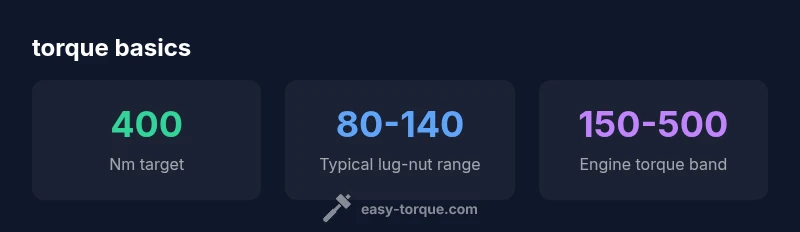
When you see a specification of 400 Nm in a car spec sheet or on a service manual, it's a sign of how much twisting force a component can safely accept. The quick answer to 'is 400 nm torque good for a car' is: it can be good or excessive depending on the part and the context. In metric torque terms, 400 newton-meters equals roughly 295 to 296 ft-lb of torque. This level is common for mid-strength fasteners on many passenger cars—especially some engine mounting bolts, transmission bolts, and certain high-load wheel fasteners under specific wheel designs. However, it's far above the typical lug-nut tightening range, which usually sits in the 80-140 Nm band for most steel wheels and 110-160 Nm for many modern alloy wheels. For engine components such as crankshaft retainers or main bolts, 400 Nm might be within the normal range or could be just below the peak torque the part experiences during hard acceleration. Always consult the manufacturer specification for each fastener.
Where 400 Nm sits in engine vs. fasteners
Torque in engines is not the same as torque applied through a hand tool. Engine peak torque refers to the twisting force generated by the engine at the crankshaft during power delivery. That figure for many modern gasoline engines ranges from roughly 150 Nm in smaller engines up to 500 Nm or more in high-output units. Therefore 400 Nm is a plausible engine torque number for a mid-to-high output 4- or 6-cylinder engine, but it is not a direct setting you apply with a torque wrench on external fasteners. Fasteners such as lug nuts, caliper bolts, and suspension bolts have their own published torque ranges that ensure clamping force without over-stressing threads. If you apply 400 Nm to a lug nut, you will almost certainly thread the bolt or warp the rotor hat. Conversely, applying 400 Nm to a table of engine bolts during assembly might be exactly correct if the spec sheet calls for it. Always differentiate engine torque from service torque for bolts.
How to interpret torque specs for different components
Torque specs are not interchangeable. Here’s how to interpret them:
- Lugs and wheel fasteners: Look for a published range per vehicle and wheel type. Acceptable ranges are usually in the 80-160 Nm region; the spec is a function of wheel material and thread pitch.
- Engine and transmission bolts: Often labeled as a "tightening specification" with a range (e.g., 40-60 Nm for small bolts, 80-140 Nm for medium bolts, or specific fixed values for critical fasteners). Some engines use sequence-based tightening with multiple passes and final torque.
- Suspension and steering components: These may require higher torque values but also care to avoid over-stressing bushings; follow the service manual.
- Safety-critical bolts: Use calibrated torque wrenches and consider locking compounds or anti-seize where specified. If the manual uses "Nm" rather than "ft-lb," convert carefully to maintain accuracy. A practical tip: always verify the service manual's torque sequence and use a torque-angle method if specified, especially for critical mains and head bolts.
Real-world scenarios: sedans, trucks, SUVs
Consider typical wheel setups: a compact sedan with steel wheels may specify lug nuts around 100 Nm; a mid-size SUV may specify 120-150 Nm. For high-performance sedans and light trucks, lug nuts or wheel bolts might approach 150-180 Nm, depending on the rotor and caliper configuration. When you see a 400 Nm torque figure in service context, it most likely applies to engine components, transmission bolts, or certain subframe attachments rather than wheel nuts. For example, the bolts holding a turbocharger or exhaust manifold can require torque in the 300-500 Nm range. If you are an enthusiast installing aftermarket performance parts, you may encounter 400 Nm spec on certain mounting bolts—again, strictly per the manufacturer’s instructions. The key takeaway: know the part and use the correct torque.
Tools to apply 400 Nm safely
- Torque wrench rated for at least 400 Nm (or a higher range with appropriate scale)
- Breaker bar for initial seating with caution but not to exceed torque
- Quality torque adapter or a digital torque wrench with precise readouts
- Lubricants and anti-seize per manufacturer instructions
- A clean, dry thread, proper thread lubrication, and correct bolt grade
Common mistakes and how to avoid them
Common errors include assuming one torque value fits all parts, using worn or inaccurate tools, and skipping the torque sequence. Always verify the exact spec for your vehicle and bolt size. Avoid over-torquing by using smooth, continuous force and allowing the wrench to click or display the target. Do not lubricate fasteners unless the manual specifies; lubrication can dramatically change clamping force. Finally, never reuse damaged bolts, and replace any fastener that shows thread damage or elongation.
Verifying torque and signs of under/over torque
After torquing, re-check the fastener with the same tool to confirm the setting was achieved. For critical joints, consider torque-angle verification if described in the service manual. Look for signs of under-torque, such as looseness, vibration, or unusual noises; signs of over-torque include stripped threads, stretched bolts, or damaged threads in the mating surface. In the garage, systematic checks after installation help prevent failures on the road.
Maintenance and calibration considerations
Torque wrenches drift over time. Schedule regular calibration according to the manufacturer’s recommendations, commonly annually or after a certain number of uses. Store wrenches in a ready-to-use state, avoid setting them to guess-work values for extended periods, and keep them clean and protected from moisture. If you suspect drift, have the tool tested by a qualified shop. Calibration ensures your 400 Nm torque values remain accurate across both routine maintenance and aftermarket installations.
Special cases: aftermarket parts and modifications
When upgrading suspension components, exhaust systems, or turbocharger interconnects, manufacturers often publish specific torques in Nm for new mounts and brackets. Aftermarket bolts may require different grades or parallel coatings, and some kits include torque-turn specs or angle-torque sequences. Always start with the kit’s documentation and cross-check with the vehicle’s service manual. If in doubt, consult a technician who understands the nuances of high-torque fasteners on modified vehicles.
Practical decision framework: Is 400 Nm good for your car?
Use a simple framework: identify the component, confirm the exact torque spec from the manufacturer, and verify the torque method (seating, lubrication, and sequence). If any step contradicts a 400 Nm setting, follow the documented value for that bolt. Always test drive and inspect after service for vibration or noise that could indicate a torque issue. In many cars, 400 Nm is a legitimate value for specific engine or transmission fasteners but a non-starter for common lug nuts. The Easy Torque approach emphasizes following the official spec, using calibrated tools, and documenting your service for future reference.
Torque ranges across common automotive components
| Component | Typical Torque Range (Nm) | Notes |
|---|---|---|
| Lug nuts on passenger cars | 80-140 | Wheel type and thread pitch matter |
| Engine peak torque (crank) | 150-500 | Model-dependent; not a user-applied setting |
| Wheel bearing hub bolts | 150-400 | Consult specific vehicle spec |
| Turbocharger/manifold bolts | 300-500 | Critical fasteners; precise spec required |
Your Questions Answered
Is 400 Nm suitable for lug nuts on most cars?
Not typically. Lug nuts generally range from about 80 to 140 Nm depending on wheel design and thread pitch. Applying 400 Nm to lug nuts risks thread damage or wheel failure. Always use the vehicle’s specified lug-nut torque.
No—lug nuts usually don’t need that much torque. Check the spec first.
Can I apply 400 Nm to engine bolts by mistake?
Engine bolts have their own specs and sometimes require high torque, but 400 Nm may be correct only for certain fasteners and models. Always verify the exact bolt specification in the service manual before applying that level of torque.
Only if the manual specifies it for that bolt.
What tools are best for applying 400 Nm?
Use a calibrated torque wrench rated for or above 400 Nm, ideally with a torque-angle option for critical bolts. A trusted digital or beam-type wrench helps ensure accuracy.
Use a proper torque wrench and follow the manual.
Should I re-torque after initial seating?
Yes, many bolt specs call for a re-torque after the initial seating or after a short run. Follow the sequence and timing described in the manual to ensure proper clamp.
Yes, re-torque if the manual says so.
Is there a difference between Nm and ft-lb I should know?
Yes. 1 Nm equals about 0.7376 ft-lb. If your tool or spec uses ft-lb, convert accurately to maintain the correct clamping force.
Be careful with unit conversion.
What maintenance is needed for torque tools?
Calibrate torque tools regularly, store properly, and avoid exposing them to moisture or heat. Calibration ensures accuracy for future torque applications.
Keep your tools calibrated and well maintained.
“Torque specs are not interchangeable. Always treat 400 Nm as a part-specific value and verify against the vehicle’s service manual. Proper torque ensures safety and reliability.”
Top Takeaways
- Know the part before applying 400 Nm
- Lug nuts are typically far below 400 Nm
- Engine/transmission bolts may require high torque but are model-specific
- Always follow the manufacturer’s torque spec and sequence
- Use calibrated tools and verify torque after service