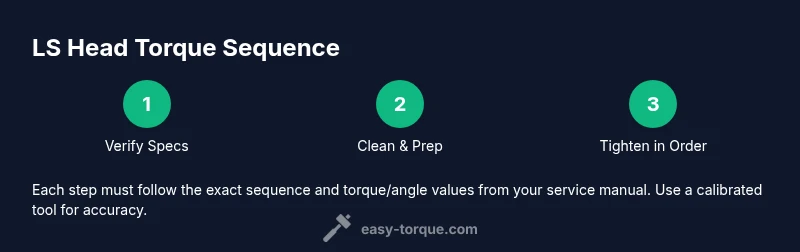
LS Head Torque Sequence: Step-by-Step Guide
Discover the LS head torque sequence with a thorough, step-by-step approach. Learn why the sequence matters, how to prepare, and how to verify torque safely for reliable engine sealing. Easy Torque shares practical methods for DIY mechanics and professionals.


Goal: correctly execute the LS head torque sequence to ensure head gasket integrity and reliable engine operation. Before you begin, verify the exact torque specs and bolt sequence for your LS model in the service manual. This quick answer previews the approach and safety considerations you’ll follow in the full guide.
Why the LS head torque sequence matters
When working on an LS engine, the head bolt torque sequence matters because it governs how clamping force is distributed across the head gasket and mating surfaces. A correct sequence minimizes uneven loading, which reduces the risk of gasket leaks, warping, or head distortion after heat cycling. In practice, engines heat up and expand at different rates, so tightening in a deliberate order helps maintain uniform contact pressure as the head and block heat up. The Easy Torque team emphasizes adherence to the manufacturer’s specifications for your exact LS variant, since there are multiple block designs and head bolt configurations across the LS family. Even small deviations from the sequence can create a scenario where a single bolt bears too much load, leading to a creeping leak or a warped cylinder surface. Before you touch a bolt, park the car on a level surface, disconnect the battery, and prepare a clean workspace. The goal is repeatable, traceable torque behavior, not guesswork. According to Easy Torque, always verify the exact specs for your model rather than assuming a generic sequence. This helps you interpret service literature with confidence.
LS engine variants and bolt strategies
LS engines cover a wide range of configurations, from small-block to tall-deck designs. While some generations use through-bolts, others rely on head studs or conventional head bolts with differing seating layouts. The torque sequence philosophy remains the same: distribute clamping force evenly, respect thread condition, and follow the exact order printed in the service manual for your engine family. The variation across LS models means a single, universal procedure is not appropriate. Easy Torque stresses checking your exact kit: bolt type, cylinder count, head gasket, and whether lubrication or thread sealants are specified. This reduces risk during reassembly and helps you avoid rework. By understanding the rationale—thermal growth, gasket seal integrity, and even load distribution—you’ll be better prepared to adapt to model-specific nuances while preserving reliability.
Understanding the typical torque+angle approach
Most LS head bolt procedures use a combination of torque steps and degree turns (torque-to-turn or torque+angle). The idea is to apply an initial clamping force with a primary torque, then supplement that with precise angular turns to compensate for friction and gasket material behavior as the system heats. The approach helps ensure consistent clamping across all bolts and minimizes distortion. Keep in mind that friction on each bolt can vary, so the angle turns are designed to bring every bolt to the same final clamping state. When in doubt, refer to the service manual for your exact engine family and verify that the procedure uses the recommended lubricant and the exact turn angles. Easy Torque’s guidance is to treat this as a collective protocol rather than a single bolt procedure, ensuring each fastener reaches the required final state.
Preparation and inspection before tightening
Preparation is half the job. Start with a clean, debris-free work area and inspect every bolt for corrosion or damage. Clean the bolt threads and the block threads with solvent and a brush; ensure the threads are dry before applying lubricant if the manual calls for it. Some LS engines require a specific thread lubricant on the bolts; others require clean, dry threads. Do not reuse bent or nicked bolts. Have the appropriate torque wrench, angle gauge, and a clean surface for the gasket and cover. Replace any gaskets or washers that show wear. By establishing a consistent baseline—clean surfaces, proper lubrication (if specified), and verified fasteners—you reduce variables that could throw off the torque sequence. The service manual is your best friend here; align every step with its exact instructions.
Step-by-step overview before you start
This section provides a high-level view of the process you will execute, reinforcing why each phase matters. Start with validating the model variation and required torque values, then proceed to layout the bolts in the official tightening order. Ensure you have the right tools and a burr-free fastener seat. Prepare the cooling system and timing components as dictated by the manual. Finally, plan for post-tightening checks, including a warm-up test and potential re-torque if required by the procedure. This overview helps you stay organized and mindful of every constraint the service documentation presents.
Post-torque checks and reassembly considerations
After completing the torque sequence, allow the engine to cool before performing any final checks. If the manual requires a heat cycle test, perform it carefully and recheck torque as specified. Inspect the head gasket area for any signs of leakage, and verify that valve cover and timing components are correctly seated. If a leak is detected, or if the bolts show signs of loosening during heat cycling, refer back to the service documentation and repeat the torque sequence with careful adherence to the prescribed steps. Maintain a log of measurements and any deviations observed during the process. This documentation helps future maintenance and potential warranty claims. Easy Torque recommends documenting the exact bolt positions and the torque values used for future reference.
Common mistakes and how Easy Torque helps
Common mistakes include skipping the exact tightening order, neglecting to clean threads, and deviating from the prescribed lubricant or torque values. These missteps can lead to gasket leaks, warped heads, or long-term reliability issues. Easy Torque emphasizes sticking to the model-specific service manual and using a calibrated torque tool with proper technique. Maintain a calm, methodical pace, and double-check that all bolts have reached the intended final state before proceeding. In this guide, we present the logic behind the sequence and offer practical recommendations for real-world applications so you can work more confidently.
Documentation and troubleshooting
Keep a detailed record of the torque sequence you used, including the exact model, bolt type, solvent or lubricant (if any), and the final torque values and angle turns. Photograph the head area after assembly and store the service documentation with your vehicle records. When troubleshooting, use the documented sequence as a baseline; if you observe leaks or uneven contact, compare against the documented procedure and verify each bolt’s condition and seating. This approach reduces guesswork and supports consistent results across maintenance cycles. Easy Torque’s practical approach is to help you create reliable, repeatable torque workflows that you can apply to future LS engine projects.
Tools & Materials
- Torque wrench(Calibrated to the engine's torque specification range. Use a secondary torque wrench for cross-checks if available.)
- Angle gauge or digital angle gauge(Needed if the procedure requires degree turns; ensure compatibility with your torque wrench.)
- Breaker bar(Helpful for incremental snugging before final torque; avoid overtightening by hand.)
- Socket set (metric and standard)(Select sizes matching your LS head bolts; keep sockets clean to prevent slipping.)
- Thread lubricant or motor oil (if specified)(Use only if the service manual specifies; otherwise skip.)
- Lint-free rags and degreaser(For cleaning bolt holes and mating surfaces before assembly.)
- Gasket set and compatible seals(Replace all gaskets and seals to ensure proper sealing after reassembly.)
- Service manual for your LS model(Contains the exact torque specs, bolt sequence, and any model-specific special instructions.)
- New head bolts (or OEM bolts, as required)(Check service manual; many LS engines require new bolts for head work.)
Steps
Estimated time: 2-4 hours
- 1
Verify model and specs
Confirm your LS model variant and pull the exact torque specification and bolt sequence from the service manual. Cross-check the bolt type, number, and lubrication requirements before touching any fasteners.
Tip: Double-check the sequence diagram in the manual; a small mismatch can cascade into issues. - 2
Prepare workspace and components
Set up a clean, well-lit workspace with a stable surface. Remove debris from the head and surface areas; organize bolts in the correct order. Ensure your tools are calibrated and within reach before starting.
Tip: Lay out bolts in a numbered tray to match the tightening order. - 3
Clean threads and inspect fasteners
Inspect the head bolts for nicks or corrosion. Clean threads with solvent and a brush; dry completely. If any bolt shows damage, replace it before proceeding.
Tip: A dirty thread can alter friction and throw off final torque readings. - 4
Apply lubrication as specified
Apply the lubricant called for in the manual to bolt threads or leave them dry if the manual specifies dry threading. Do not skip lubrication where required, as it affects accuracy.
Tip: Use a light, even coating; avoid pooling lubricant on the bolt head. - 5
Snug bolts in the correct sequence
Hand-tighten bolts starting from the center or as per diagram, moving outward in the prescribed order. Do not fully tighten yet—this is just the initial seat.
Tip: Keep torque wrench off until you reach the final tightening stage. - 6
Apply primary torque in stages
Tighten each bolt to the specified torque in the published sequence, performing intermediate checks as required. Maintain a consistent pace to avoid heat build-up until you reach the final state.
Tip: Use a smooth, even motion; avoid sudden increases in force. - 7
Execute angle turns as required
If the procedure specifies degree turns after the torque step, apply them in the exact sequence. Rotate bolts by the prescribed degrees and confirm alignment with the diagram.
Tip: Record degree turns per bolt for future reference. - 8
Verify, re-check, and reassemble
After the sequence, re-verify torques, perform any required heat cycle checks, and complete reassembly per manual. Document outcomes and store notes for future maintenance.
Tip: A post-job log helps with future diagnostics and service history.
Your Questions Answered
What if I can't find model-specific torque specs for my LS engine?
If the exact specs aren’t printed in your manual, contact the manufacturer or a dealer for the precise values. Do not improvise or guess, as incorrect torque can cause gasket leaks or head distortion.
If you can’t find the exact specs, contact the manufacturer or dealer and don’t guess. Incorrect torque can damage the engine.
Can I reuse head bolts on LS engines after removing the head?
Most LS head bolts are intended for single-use or require checking the service manual to determine reuse viability. If reuse is allowed, follow the specified inspection criteria and replacement guidelines.
Head bolts are often single-use. If reuse is allowed, follow the manual’s inspection criteria before reusing.
Do I need to retorque after a heat cycle?
Some LS procedures require a recheck after a heat cycle; follow your manual’s guidance. If the manual specifies a re-torque, perform it with care and document the results.
Some manuals require a retorque after heat cycling. Follow the guide and document it.
Is a torque-angle method mandatory for LS heads?
Not all LS procedures use angle turns; if the manual specifies degree turns, follow them exactly. If it only specifies torque, complete the steps as documented and avoid guessing.
Angle turns may be required depending on the manual. Follow the documented method exactly.
What are the consequences of over-torquing LS head bolts?
Over-torquing can strip threads, distort the head, or damage the gasket seal. Always use the prescribed torque value and method from the manual and verify with calibrated tools.
Over-torquing can cause severe engine damage. Follow the manual with calibrated tools.
Watch Video
Top Takeaways
- Follow model-specific torque specs from the service manual.
- Use the correct tightening order to ensure even clamping.
- Keep surfaces clean and bolts in good condition.
- Document torque data for future maintenance.
- Always perform post-tightening checks and safety verifications.