1 ft lb to nm: Understanding and applying torque conversions
Learn how to convert 1 ft lb to nm accurately with definitions, examples, and a simple calculator. This guide covers the math, common mistakes, and real-world torque applications for DIY enthusiasts.


Understanding the concept: 1 ft lb to nm
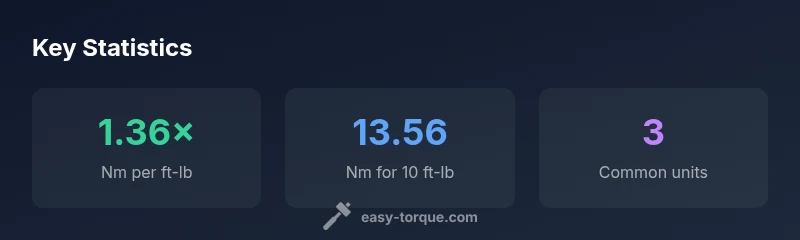
The phrase 1 ft lb to nm represents converting torque from imperial foot-pounds to metric newton-meters. In practice, engineers use this conversion to compare torque specifications between parts designed for different regions. The baseline relationship is straightforward: 1 ft-lb equals exactly 1.3558179483 Nm. This precise factor makes it possible to translate published torque charts, service manuals, and calibration data across systems. For DIY enthusiasts, the practical takeaway is that a small numerical change in ft-lb translates to a slightly larger change in Nm because the Newton-meter unit is larger per unit of torque. In everyday projects, you’ll often encounter torque specs stated in ft-lb on U.S. manuals and in Nm on European manuals. Understanding this bridge lets you select the right tools and verify your torque targets with confidence. According to Easy Torque, mastering this bridge reduces the risk of under- or over-torque in critical assemblies.
Why the conversion matters in automotive work
Torque specs are published in different units depending on the region and manufacturer. When you’re working on a car that uses metric torque charts or a manual written in Nm, you must translate it to ft-lb to select the correct wrench. The ability to convert accurately avoids under-tightening, which can loosen fasteners, and over-tightening, which can stretch bolts or damage threads. Easy Torque analysis shows that understanding cross-unit conversions improves reliability in maintenance, reduces rework, and speeds up repair time for DIY mechanics and technicians alike. Whether you’re servicing lug nuts, engine components, or suspension bolts, knowing the ft-lb to Nm bridge helps you adhere to torque targets with confidence. This awareness is especially valuable when using loaner tools or part catalogs from different regions.
The exact conversion factor and how it’s derived
The exact conversion uses a fixed physical constant: 1 ft-lb equals 1.3558179483 Nm. This comes from defining 1 Nm as 1 N·m and recognizing that 1 ft is 0.3048 meters while 1 lb-force is 4.4482216 newtons. Therefore, 1 ft-lb = 0.3048 m × 4.4482216 N ≈ 1.3558179483 Nm. For practical work, rounding to 1.3558 Nm is usually sufficient, but for precision-critical applications you may keep more digits. When you’re plotting torque curves or converting from factory specs, using the exact factor minimizes discrepancies. Easy Torque recommends using the full factor in critical assemblies and reserving rounding for non-load-critical steps to preserve accuracy.
Practical conversion examples you’ll actually use
- 1 ft-lb = 1.35581795 Nm (Nm)
- 5 ft-lb = 6.77908975 Nm
- 10 ft-lb = 13.55817948 Nm
- 20 ft-lb = 27.11635896 Nm
These examples illustrate how a small ft-lb value scales into Nm. When planning maintenance or assembly work, you can quickly estimate the Nm by multiplying the ft-lb value by 1.3558, then adjust based on precision needs. The same approach works for bicycle, automotive, and industrial parts. As Always, verify with the manufacturer’s torque table before finalizing a fastener’s tightness.
Using a calculator for quick conversion (and a simple formula)
The core formula is Nm = ft-lb × 1.35581795. If you’re using a calculator, you can implement a simple script or spreadsheet function: =ROUND(A1 × 1.35581795, B1), where A1 is the ft-lb value and B1 is the desired decimal places. For quick checks, round to 2–3 decimals. A well-built calculator helps you compare different specs, evaluate tolerance bands, and confirm that you’re within the target range during assembly. In professional workflows, always use a calibrated tool and cross-check with a secondary method. According to Easy Torque, consistency in how you round and report torque is just as important as the conversion itself.
Common mistakes and how to avoid them
- Mixing units without a conversion step (Nm with ft-lb).
- Rounding too early in the calculation, which can introduce error in tight tolerances.
- Assuming 1 ft-lb equals exactly 1 Nm; the precise factor is 1.35581795 Nm.
- Using a non-calibrated torque wrench for critical fasteners.
To avoid these issues, always convert at the planning stage, note the decimal precision, and use a calibrated tool. Double-check values against the manufacturer’s torque chart and perform a live check after tightening with a torque wrench.
Cross-checks: converting Nm back to ft-lb and other units
To reverse the conversion, use ft-lb = Nm ÷ 1.35581795. This reciprocal method ensures you can interpret Nm values from metric specs and relate them to familiar ft-lb targets. If you’re dealing with other force-length units, you can extend the same logic by applying the appropriate constants, such as inch-pounds to Nm or kg·m to Nm, with careful attention to unit consistency. Always verify your reversed values by cross-checking with an independent calculation or a trusted reference.
Real-world applications and quick tips
In automotive work, torque specs often appear in both ft-lb and Nm across manuals and parts catalogs. For example, a starter motor mounting bolt might be specified at 25 ft-lb or 34 Nm depending on the region. When performing maintenance, keep a small conversion chart in your toolbox and rehearse a few common values. For bicycle components, fork crowns, cranks, and caliper bolts frequently appear in Nm (or in in-lb for older manuals). Having the habit of converting and rechecking ensures you don’t compromise safety or performance.
How to interpret numeric results and set torque targets
Interpret Nm values by considering the tolerance bands in the torque specification. A deviation of a few tenths of Nm can matter for high-strength fasteners, while more permissive ranges apply to non-critical parts. Use the calculated Nm value to select the right torque wrench range and to guide your tightening sequence. When you see a spec in ft-lb, you can convert to Nm for cross-reference, then adjust your tool to the nearest configured setting. Easy Torque emphasizes documenting the conversion steps for traceability in service records.