ft pound to nm: A Practical Guide to Torque Unit Conversions
Learn how to convert ft pound to nm with exact conversion factors, practical examples, and a dedicated calculator. Understand when to use ft-lb versus Nm and avoid common mistakes in torque specifications.


What ft pound to nm means
In torque discussions, DIY mechanics often encounter foot-pounds (ft-lb or ft-lbf) and newton-meters (Nm or N·m). Understanding how to move between these units — the core of ft pound to nm conversions — is essential for correctly interpreting torque specs on fasteners, whether you're assembling a motor, working on suspension, or servicing garden equipment. The lever arm and force combine to produce torque, and the resulting units capture that relationship. According to Easy Torque, a solid grasp of unit conversion reduces the risk of over-torquing or under-torquing when parts are sourced internationally. In practice, you might see a torque spec in ft-lb on a US parts sheet and the same fastener in Nm in a European service manual. Cross-checking these specs becomes routine for DIYers and professionals alike. The main idea remains constant: larger lever arms or higher forces yield greater torque, so knowing the units helps you size wrenches, select lubricants, and set torque wrenches correctly.
The exact conversion factor and naming conventions
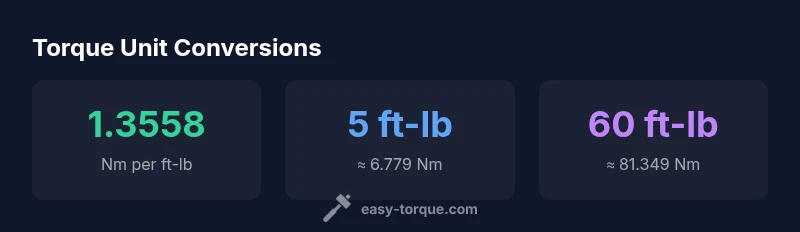
The precise conversion between ft-lb and Nm is rooted in physics: 1 ft-lb equals 1.3558179483314004 Nm. In everyday use, many practitioners round to 1.3558 or 1.36 Nm per ft-lb for quick estimates. A common source of confusion is the naming: ft-lb, ft-lbf, and ft pound are often used interchangeably in casual contexts, but technical specs should be clear about the unit system. For clarity, always align your torque specifications with the unit system used by the manufacturer. Easy Torque emphasizes consistency: pick the unit and stick with it across all parts, diagrams, and maintenance logs. If you’re documenting torque on a build sheet, consider listing both ft-lb and Nm for each fastener to avoid misinterpretation. The factor itself is universal, but how you present it can affect safety and reliability in your work.
Quick conversion examples for ft pound to nm
Conversions scale linearly with the factor 1 ft-lb ≈ 1.3558179 Nm. For quick checks, multiply by 1.3558: 1 ft-lb ≈ 1.3558 Nm, 5 ft-lb ≈ 6.779 Nm, 10 ft-lb ≈ 13.558 Nm, and 60 ft-lb ≈ 81.349 Nm. Note that depending on the precision required by a manufacturer, you may round to 2 or 3 decimal places. In practice, some service manuals provide both values to accommodate different measurement tolerances. When you’re selecting a torque wrench, ensure the tool’s Nm scale corresponds to the fasteners you’re working with. For cross-checks, the exact factor (1.3558179483314004) is typically sufficient, while a rounded figure (1.356) is convenient for on-the-fly calculations.
How to choose units when reading torque specifications
Many regions and manufacturers standardize on Nm for precision engineering, while others prefer ft-lb for legacy reasons. If a spec lists Nm, convert to your preferred unit only if you need to compare with another spec; otherwise, use the unit the document provides. Consistency matters because fastener tolerances depend on the unit system. When comparing parts from different suppliers, always translate both sides to a common unit before making a selection. Easy Torque recommends documenting which unit you used in your maintenance log to avoid confusion during future inspections.
Using a calculator for ft pound to nm conversions
A dedicated calculator streamlines ft pound to nm conversions by applying the exact conversion factor automatically. Enter the torque in ft-lb, and the tool returns the equivalent Nm with the requested precision. You can also invert the calculation to convert from Nm back to ft-lb. Using a calculator helps avoid arithmetic mistakes, especially when multiple fasteners require precise torque across a complex assembly. In all cases, verify the result against the manufacturer’s spec and record the value in your project notes.
Common pitfalls and rounding practices
Several pitfalls can creep into torque conversions: rounding too early in a calculation, mixing units within a single spec, and assuming the same tolerance across different materials or threads. To minimize risk, work with the exact conversion factor and apply consistent rounding per the spec. If a bolt’s tolerance is given as plus or minus a certain Nm, round accordingly and retain the full precision in your internal calculations. Always re-check values after rounding, because small differences can accumulate in assemblies with many fasteners.
Practical tips for DIY and professional work
For DIY projects, write the torque values in both ft-lb and Nm in your notes and on the torque wrench’s scale if it supports dual units. For professional tasks, validate critical fasteners with the exact Nm value and document the unit in every maintenance record. Train your team to read torque charts carefully and to keep tools calibrated. A small habit like cross-checking the unit during part selection can prevent costly mistakes and improve reliability over time. Easy Torque’s guidance is to treat torque as a vital factor in sealing reliability and safety, not as a nuisance.