Newton Meter to Foot Pound: A Practical Torque Guide
Learn how to convert Newton meters to foot-pounds accurately, with practical examples for torque wrenches and fasteners. This guide explains conversion factors, step-by-step methods, and tips for minimizing error in automotive and mechanical work.


Understanding Torque Units: Nm and ft-lb
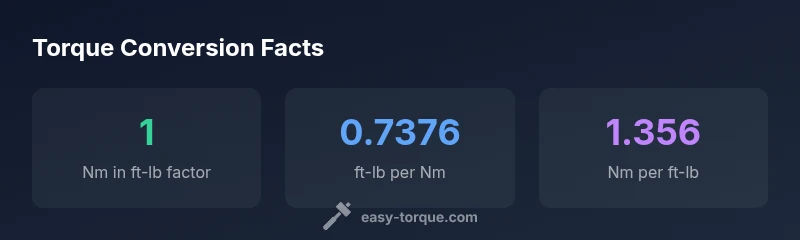
Torque is a twisting force that engineers and technicians quantify in different units depending on the measurement system in use. In mechanical contexts you’ll encounter newton meters (Nm) and foot-pounds (ft-lb). If you’re asking how to convert newton meter to foot pound, you’re not alone. This section lays the groundwork by explaining what each unit represents and why a fixed conversion factor exists. Although the two units originate from different systems—SI (Nm) and the imperial system (ft-lb)—they describe the same physical quantity: torque. The practical bridge is the conversion factor: 1 N·m equals 0.737562149 ft·lb. With this, 10 N·m is about 7.3756 ft·lb, and 20 N·m about 14.75 ft·lb. Conversely, 1 ft·lb equals 1.355817949 N·m. Grasping this relationship helps you choose the correct tool and setting in real-world tightening tasks. Remember: accuracy matters for joint integrity, thread safety, and overall mechanical performance.
The Exact Conversion Factors That Matter
No guesswork here: the numbers you rely on are exact within the known precision of our constants. The primary conversion is straightforward:
- 1 N·m = 0.737562149 ft·lb (Nm to ft-lb)
- 1 ft·lb = 1.355817949 N·m (ft-lb to Nm)
- 1 N·m = 8.850745787 in·lb (Nm to in-lb)
- 1 in·lb = 0.112984829 N·m (in-lb to Nm)
These factors enable fast, accurate mental math or quick checks with a calculator. When you work across metric and imperial tooling, keeping these constants handy reduces the chance of under- or over-torquing fasteners. For practical use, many technicians memorize the core pair: 1 Nm ≈ 0.73756 ft·lb and 1 ft·lb ≈ 1.35582 Nm. The more you practice, the quicker and more confident your conversions become.
Manual Conversions: Step-by-Step Examples
Let’s walk through a few concrete conversions to illustrate the process and build intuition. These examples assume precise factors and round only at the end for reporting.
-
Convert 12 Nm to ft-lb: 12 × 0.737562149 = 8.850745788 ft·lb ≈ 8.85 ft·lb.
-
Convert 50 Nm to ft-lb: 50 × 0.737562149 = 36.87810745 ft·lb ≈ 36.88 ft·lb.
-
Convert 30 ft-lb to Nm: 30 × 1.355817949 = 40.67453847 Nm ≈ 40.67 Nm.
-
Convert 100 Nm to in-lb: 100 × 8.850745787 = 885.0745787 in·lb ≈ 885.07 in·lb.
These steps show how to move back and forth between units with confidence. When documenting results, extract a consistent number of significant figures and label the final unit clearly to avoid miscommunication on the shop floor.
Practical Tips for Accuracy in The Shop
Accuracy in torque work hinges on consistent units, clean tool setup, and disciplined calculation habits. Here are practical tips you can apply right away:
- Always verify that your torque wrench is calibrated and set to the manufacturer’s specification in the correct unit (Nm, ft·lb, or in·lb).
- Do calculations in a single unit system (preferably Nm or ft·lb) and only convert at the end if required by the procedure.
- Preserve precision during intermediate steps; round only the final result to the appropriate number of significant figures.
- Be mindful of temperature effects on fasteners and lubrication, which can influence the effective torque you achieve.
- Use an online converter or a calculator app as a cross-check, especially for critical assemblies.
By keeping these practices, you minimize the risk of under-tightening or over-tightening fasteners in automotive and mechanical work.
Common Pitfalls and How to Avoid Them
Even experienced technicians slip into a few common traps when converting torque units:
- Pitfall: Rounding too early in the calculation. Solution: Carry extra digits until the final step.
- Pitfall: Mixing units in the same calculation. Solution: Pick Nm or ft·lb as the working unit and convert later.
- Pitfall: Assuming the same factor for all bolts. Solution: Use the torque spec for the exact fastener and apply the correct unit.
- Pitfall: Ignoring tool tolerances and measurement error. Solution: Calibrate tools regularly and verify with a torque sensor when precision is critical.
When to Use Nm vs ft-lb vs in-lb in Automotive Work
Automotive specifications may present torque targets in Nm or ft·lb, with some older manuals using in-lb for small fasteners. In practice:
- Use Nm when working with modern, metric hardware or when the service manual specifies SI units.
- Use ft·lb when your workshop tools or maintenance logs are imperial-oriented.
- Use in-lb for very small fasteners and in situations where torque values are given in inch-pounds.
The key is to stay consistent within a project and to verify the final torque with a calibrated tool. Consistency reduces mistakes and improves repeatability across technicians and service intervals.
Quick Reference Formulas You Can Memorize
Keep these core formulas handy as a mental checklist:
- Nm to ft-lb: Nm × 0.737562149 = ft-lb
- ft-lb to Nm: ft-lb × 1.355817949 = Nm
- Nm to in-lb: Nm × 8.850745787 = in-lb
- in-lb to Nm: in-lb × 0.112984829 = Nm
With these, you can perform rapid checks and ensure your tightened joints meet specifications without fumbling for a calculator every time.