Foot Pound to Nm: A Practical Guide to Torque Unit Conversion
Master the foot pound to nm conversion with an easy-to-use calculator, clear formulas, real-world examples, and practical tips for DIY mechanics and technicians.


Understanding the term foot pound to nm and why it matters
Torque is a way to express how hard a fastener is twisted. The phrase foot pound to nm describes converting imperial torque values (foot-pounds, or ft-lbf) into metric torque values (newton-meters, Nm). This matters in automotive work, bike maintenance, and machinery where tools may use different unit systems. By keeping your units consistent, you prevent under-tightening that can loosen a fastener or over-tightening that can strip threads. Easy Torque often sees confusion when technicians mix unit systems, especially when following repair manuals, service bulletins, or torque specs supplied in Nm or ft-lbf. A quick habit is to convert any specification you encounter to the unit on your tool before.
Why unit conversion matters in torque-critical tasks
Torque specifications guide the clamping force on bolts, studs, and joints. When you perform maintenance across different brands or continents, the ability to convert foot-pound to nm helps you apply the exact load regardless of the tool or standard in the shop. Consistent units reduce rework, improve reliability, and support safer repairs. In practice, a mismatch between ft-lbf and Nm can happen if a technician forgets to convert the number or misreads the tool setting. Easy Torque emphasizes developing a routine for unit checks, especially on critical components such as cylinder heads, wheel studs, or suspension fasteners.
The math behind the conversion
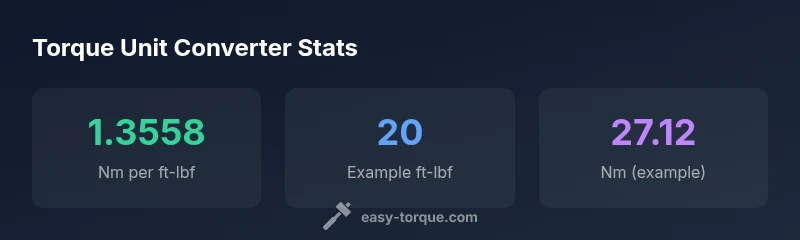
The core idea is simple arithmetic. The exact conversion factor is approximately 1 ft-lbf = 1.35581795 Nm. To convert from ft-lbf to Nm, multiply by 1.35581795. To convert the other way, divide by 1.35581795. A practical note: rounding to an appropriate decimal place is often enough for non-critical work, but when specs are tight, use the full precision from the manual. For example, 20 ft-lbf equals about 27.12 Nm, and 100 ft-lbf equals about 135.58 Nm.
Common mistakes and how to avoid them
- Mixing sources: Don’t apply a Nm value to a tool set in ft-lbf without converting.
- Rounding too aggressively: Rounding to too few decimals can push you past the spec. Prefer rounding to 2–3 decimals for many automotive tasks.
- Assuming exactness: The conversion is accurate to the factor used, but tool calibration, thread friction, and lubrication can shift the effective torque. Always verify with a properly calibrated wrench and the manufacturer’s spec.
Real-world examples: automotive torque scenarios
Here are safe, simple conversions you can reuse in the shop. If a torque spec reads 20 ft-lbf, that’s about 27.12 Nm. If you encounter 45 ft-lbf, it’s roughly 61.01 Nm. For a heavy axle bolt that might be specified as 150 Nm, that equals about 110.72 ft-lbf. Use a calculator to perform these conversions precisely, and round to the desired precision before tightening. These examples illustrate the mechanics of conversion without tying you to a single vehicle model.
How to use a torque calculator effectively
- Input the value in the source unit (ft-lbf) and select the target unit (Nm).
- Use a consistent precision, and round to the specification required by the task.
- Cross-check the result by performing the reverse conversion (Nm back to ft-lbf) to confirm symmetry.
- Keep a small reference sheet of common conversion factors handy in the workshop to speed up reads during repairs.
Factors that affect torque readings
Torque is not a single number you get from one wrench. Calibration, wrench type (click, dial, or beam), lubrication, threaded condition, and angle of tightening all influence the final clamping force. A torque wrench set to Nm readings assumes clean threads and proper lubrication. If bolts are rusty, cross-threaded, or dry, the actual clamp may differ from the indicated setting. Always inspect hardware and follow approved procedures to ensure accuracy.
Quick reference guide and tips
- Use the exact unit your service instructions specify.
- Convert before tightening and document the unit you used.
- Keep a working knowledge of common conversion factors and rounding rules.
- When in doubt, consult the vehicle or equipment manufacturer’s torque table and verify with a calibrated tool.