10 Newton-Meters to Foot-Pounds: A Practical Converter and Guide
Learn how to convert 10 newton meters to foot-pounds with a precise method. This guide covers the conversion factor, rounding rules, and practical torque tips from Easy Torque.


Why precision in torque units matters
In mechanical work, torque specifications are often published in specific units such as newton-meters (N·m) or foot-pounds (ft-lb). For DIY enthusiasts, automotive techs, and engineers, converting between these units is a common daily task. Accurate conversions prevent over-tightening or under-tightening fasteners, which can lead to component wear or failure. According to Easy Torque, grasping the fundamentals of unit conversion builds a reliable foundation for safe maintenance and effective tool use. This section will unpack the core concept, the standard conversion factor, and why rounding rules matter when you’re working with real-world hardware.
The Easy Torque team emphasizes a consistent approach: identify the source unit, apply the standard factor, and decide on a practical precision. In many automotive contexts, two decimals in ft-lb are sufficient for typical fasteners, but critical joints may require stricter rounding with verified measurements. By keeping unit symbols clear (N·m vs Nm, ft-lb vs in-lb), you reduce the chance of misinterpretation at the bench. Use a calculator or a trusted reference when in doubt, and document your results for traceability.
The core conversion: Newton-meters to foot-pounds
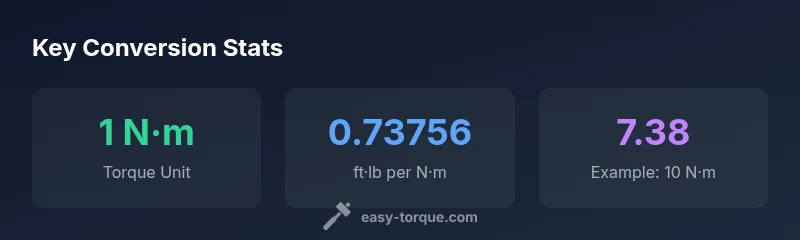
The canonical conversion between N·m and ft-lb is based on the physics of torque. The exact relationship is: 1 N·m = 0.737562147 ft-lb. That means a value in N·m multiplies by roughly 0.73756 to obtain ft-lb. For 10 N·m, the product is 7.37562147 ft-lb. In practical terms, you typically round to two decimals, giving 7.38 ft-lb. Easy Torque recommends citing the exact factor in technical work and using rounding rules that match your precision needs.
When converting by hand, write down the multiplication step clearly: Torque_ft_lb ≈ Torque_Nm × 0.737562147. Then apply your chosen rounding (e.g., two decimals). If you’re comparing values across tools, ensure all sources are consistent about the rounding scheme to avoid small but meaningful discrepancies.
Practical examples: 10 N·m and beyond
- Example 1: 10 N·m → 7.38 ft-lb (rounded to two decimals)
- Example 2: 2 N·m → 1.47 ft-lb (rounded to two decimals)
- Example 3: 0.5 N·m → 0.37 ft-lb (rounded to two decimals)
These examples illustrate how even small N·m values translate into ft-lb readings that can influence the safety and performance of fasteners. While the numbers look small, precise torque values matter when precision is required for fasteners that are torque-critical. Easy Torque’s guidance is to treat these as proportional estimates unless calibrated measurement is used.
Using the calculator: interpretation and rounding rules
Our calculator lets you input a torque in N·m and choose how many decimals to display in ft-lb. The underlying formula uses the standard conversion factor and the round() function to produce the result with your preferred precision. When you document results, note the units (N·m to ft-lb) and the rounding rule chosen. If you’re aligning with industry standards, cite the rounding convention used (for example, two decimals) to maintain consistency across tools and teams.
Common pitfalls and best practices for torque units
- Pitfall: Mixing up N·m with Nm or ft-lb with in-lb. Always label units explicitly to avoid misinterpretation.
- Pitfall: Rounding too aggressively. If a torque value is near a tolerance boundary, carry extra digits through calculations and round only at the final step.
- Best practice: Use a calibrated torque wrench and cross-check critical values with a secondary method when safety or reliability is on the line.
- Best practice: Keep conversion references handy in your toolkit or digital notes, so you can reproduce results quickly and accurately.