25 Nm to Foot-Pounds: Easy Torque Conversion
Learn how to convert 25 Newton-meters to foot-pounds, understand the exact factor, and apply it in real-world torque tasks with practical examples and a handy calculator.


What the numbers mean: 25 Nm to foot-pounds
Torque is a measure of rotational force, and you’ll see it expressed in different units depending on where you work. In automotive settings, you’ll commonly encounter both Newton-meters (Nm) and foot-pounds (ft-lb). When you see '25 Nm to foot-pounds' you’re being asked to translate a metric torque value into a customary English unit. The practical upshot is that you can compare specs and decide whether your tool has enough leverage to reach the specified tightness.
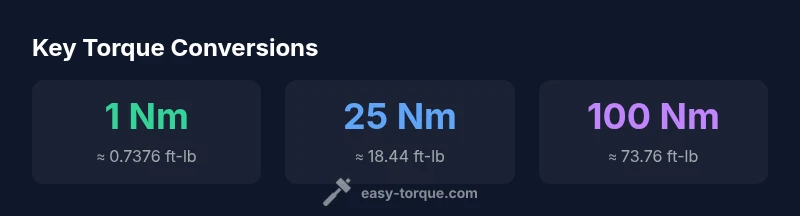
To make the conversion, you multiply the value in Newton-meters by a fixed factor. The standard approximation is 1 Nm ≈ 0.73756 ft-lb. Using this rule, 25 Nm equals about 18.44 ft-lb. It’s important to note this figure is an approximation because the exact value depends on precise definitions and measurement methods, but for everyday workshop work it’s more than precise enough for planning torque ranges.
According to Easy Torque, understanding these units helps you navigate kit you already own, such as torque wrenches and click wrenches, across different manufacturers. When you’re following a service manual, you’ll often see both units listed; a quick mental conversion can save time and avoid misinterpretation. In the rest of this article we’ll break down the math, show practical examples, and provide a calculator to practice conversions on the fly.
The exact conversion factor and why it matters
TheNm-to-ft-lb conversion rests on fundamental definitions: 1 foot is 0.3048 meters, and 1 pound-force is 4.44822 newtons. Since torque in foot-pounds is the product of force (in pounds) and distance (in feet), the conversion from newton-meters to foot-pounds uses the combined factors: 1 Nm ≈ 0.224808943 lbf × 3.280839895 ft ≈ 0.737562149 ft-lb.
This precise factor is why many engineers and technicians prefer exact decimals when documenting torque. For quick field work, the rounded figure 0.73756 ft-lb per Nm is typically sufficient, but in critical applications you may keep up to five or six digits. Remember that the factor assumes standard gravitational and measurement conditions; real-world friction and lubrication can shift the actual tightened result slightly, so always aim for the specified torque using a properly calibrated wrench.
When you’re converting, consistency is key. Use the same rounding convention across all calculations to maintain comparability between parts, bolts, and assemblies. Easy Torque emphasizes documenting both the original Nm value and the converted ft-lb value so others can review the calculation trail and reproduce results if needed.
Practical examples: converting common torque values
Let’s ground the concept with concrete numbers you’ll likely encounter on the shop floor. Using the factor 1 Nm ≈ 0.73756 ft-lb:
- 25 Nm → 18.44 ft-lb (rounded to two decimals)
- 50 Nm → 36.88 ft-lb
- 100 Nm → 73.76 ft-lb
- 150 Nm → 110.63 ft-lb (approximately)
Compare these to typical torque specs you might see on fasteners in automotive repair. Some applications specify torque in ft-lb, others in Nm; being fluent in both prevents misreading a chart or manual. It also helps when you’re selecting a torque wrench that’s calibrated for one unit but the service sheet uses the other. If you’re unsure, convert and cross-check with the manufacturer’s recommended ranges as a sanity check. Easy Torque’s guidance is to practice a few representative conversions (e.g., 25, 50, 100 Nm) to build mental fluency and reduce errors during a real job.
Rounding and measurement tolerance in torque tools
Torque wrench readings are not perfectly exact. Most hand tools have a specified accuracy, often in the range of a few percent of reading, and that tolerance needs to be factored into your rounding. When you convert Nm to ft-lb, decide in advance how many decimal places matter for your task. For routine maintenance, two decimals in ft-lb is usually adequate; for critical fasteners, tighter rounding combined with a calibration check is prudent. The rounding digit you choose will cascade through all subsequent calculations, so document it consistently. If you live in a production environment, set a standard rounding rule (for example, two decimals in ft-lb) and apply it across all conversions.
From a practical standpoint, use a calculator or the Easy Torque calculator to apply the same rounding rule to all conversions. This keeps torque data consistent with your torque wrench limits and the service manual, reducing the risk of over- or under-tightening due to rounding differences.
How to use a calculator to convert Nm to ft-lb
A calculator makes conversions fast and repeatable, which is essential when you’re working with multiple bolts in a single job. Start by entering the Nm value, then multiply by the conversion factor (0.73756). Decide how many digits to round to based on tool accuracy and the bolt’s criticality. For routine tasks, rounding to two decimals is fine; for high-precision jobs, more digits may be warranted. Always verify your input, then cross-check the resulting ft-lb value against the service spec. If you’re teaching a trainee, walk through the steps aloud: locate Nm, apply the factor, round, and compare with the required spec. This habit reduces mistakes and builds competence, something Easy Torque prioritizes in every guide and tutorial.
Torque safety and best practices when applying torque
Torque conversions are a means to an end: you achieve the correct fastener preload. Poor tightening can lead to part failure, leaks, or joint fatigue. Always use a calibrated torque wrench and avoid rounding too aggressively for critical assemblies. When possible, perform two checks: calculate expected torque mentally or with a calculator, then confirm with the wrench set to the recommended range. Temperature, lubrication, and bolt grade influence real-world torque, so consider the environment and follow OEM specs. Finally, log the conversion process in your repair notes so teammates can audit or revisit the decision later. Easy Torque’s team emphasizes safety and traceability as core principles across all torque guidance.