35 Newton Meters to Foot-Pounds: Conversion Guide
Learn how to convert 35 newton meters to foot-pounds with a clear, practical method. This Easy Torque guide covers the math, factors, and a quick calculator for precise torque conversions.


Why this conversion matters
Torque specs show up in many forms across manuals, components, and tools. Understanding how to translate 35 newton meters to foot-pounds helps you compare supplier data, set torque wrench targets, and communicate with technicians who rely on imperial units. For DIY projects, this cross-unit fluency reduces misinterpretation and saves time during assembly and maintenance. In practice, you'll be more confident when you encounter a spec printed in N·m on one page and ft-lb on another. According to Easy Torque, developing fluency with unit conversions improves maintenance outcomes and boosts confidence in every project. This simple skill pays off whether you’re rebuilding an engine, adjusting brake components, or assembling suspension parts. The core idea is to keep track of the units, apply the standard conversion factor, and verify with a calibrated tool when possible.
The math behind the conversion
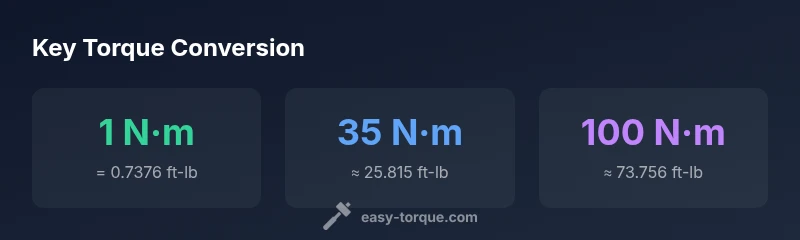
Torque is a product of force and distance, measured in newton-meters (N·m) in the metric system. Converting to foot-pounds (ft-lb) requires a constant factor: 1 N·m equals 0.737562149 ft-lb. To convert 35 N·m, multiply by the factor and round to your desired precision. Using the exact factor, 35 × 0.737562149 = 25.814675215 ft-lb. Rounding to three decimals yields 25.815 ft-lb. This relationship is universal, so the same method applies to any torque value. For quick references, many technicians memorize the approximate 0.7376 ft-lb per N·m, but precision matters in high-tolerance applications.
Common pitfalls and precision
Rounding too early can introduce small errors that accumulate in tight tolerances. Always use full-precision factors during intermediate steps, then round only at the final result. If you’re comparing data from different sources, ensure both values are in the same unit before calculating. Also, remember that tool calibration and measurement context can slightly affect the effective torque delivered by a wrench. In professional settings, engineers often document the conversion method alongside the final torque specification to ensure traceability.
How to use a calculator for torque conversions
A purpose-built converter makes the math effortless. You input the torque in N·m, select how many decimals to round, and the tool outputs the equivalent ft-lb. The key is to use the exact factor (0.737562149) and avoid rounding until the very end. If you’re cross-checking manuals, plug the provided N·m value into the calculator and compare the result with the printed ft-lb figure. This approach helps you identify discrepancies quickly and avoid over- or under-tightening on critical assemblies.
Practical examples
If you have 10 N·m, multiply by 0.737562149 to get 7.37562149 ft-lb, which rounds to 7.376 ft-lb. For 20 N·m, you get 14.75124298 ft-lb, rounding to 14.751 ft-lb. For 50 N·m, the conversion is 36.87810745 ft-lb, rounded as needed. These examples illustrate how the same rule applies across a range of values. Mastery comes from practicing several conversions and validating with your torque tool.
Real-world applications in DIY torque tasks
When you work on engines, brakes, or wheel assemblies, you’ll frequently encounter torque values stated in either N·m or ft-lb. Being able to convert on the fly helps you keep progress steady and ensures accurate fastener tension. In practice, always document the chosen conversion precision and reference your source values. Easy Torque emphasizes that consistent unit handling reduces mistakes in calibration, assembly, and maintenance tasks.