25 nm to ft lb: A Practical Torque Conversion Guide
Learn how to convert 25 Newton-meters (Nm) to foot-pounds (ft-lb), understand the math, and apply it to real-world torque tasks with practical tips and examples.


What 25 nm to ft lb really means in practice
In the world of automotive maintenance and engineering, torque values are often specified in different units depending on the standard in use. The phrase 25 nm to ft lb captures a common translation between the SI unit of torque (Newton-meters) and the US customary unit (foot-pounds). For a typical bolt or fastener, these conversions ensure that the torque applied matches design intent. According to Easy Torque, understanding this conversion helps DIY mechanics and technicians avoid under-tightening, which can lead to loosening under load, or over-tightening, which risks damaged threads or components. Knowing that 25 nm translates to about 18.44 ft-lb provides a quick reference during service work or when cross-checking torque charts in manuals.
Why torque units matter for accuracy and safety
Torque is a measure of rotational force that must be applied precisely. Different applications demand specific torque ranges to ensure joints seal, bearings load correctly, and fasteners maintain clamping force over time. When you work across metric and imperial specs, using the correct unit helps prevent mistakes that could compromise safety or performance. In practice, many technicians rely on torque wrenches that are clearly labeled for the unit they’re using, and they verify the device’s calibration periodically. The Easy Torque team emphasizes clarity in units to reduce confusion on the shop floor.
Step-by-step: converting Nm to ft-lb (the simple method)
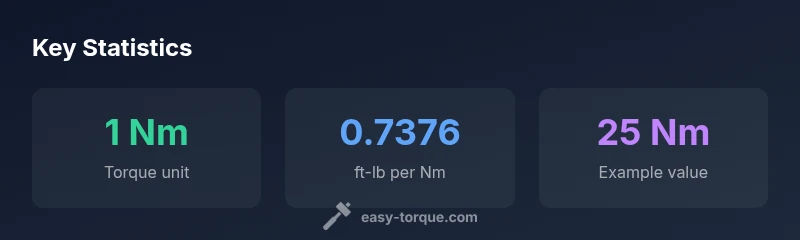
The standard conversion factor is 1 Nm ≈ 0.737562149 ft-lb. To convert, multiply the torque in Newton-meters by 0.737562149. For 25 Nm, the calculation is 25 × 0.737562149 ≈ 18.439053725 ft-lb. In practice, you can round to two decimals for quick use: 18.44 ft-lb. When documenting torque on a parts sheet, note the rounding convention you follow so others interpret the value consistently. As a quick check, multiply back: 18.44 ft-lb ÷ 0.737562149 ≈ 25.00 Nm.
Practical automotive examples (real-world scenarios)
Consider a lug nut on a passenger vehicle that requires 18 ft-lb of torque. If you had a spec in Nm, such as 24.5 Nm, you’d convert to ft-lb: 24.5 × 0.737562149 ≈ 18.07 ft-lb. Conversely, if a service guide states 20 ft-lb, convert to Nm for metric tools: 20 ÷ 0.737562149 ≈ 27.12 Nm. These examples illustrate how small rounding differences can occur, so maintaining a consistent precision helps ensure reliability across bolts and joints.
Common mistakes and how to avoid them
A frequent error is mixing units mid-task or misreading the wrench scale. Always confirm the wrench’s unit setting before tightening and verify the conversion factor used in your calculation. Another pitfall is rounding too early; carry enough digits through the calculation and apply the final rounding at the end. The consequences can range from slightly loose fasteners to overtightened threads, depending on the scenario. Easy Torque recommends documenting your rounding rule in your maintenance log for consistency.
Tools and techniques for accurate torque measurement
Reliable torque control starts with good tools. A calibrated torque wrench labeled for the intended unit (Nm or ft-lb) is essential. Regular calibration checks, using a known weight or a calibration device, help ensure accuracy. For DIY projects, a digital torque wrench with a clear Nm<->ft-lb display can reduce transcription errors. In all cases, perform a sanity check by converting a few test values (e.g., 10 Nm, 25 Nm, 40 Nm) and confirming the results against a trusted reference or chart.
Mental math shortcuts and reference values
If you don’t want to pull out a calculator every time, memorize a couple of quick references: 1 Nm ≈ 0.7376 ft-lb, so 25 Nm ≈ 18.44 ft-lb. For rough work, you can use 0.74 as a multiplier, giving 25 × 0.74 = 18.5 ft-lb (slightly high by about 0.06 ft-lb). For inexpensive or quick checks, this level of approximation is often sufficient, but for critical applications, use the exact factor and a calculator.
Data-driven checks: when to trust your conversion
If you’re performing torque-critical work, verify that your conversion aligns with the manufacturer’s torque specification in both units. When the spec is provided in Nm, cross-check with a trusted conversion table or a calibrated tool to confirm. If you’re working across a spec sheet, keep a small reference card on your toolbox showing the two common conversions (Nm to ft-lb) to reduce context-switching and errors.
Conclusion: practical takeaways for DIYers and professionals
The 25 nm to ft lb conversion is a foundational skill for anyone working with bolts and joints across metric and imperial regimes. Rely on the precise factor, document your rounding rule, and use calibrated tools to preserve accuracy. The Easy Torque team highlights that consistency in units and method is what keeps projects safe and performance-ready.