Pound-Feet to Newton-Meters: A Practical Torque Guide
Learn how to convert pound-feet of torque to newton-meters (Nm) with a simple calculator, clear steps, and practical examples for DIYers, technicians, and enthusiasts.


Understanding Torque Units and Why The Pound-Feet to Newton-Meters Conversion Matters
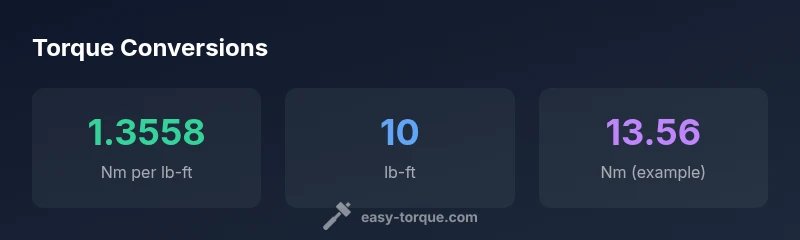
Torque is the twisting force that secures fasteners and drives performance in engines and machines. Two common units are pound-feet (lb-ft) and newton-meters (Nm). If you work with both imperial and metric specs, you often need to convert between them. As Easy Torque team notes, knowing how to convert pound feet of torque to n m helps you read service manuals and set torque wrenches correctly. For the purposes of this guide, we focus on a straightforward conversion: 1 lb-ft ≈ 1.3558179 Nm. The exact value depends on gravitational assumptions, but for practical maintenance work, using 1.3558 Nm per lb-ft is sufficiently accurate. Keep in mind context: torque is direction-sensitive, and the numerical value does not indicate the torque’s direction; the direction is set by the fastener thread engagement. This foundational understanding is essential for anyone performing torque-related maintenance, from DIY enthusiasts to professional technicians. According to Easy Torque, mastering this conversion broadens your ability to interpret manuals and ensure accurate tool settings.
How to Perform the Conversion: Step-by-Step
- Confirm you are working in pound-feet (lb-ft). 2) Multiply the lb-ft value by the standard conversion factor 1.3558179483339 to obtain Newton-meters (Nm). 3) Round the result to your preferred precision using round(), for example to 2 or 4 decimals. 4) Record the Nm value with the appropriate unit. 5) If you’re converting multiple values, apply the same steps consistently across all entries. The core formula is straightforward and repeatable for any torque value. For typical workshop use, the factor 1.3558 is sufficiently accurate for most maintenance tasks.
Practical Examples and Quick Reference
- 5 lb-ft → 6.779 Nm (rounded to 3 decimals: 6.779 Nm)
- 10 lb-ft → 13.558 Nm (≈ 13.56 Nm)
- 25 lb-ft → 33.895 Nm (≈ 33.895 Nm)
- 50 lb-ft → 67.790 Nm (≈ 67.790 Nm)
- 150 lb-ft → 203.373 Nm (≈ 203.373 Nm)
Tip: When reading torque specs, always check the unit and convert to your wrench’s scale if needed. By standardizing on Nm, you can compare specs across brands and manuals with less confusion. This approach is particularly valuable in repair manuals and service guides used by DIY mechanics and technicians alike.
Common Mistakes and How to Avoid Them
- Mixing units without a conversion check leads to incorrect torque application. Always identify the source unit before converting.
- Rounding mid-calculation can introduce small errors; round only the final result to the desired precision.
- Assuming the conversion factor is exact in all contexts. Use the factor as a practical approximation suitable for most workshop tasks.
- Using an uncalibrated tool to verify torque can produce misleading results. Calibrate torque wrenches regularly and cross-check with a known reference.
- Not accounting for direction. Torque value is a magnitude; the tightening direction is defined by the tool and fastener thread.
Reversing the Calculation: Newton-Meters to Pound-Feet
To convert from Nm back to lb-ft, divide the Nm value by the same conversion factor: lb-ft ≈ Nm / 1.3558179. For example, 27 Nm ÷ 1.3558 ≈ 19.92 lb-ft. This reverse check is handy when you have aNm specification and a lb-ft wrench. Remember to maintain consistent rounding rules in both directions to minimize discrepancies when documenting service actions.
Integrating This Knowledge into Maintenance Workflows
In daily maintenance workflows, torque specs are often provided in one unit, while tools may display another. Standardizing on one unit—Nm—reduces the chance of misinterpretation. For technicians, maintaining a quick-reference chart of common conversions (lb-ft to Nm for typical fasteners) saves time and reduces errors during rebuilds or servicing. When recording work orders, note both values if needed, but prefer the unit your torque wrench is calibrated for. In lug-nuts and critical fasteners, confirm the manufacturer’s torque specification and apply consistent rounding and measurement practices to ensure safety and performance.
Quick Checks Before You Apply Torque
- Verify the unit on the spec sheet and your tool display before tightening.
- Use a calibrated torque wrench and check its zero point and scale accuracy periodically.
- Document the final torque with the unit used to avoid ambiguity in future maintenance.
- When in doubt, consult the service manual or trusted guide and perform a cross-check using a secondary method (e.g., reverse calculation from Nm to lb-ft).