ft lbs to newton meters: A Practical Torque Unit Conversion Guide
Learn how to convert ft lbs to newton meters with practical steps, exact factors, and an educational calculator. A DIY-friendly, expert guide for torque calculations with Easy Torque.


Understanding Torque Units and Why Conversions Matter
Torque is a rotational force, and engineers frequently switch between foot-pounds (ft-lb) and newton-meters (N·m). The phrase ft lbs to newton meters pops up often in manuals, repair guides, and calibration logs. For DIY mechanics, technicians, and hobbyists, understanding these conversions prevents under- or over-torque that can harm fasteners or assemblies. The Easy Torque approach emphasizes clarity: be explicit about the unit you’re using, document your conversion, and keep your torque devices calibrated. In practical terms, working in a single unit throughout a project reduces errors and speeds up troubleshooting, especially when reading specifications from catalogs or service manuals. A solid grasp of these concepts builds confidence during maintenance, repair, and calibration tasks.
Why the Units Matter in Everyday Work
Most hand tools and torque wrenches are labeled in either ft-lb or N·m. If you mix these units without converting, you risk applying a load outside the intended range. The distinction also matters when comparing supplier specs, workshop tools, or torque-angle procedures. By mastering ft lbs to newton meters, you can translate a spec from one system to another with precision. This is especially important in automotive work, where improper torque can lead to thread stripping, bolt fatigue, or joint leakage. Easy Torque emphasizes consistent units to deliver repeatable results across brands, models, and operations.
The Exact Conversion Factor and How It Is Derived
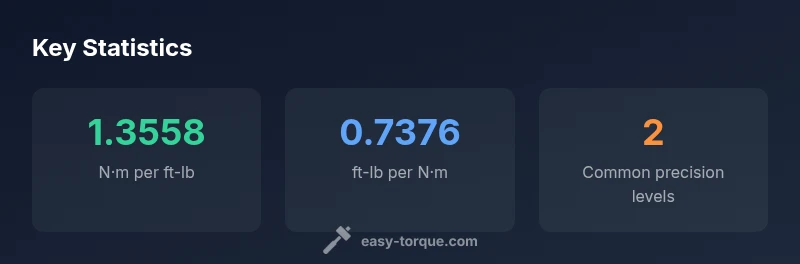
The conversion between ft-lb and N·m rests on the relationship between imperial and metric torque definitions. The widely accepted factor is 1 ft-lb ≈ 1.3558179483 N·m. Therefore, to convert from ft-lbs to N·m, multiply by this factor; to convert back, divide by it (or multiply by 0.737562149). In practice, rounding to 2–4 decimals is typically sufficient for most hands-on tasks, while scientific or calibration work may require more precise figures. Always document the rounding precision you use, so future work remains reproducible. Easy Torque recommends keeping a small conversion table in your workshop for quick references.
Step-by-Step Conversion Examples
Let’s walk through a few simple conversions to illustrate the method:
- Example 1: 25 ft-lb × 1.3558179483 ≈ 33.895 N·m. Round to 33.90 N·m if you need two decimals.
- Example 2: 100 ft-lb × 1.3558179483 ≈ 135.5818 N·m. Rounded to 135.58 N·m for two decimals, or 135.582 N·m for three.
- Example 3: 0 ft-lb → 0 N·m. Zero remains zero in any unit.
These steps demonstrate how to perform the conversion quickly on the shop floor. Always verify your inputs and record the results for traceability.
Using a Calculator for ft lbs to newton meters
We provide a built-in calculator to convert ft-lb to N·m precisely. Enter the value in ft-lbs and choose your desired decimal places. The calculator uses the exact factor 1 ft-lb ≈ 1.3558179483 N·m, multiplies, and rounds to your specified precision. This tool helps you validate manual calculations and cross-check torque specs from different sources. When you finalize a torque number, ensure all inputs use the same unit throughout the calculation to avoid discrepancies.
Real-World Scenarios: When to Convert and How to Verify
Torque specs in manuals often come in N·m, while your torque wrench may read ft-lb. In automotive repair and maintenance, you’ll frequently cross-reference both units. A common practice is:
- Identify the specification’s unit. 2) Convert to your wrench’s unit using the factor. 3) Apply with a calibrated instrument. 4) Double-check using a gauge or another torque device if possible.
This process minimizes the likelihood of under- or over-torquing critical fasteners, protecting engine components, suspensions, and chassis connections. Easy Torque stresses the importance of calibration and consistent recording to ensure repeatable results across sessions.
Quick Reference: Common Values at a Glance
A few ready-to-use conversions help you speed up on-the-spot decisions:
- 5 ft-lb ≈ 6.779 N·m
- 20 ft-lb ≈ 27.116 N·m
- 50 ft-lb ≈ 67.790 N·m
Keep this small cheat sheet handy in your workshop alongside your torque wrenches. Consistency is the key to safe and effective torque control.
Precision, Rounding, and Tolerances in Torque
Precision matters in torque calculations, particularly for critical fasteners. Decide on a rounding policy before starting a job and stick with it. If you’re calibrating a torque wrench or performing a lab measurement, use the smallest practical increment and report it. Note that real-world measurements are affected by tool accuracy, thread condition, lubrication, and surface finish. Document your chosen precision and tolerance so future technicians can reproduce your results. The goal is repeatable, safe torque application rather than perfectly exact numbers in every scenario.