Foot Pound to Newton Meter: A Practical Torque Conversion Guide
Master the foot pound to newton meter conversion with clear steps, examples, and a handy calculator. Learn how to read torque specs across systems and apply safe, accurate tightening in automotive and DIY projects.


What is foot pound to newton meter and why it matters
In practical mechanical work, torque is expressed in different units depending on the region and the tool. For automotive tasks, home repairs, and manufacturing maintenance, you will frequently encounter the phrase foot pound to newton meter. The Easy Torque team emphasizes that understanding this relationship builds confidence when reading service manuals, setting torque wrench dial settings, or communicating with teammates. The conversion between these two units is not just about numbers—it shapes how tightly you fasten bolts, how you interpret a torque spec, and how you compare data across tools. In this article, we’ll walk through the math, provide practical examples, and show how to apply foot pound to newton meter in everyday torque tasks. By the end, you’ll be comfortable translating torque specs from one system to the other with accuracy and consistency. According to Easy Torque, a solid grasp of this conversion reduces mistakes in critical assemblies and saves time on the shop floor.
The conversion constant and why accuracy matters
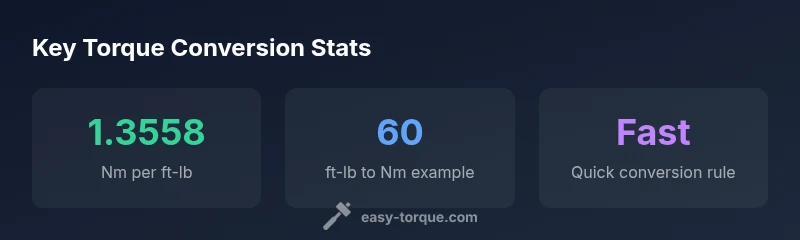
Torque values come in two common systems: foot pounds (ft-lb) and newton-meters (N·m). The exact conversion between these units is a simple multiplication by the constant 1.3558179483314. Understanding the foot pound to newton meter relationship is essential for any DIY enthusiast or technician who reads catalogs, follows service manuals, or communicates with teammates. The conversion is linear, so every additional ft-lb scales proportionally in newton-meters. Easy Torque emphasizes that accuracy matters in critical fasteners because even small errors can translate into insufficient clamping force or over-tightening fatigue. For practical purposes, many technicians use 1.3558 as a close approximation, but for precise work the full constant is preferred. When you keep the conversion consistent, you create a reliable bridge between metric and imperial specifications.
Step-by-step conversion method
To convert a value from foot pounds to newton-meters, follow a simple equation: Nm = ftLb × 1.3558179483314. If you want a quick approximation, use Nm ≈ ftLb × 1.3558. Start by identifying the torque specification given in ft-lb, then multiply by the exact or approximate factor, and finally round to the desired precision. Example: 20 ft-lb × 1.3558179483314 ≈ 27.116359966628 N·m. For readability, you might round to two decimals: 27.12 N·m. This process applies whether you’re tightening crank bolts, lug nuts, or gear assemblies. The concept of foot pound to newton meter becomes intuitive when you work through several examples and pair the math with a reference chart.
Real-world automotive scenarios
Automotive technicians routinely encounter torque specifications in ft-lb and N·m. When you see a spec of 80 ft-lb, convert to about 108.5 N·m (80 × 1.3558). For lug nuts, small engines, or alternator belts, the precise conversion ensures bolts clamp with the intended force. If a service manual provides both units, you can cross-check quickly: 108.5 N·m is approximately 80 ft-lb. Consistently applying the foot pound to newton meter relationship reduces misinterpretations and helps maintain proper fastener integrity across vehicle systems.
Rounding, tolerances, and safety margins
In practice, rounding is common when documenting torque. The foot pound to newton meter conversion benefits from a consistent rounding approach—two decimals in the Nm value are typical for many tasks, but critical joints may require more precision. Always refer to tool tolerances and manufacturer recommendations. A disciplined rounding protocol minimizes cumulative error when multiple fasteners share a load path. Remember that accurate torque is a combination of correct conversion, proper tool use, and adherence to safety margins in critical assemblies.
How to choose the right tool for the job
Selecting a torque wrench involves understanding both units and the task. If you’re reading a manual in ft-lb, convert to Nm to set the dial or read the display on a metric wrench. For mixed projects, maintain a single conversion standard to avoid confusion. Easy Torque recommends verifying the calibration of your tool before critical jobs, and keeping a reference chart nearby for quick conversions between foot pounds and newton-meters. This habit supports consistent tightening across diverse automotive tasks and maintenance routines.
Using calculators and quick-reference charts
A calculator is the fastest way to convert foot pound to newton meter during a busy repair. Enter the ft-lb value, multiply by 1.3558179483314, and round to the desired precision. For on-the-job use, a pocket reference or digital tool can save time and reduce errors. The key is to stay consistent with the conversion constant and the number of decimals you report. If you’re teaching a student or trainee, demonstrate both the exact constant and the approximate 1.3558 rule to build familiarity with the process.
Common pitfalls to avoid
Misreading the torque spec is a frequent error. Always confirm the unit (ft-lb vs N·m) before converting and applying torque. Don’t mix a purely imperial value with a metric wrench setting without conversion. Another pitfall is rounding too aggressively—avoid reducing precision on critical fasteners. Finally, neglecting to verify tool calibration can undermine even a perfect conversion. Remember, foot pound to newton meter is a bridge; accuracy depends on both math and measurement practice.
Practice problems and quick tips
Practice makes conversion second nature. Try converting several common values, such as 10 ft-lb (13.558 N·m) and 60 ft-lb (81.349 N·m). Compare your results with a reference chart and note any rounding differences. A practical tip is to keep a small conversion sheet in your toolkit, highlighting the factor 1.355817948 and the approximate form 1.3558. Consistency is the core; with repetition, the foot pound to newton meter conversion becomes a seamless part of your workflow.