Convert Foot-Pounds to Newton Meters of Torque
Learn how to convert foot-pounds to newton meters of torque with a precise formula, practical examples, and a built-in calculator for accurate fastener torque calculations.


Why this conversion matters
Torque is a key parameter in fastener integrity and engine performance. When working with both metric and imperial tools, knowing how to convert foot pounds to newton meters of torque keeps you within design specifications and prevents over-tightening or under-tightening. According to Easy Torque, accurate conversions reduce guesswork and improve repeatability across projects, from brake bleeds to suspension work, especially in mixed-tool environments common in DIY garages in 2026.
Understanding the conversion factor
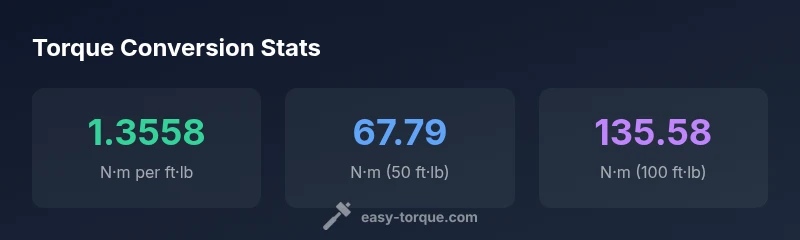
The exact conversion factor is 1 ft·lb = 1.3558179483314 N·m. This means that for every foot-pound of torque, you have about 1.3558 newton meters of torque. This factor arises from the definition of the newton and the foot; when you multiply force by distance, the units convert accordingly. Always use the exact factor for calculations that affect fastener specs.
Common rounding practices
In practice, most tools and manufacturer charts specify torque to 1–2 decimal places or a single percent tolerance. To avoid misreporting, choose a rounding policy and apply it consistently. For example, using two decimals (e.g., 67.79 N·m for 50 ft·lb) is common for automotive work, while high-precision lab tasks may require four decimals. The conversion remains exact; rounding is a display choice.
Practical examples
Example 1: Convert 50 ft·lb to N·m. 50 × 1.3558179483314 ≈ 67.79089741657 N·m. Rounded to two decimals: 67.79 N·m. Example 2: 12 ft·lb → 16.269815380 N·m, rounded to three decimals: 16.270 N·m. These straightforward calculations help you set torque wrenches correctly.
Hand calculations vs. calculators
When doing this by hand, multiply the foot-pounds by the exact factor, then apply your rounding. A calculator or spreadsheet can perform the same steps, but be mindful of input precision and display format. For repeatability, keep a small reference chart nearby that lists common conversions (e.g., 10 ft·lb = 13.558 N·m, 100 ft·lb = 135.58 N·m).
Using the converter tool in Easy Torque's guide
The built-in converter lets you enter ft·lb and see the result in N·m with the chosen precision. Use the precision setting to match your measurement tool. This approach reduces arithmetic errors and ensures your torque calculations align with vehicle service specifications.
Tips for accuracy and safety
- Always verify the torque spec on the fastener manufacturer page or service manual. - Calibrate your torque wrench regularly to ensure the measurement accuracy matches the calculation. - Account for thread lubricant and surface condition, which can alter the effective friction and torque required. - Use a clean, dry environment to avoid added resistance that would skew results.
Quick reference checks you can do now
- Confirm you are using the correct units: ft·lb vs N·m. - Check if your wrench displays the torque in the same units you need. - Round consistently and document the rounding rule for your project. - Re-check critical fasteners after an initial torque to ensure stability.