40 Nm to ft-lbs: Practical Torque Conversion
Learn how to convert 40 Nm to ft-lbs (ft-lbf) and understand Nm-to-ft-lbf conversions. This guide covers the math, examples, and a calculator to ensure accurate torque in automotive work.


Why Torque Units Matter in Automotive Context
Torque controls clamping force on fasteners and plays a critical role in engine assembly, braking, and drivetrain reliability. Misinterpreting units can lead to assemblies that are too loose or too tight, increasing risk of component failure or safety hazards. In practice, readers encounter both metric (Nm, N·m) and imperial (ft-lbf or in-lbf) torque notations. For example, a service manual might specify 40 Nm, while a brake caliper or wheel studs may be listed in ft-lbf. The bridge between these systems is essential knowledge for DIY mechanics, technicians, and enthusiasts who use a mix of torque wrenches and digital calculators. Easy Torque emphasizes clear, consistent language so you can translate specs accurately without chart hunting. Building literacy in torque units also helps when comparing torque specs across brands, service bulletins, and different regional standards. With this foundation, you can approach tightening tasks with confidence and reduce the chance of mis-torquing, leaks, or joint fatigue.
The Nm to ft-lbf Relationship
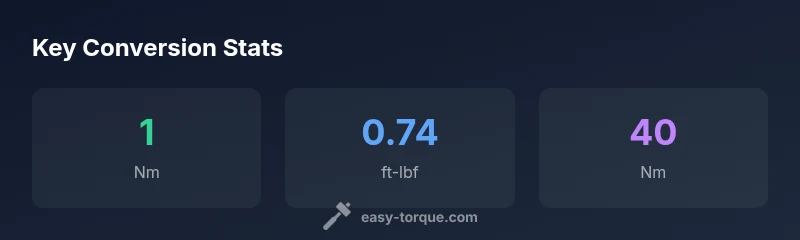
Torque is a product of force and radius, and the units reflect those two components. A Newton-meter is the torque produced by a one-newton force applied at a one-meter radius. Foot-pounds combine pounds of force with feet of lever arm. The exact conversion is 1 Nm ≈ 0.737562149 ft-lbf. In everyday practice, many technicians use 0.7376 or 0.74 as a convenient two-decimal approximation. This means that 40 Nm is roughly 29.50 ft-lbf when rounded to two decimals. The relationship is linear, so you can scale up or down with simple multiplication. Always confirm the unit used in the target specification before tightening, and remember that your torque wrench’s calibration affects the practical outcome just as much as the math does.
Step-by-step: Convert 40 Nm to ft-lbf
To convert 40 Nm to ft-lbf, multiply by the conversion factor: 40 × 0.737562149 ≈ 29.50248596 ft-lbf. Rounding to two decimals gives 29.50 ft-lbf. This quick calculation helps you compare specs across countries and tools without needing a conversion chart. If you’re checking a shop manual that lists nm or ft-lbs, you can reverse the process using the same factor (divide by 0.737562149 to go from ft-lbf to Nm).
Common Conversion Scenarios
Conversions aren’t limited to 40 Nm. Here are quick, practical conversions you can memorize or reference on the fly:
- 5 Nm ≈ 3.69 ft-lbf
- 10 Nm ≈ 7.38 ft-lbf
- 25 Nm ≈ 18.44 ft-lbf
- 50 Nm ≈ 36.88 ft-lbf
- 100 Nm ≈ 73.76 ft-lbf These values are rounded to two decimals for fast mental checks. The same factor applies whether you’re dealing with metric fasteners or imperial tools; consistency in torque language is key.
The Calculator: How to Use It
The converter accepts an input in Newton-meters (Nm) and outputs the equivalent in foot-pounds (ft-lbf) with user-selected precision. Enter a torque value (for example, 40) and choose the number of decimal places (0–3). The result reflects the standard factor 1 Nm ≈ 0.73756 ft-lbf, and is rounded to your chosen precision. This tool is helpful for quick checks while reading manuals, cross-checking with imperial-labeled tools, or planning tightening sequences. Remember that the calculator provides a numerical estimate; always verify with a calibrated torque wrench in real-world applications.
Reference Data: Quick Tables and Formulas
For quick reference, the standard conversion is 1 Nm ≈ 0.73756 ft-lbf. The 40 Nm example equals about 29.50 ft-lbf. You can store this in your workshop cheat sheet to keep conversions fast and accurate as you work on brakes, wheels, and engine hardware. Always double-check the source specification and ensure your torque wrench is calibrated.
Practical Tips for Precision and Safety
- Always confirm the torque unit before tightening; mismatch is a common error.
- Use a calibrated torque wrench and recheck tightness after the initial pass.
- Document the rounding approach you used to record torque values consistently.
- For critical fasteners, rely on the spec exactly as written and avoid rounding beyond the documented tolerance.
- If you’re teaching others, walk through a live conversion using a real-world example to build confidence.
Real-World Applications: Fasteners and Torque Specs
Many automotive tasks require cross-unit understanding. Wheel lug nuts, cylinder-head bolts, exhaust studs, and suspension components often list specs in Nm or ft-lbf. The ability to translate 40 Nm into about 29.50 ft-lbf helps you compare torque charts across brands and ensure you’re tightening to spec. This skill improves consistency in maintenance routines, reduces the risk of damage from over-tightening, and supports safer vehicle operation. The Easy Torque team encourages practitioners to practise these conversions during routine maintenance to build speed and accuracy in any workshop setting.